
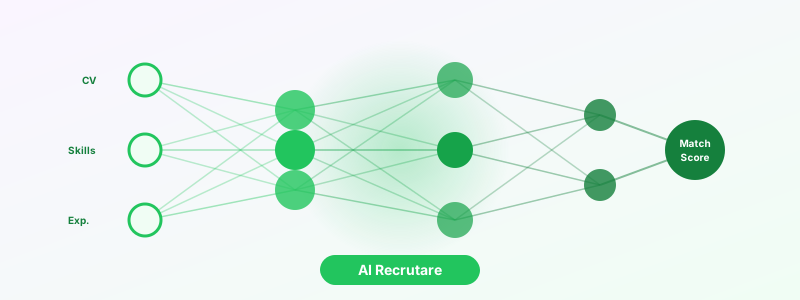
When Amazon discovered in 2018 that its AI recruitment tool was systematically downranking resumes from women — because it had been trained on 10 years of male-dominated hiring data — the company scrapped the tool entirely. The lesson was stark: AI doesn't just inherit human bias, it amplifies and scales it at speed. Every resume screened, every candidate ranked, every application auto-rejected multiplies the discriminatory pattern. For HR teams adopting AI hiring tools in 2026, the question isn't whether AI bias is a risk — it's how to measure it, mitigate it, and stay legally compliant as regulation tightens.
How AI Bias Enters Hiring Processes
AI hiring tools develop bias through several distinct mechanisms, and understanding each one matters for how you audit and remediate them:
- Training data bias: If an AI is trained on historical hiring decisions from a workforce that was predominantly white, male, or from elite universities, it learns to favor candidates who resemble those prior hires. This replicates systemic bias from the past into automated decisions at scale.
- Proxy variable bias: AI models sometimes learn that seemingly neutral variables — zip code, specific university names, gaps in employment — correlate with protected characteristics in the training data. Screening on these proxies produces disparate impact even without any intent to discriminate.
- Feedback loop bias: If an AI recommends candidates and hiring managers accept those recommendations, the model receives confirmation that its patterns are correct — reinforcing biased outputs over time regardless of actual performance outcomes.
- Natural language processing bias: Language models trained on general text can absorb societal stereotypes — associating certain professions, leadership language, or communication styles with specific demographic groups in ways that disadvantage protected candidates.
The Scale Problem
A human recruiter who carries bias affects dozens of hiring decisions. An AI model that carries bias affects hundreds of thousands — simultaneously, at every stage of your funnel. The efficiency gain that makes AI attractive also makes bias remediation urgent.
The Legal Framework: What US Law Requires
The regulatory landscape for AI in hiring is evolving rapidly, and HR leaders need current awareness of both federal and state-level requirements:
Federal level — Title VII / EEOC: The Equal Employment Opportunity Commission's technical assistance guidance (issued April 2023) makes clear that automated employment decision tools are subject to the same disparate impact analysis as any other employment practice. If an AI screening tool produces selection rates that disadvantage a protected group, the employer bears the burden of demonstrating the tool is job-related and consistent with business necessity. The EEOC has explicitly warned that the "delegated to AI" defense provides no legal protection.
NYC Local Law 144: Effective July 2023, New York City employers using automated employment decision tools must (1) conduct annual bias audits by an independent third party, (2) publish summary audit results on their website, and (3) notify candidates before using an AEDT and provide a mechanism to request an alternative process. Violations carry fines of up to $1,500 per day.
Illinois and Maryland: Both states have enacted AI interview analysis laws requiring notice and consent before analyzing facial expressions or voice patterns in video interviews. Multiple other states have similar legislation pending.
The Four-Fifths Rule as Your Starting Point
The EEOC's four-fifths (80%) rule states that if any protected group's selection rate is less than 80% of the highest group's rate, disparate impact is indicated. Calculate this ratio for every stage of your AI-assisted hiring funnel — resume screening, assessment scores, interview advancement — to identify where bias is entering.
How to Conduct an AI Bias Audit
A meaningful bias audit goes beyond surface-level review. Here is a structured approach aligned with best practices and emerging regulatory requirements:
Step 1 — Define the scope: Identify every point in your hiring process where AI influences a decision: resume screening scores, candidate rankings, video interview analysis, assessment results. Each touchpoint should be audited independently.
Step 2 — Collect demographic data with candidate consent: You cannot measure disparate impact without knowing the demographic composition of your candidate pool versus those advanced at each stage. Voluntary self-identification through EEOC-compliant data collection provides the raw data for the analysis.
Step 3 — Calculate selection rates by protected group: At each AI-influenced stage, calculate the percentage of candidates from each demographic group who are advanced. Apply the four-fifths rule to identify gaps that require investigation.
Step 4 — Examine training data composition: Request documentation from your AI vendor on how the model was trained, what data sources were used, and what demographic representation looks like in the training set. Lack of transparency here should be a red flag.
Step 5 — Test with synthetic profiles: Create candidate profiles that are identical except for name (which signals race and gender through research on name-based discrimination). Submit these through the AI system and compare scores. Significant score differences for matched profiles indicate proxy discrimination.
Step 6 — Document and remediate: Document all findings. For identified bias, work with your vendor on model retraining, feature removal, or re-weighting. Add human review checkpoints at stages where AI scores show the largest demographic gaps.
Questions to Ask Your AI Vendor
Before deploying any AI-powered hiring tool, get written answers to these questions:
- What data was used to train this model, and what was its demographic composition?
- Has the tool been independently audited for disparate impact against protected groups?
- What features does the model use as inputs? Does it use any variables that could serve as proxies for protected characteristics?
- What ongoing monitoring do you conduct for bias drift as the model learns from new data?
- Do you comply with NYC Local Law 144 requirements? Can you provide audit documentation?
Vendors who cannot or will not answer these questions clearly represent a legal and reputational risk. Treegarden's AI-assisted features are designed with transparency by default — users can see exactly which factors are influencing candidate scores and override AI recommendations at any stage, ensuring human accountability is never removed from the hiring decision.
AI as Input, Not Decision-Maker
The safest posture — legally and ethically — is to use AI scores as one input among several, with a human making the final advancement decision at every stage. When AI is a decision-maker rather than an advisor, legal exposure grows significantly and the feedback loop for bias correction breaks down.
Building a Responsible AI Hiring Policy
Beyond tool-level audits, responsible AI hiring requires organizational policy:
- Publish your AI use policy: Candidates deserve to know when AI is assisting their evaluation. Transparency builds trust and is increasingly required by law.
- Establish a bias review cadence: Annual audits are the regulatory minimum; quarterly reviews of key selection metrics are better practice given how quickly bias can compound in actively learning systems.
- Train recruiters on AI limitations: Recruiters who understand how AI bias occurs are more likely to apply appropriate skepticism to AI-generated scores and intervene when something seems wrong.
- Create an appeals mechanism: Candidates should have a clear path to request human review of any AI-influenced decision. This is a legal requirement in some jurisdictions and good practice everywhere.
Frequently Asked Questions
What laws regulate AI bias in hiring in the US?
The primary federal framework is Title VII enforced by the EEOC, which prohibits employment practices with disparate impact on protected groups — including AI-driven screening. NYC Local Law 144 requires annual independent bias audits and candidate notification. Illinois and Maryland have enacted AI interview analysis laws, and multiple states have similar legislation pending in 2026.
How do I know if my AI hiring tool has bias?
Conduct a disparate impact analysis: compare selection rates for protected groups against the majority group at each hiring stage. Under the EEOC's four-fifths rule, if any group's selection rate is less than 80% of the highest group's rate, you likely have disparate impact requiring investigation and remediation before continuing use of the tool.
What is an AI bias audit and who should conduct it?
An AI bias audit evaluates whether an automated employment decision tool produces discriminatory outcomes across protected categories. NYC Local Law 144 requires audits by an independent third party. At minimum, audits analyze selection rate disparities, review training data composition, test model outputs against synthetic candidate profiles, and produce documented findings with remediation recommendations.
Can AI actually reduce bias in hiring or does it always amplify it?
Both are possible depending on design and oversight. AI trained on historically biased data will replicate those biases at scale. AI built with diverse training data, regularly audited for disparate impact, and used as one input among many — rather than sole decision-maker — can genuinely reduce bias compared to unstructured human evaluation. The difference lies in governance, not the technology itself.
What should candidates be told about AI use in hiring?
NYC Local Law 144 requires employers to notify candidates before using AI tools that make or assist employment decisions. Best practice nationwide is to disclose AI use in the application process, explain what data is analyzed, and provide a mechanism for candidates to request human review. Transparency reduces legal exposure and improves candidate trust in your process.
AI in hiring is a powerful lever — but only if it's governed responsibly. The tools that scale your screening efficiency can also scale your legal exposure if they carry undetected bias. The answer isn't to avoid AI but to audit it rigorously, use it as an input rather than a final decision-maker, maintain full human oversight, and stay ahead of the regulatory curve. As these laws evolve, organizations with documented audit trails and transparent candidate communications will be far better positioned than those treating AI bias as someone else's problem.