
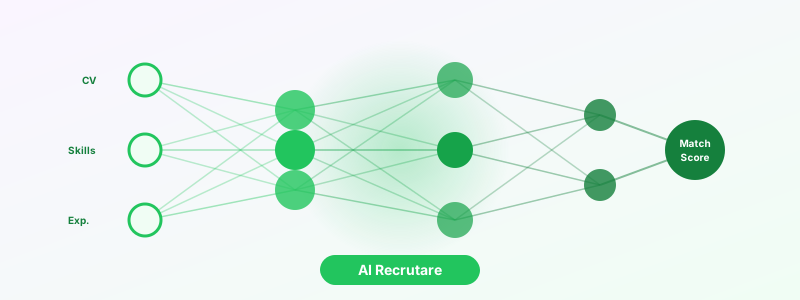
AI in recruitment has moved past the hype cycle and into selective, practical deployment. The tools that actually save time in 2026 are narrow and specific: CV parsing, candidate scoring, interview question generation, and pipeline automation. The tools that claim to do everything — replace the recruiter, predict cultural fit, automate human judgment — remain aspirational at best and legally risky at worst. The recruiter who understands this distinction will use AI to move faster without creating compliance exposure.
Where AI Is Making a Real Difference in Recruiting
Based on adoption data and recruiter feedback in 2026, AI delivers measurable productivity gains in four specific areas:
- Bulk CV parsing and data extraction. AI can extract structured data from unstructured CV documents at scale, converting PDF and Word files into searchable candidate profiles without manual data entry. This is the most widely adopted and most mature AI application in recruitment technology.
- Candidate-to-job matching and scoring. AI can score candidates against job requirements, ranking applications by match quality so recruiters review highest-fit candidates first. This reduces time-to-shortlist significantly when applied to high-volume application scenarios.
- Interview question generation. LLM-based tools can generate role-specific interview questions aligned to job requirements, competency frameworks, and industry context. This produces better-quality structured interviews in less preparation time.
- Administrative automation. Scheduling, status notifications, rejection emails, and pipeline stage transitions can all be triggered by AI-powered workflow logic, eliminating hours of administrative work per vacancy.
The AI productivity reality check
Recruiters using AI-assisted screening consistently report 40 to 60% reductions in time-to-shortlist for high-volume roles. The gains are most pronounced for roles receiving 50+ applications where manual CV review is the primary bottleneck. For specialist roles receiving 5 to 15 applications, AI screening adds limited incremental value — the human review time is already manageable.
CV Parsing and Screening: AI's Strongest Use Case
CV parsing converts unstructured document content into structured data fields: name, contact details, work history, skills, education, and other relevant attributes. Modern AI parsers handle the full range of CV formats — multi-column layouts, creative designs, non-standard section headings, multiple languages — with high accuracy.
The practical workflow impact:
- A recruiter receives 80 CVs for an engineering role via email and direct applications
- They upload all 80 to the ATS simultaneously using bulk upload
- AI parses and structures all 80 within 2 to 3 minutes
- AI scores each candidate against job requirements based on skills match, experience relevance, and keyword alignment
- Recruiter reviews the top-scored 15 candidates rather than manually reading 80 CVs
- Time saved: 2 to 3 hours of manual CV reading reduced to 30 minutes of reviewing pre-ranked candidates
Treegarden AI CV parsing: how bulk processing works
Treegarden supports batch upload of up to 50 CVs simultaneously. The AI parser extracts name, contact details, work history, skills, education, and certifications from each CV regardless of format. Parsed data populates candidate profiles automatically, and each candidate receives an initial match score based on the job description. Recruiters can then filter and sort the candidate list by score, experience level, or specific skill requirements without reading each CV individually.
AI Interview Frameworks: Generating Questions Automatically
Structured interviewing — using consistent questions across all candidates for a role — is both a legal best practice (it provides comparable, defensible evaluation data) and a quality improvement over ad hoc questioning. The challenge is that creating a strong structured interview guide takes time that many hiring managers do not have.
AI interview question generation addresses this directly. When you create a job posting, the AI analyses the job description and generates role-specific interview questions aligned to:
- Technical competencies required for the role
- Behavioural competencies specified or implied by the job requirements
- Industry-specific context and relevant scenarios
- Seniority level (graduate, mid-level, senior, leadership)
The recruiter or hiring manager reviews and edits the generated questions, adds any company-specific questions, and saves the framework as the scorecard for that role. All interviewers use the same question set, and scores are captured in a structured format rather than unstructured notes.
Legal significance of structured interviewing
Structured interviews, where all candidates are asked the same questions and scored against the same criteria, significantly reduce the risk of discrimination claims. When selection decisions are challenged under the Equality Act 2010 or Title VII, documented evidence that all candidates were evaluated consistently on the same job-related criteria is a powerful defence. AI-generated frameworks make structured interviewing accessible to teams that previously lacked the time to build them.
AI Scheduling and Pipeline Automation
Interview scheduling is one of the most time-consuming administrative tasks in recruitment. Coordinating availability between candidates, hiring managers, and panel members across time zones consumes recruiter time disproportionate to its strategic value.
AI scheduling tools automate this coordination:
- Calendar integration. The ATS syncs with Google Calendar and Outlook, showing available slots across all required participants.
- Candidate self-scheduling. Candidates receive a link to book their own interview slot from pre-approved windows, eliminating email back-and-forth entirely.
- Automated reminders. The system sends confirmation emails and reminder notifications to all participants, reducing no-show rates.
- Pipeline stage automation. When a candidate is moved to “Interview Scheduled” in the ATS, the system triggers the scheduling workflow automatically. When the interview is completed and scored, the system notifies all relevant stakeholders.
Where AI Still Gets Recruitment Wrong
Honest assessment requires acknowledging where AI underperforms or creates risk:
Where AI recruitment tools still fail
AI video interview analysis — which claims to assess candidate suitability from facial expressions, speech patterns, and body language — has no validated scientific basis for predicting job performance and creates significant discrimination risk. The EEOC has flagged AI-based personality and video assessment tools as a priority concern. UK employers using such tools face potential liability under the Equality Act 2010. No credible HR technology vendor should be recommending these tools to clients in 2026.
Additional areas where AI underperforms:
- Cultural fit assessment. No current AI can reliably assess cultural fit. The concept is also legally fraught, as “culture fit” has been shown to correlate with protected characteristics and is often a proxy for homogeneity rather than performance.
- Passive candidate identification. AI sourcing tools that scrape social profiles claim to identify passive candidates likely to be open to roles. In practice, accuracy rates are low and the time investment in outreach often exceeds manual sourcing approaches.
- Predictive attrition scoring. AI tools that claim to predict whether a candidate will leave within 12 months have not demonstrated reliable predictive validity outside controlled research environments.
Bias in AI Recruitment Tools: What to Watch For
AI bias in recruitment is a genuine concern, not a theoretical one. Amazon famously abandoned an AI CV screening tool in 2018 after discovering it systematically downgraded CVs containing the word “women” because the training data reflected historical male dominance in the roles it was screening for. The underlying problem has not been fully solved.
Practical safeguards for UK and US employers:
- Audit AI scoring outputs for demographic patterns. Periodically compare AI scores across protected characteristic groups to identify systematic disparities that may indicate bias in the underlying model.
- Ensure human review before rejection. AI scoring should inform human judgment, not replace it. No candidate should be rejected purely on an AI score without human review of the application.
- Be cautious with named-entity bias. AI parsers that score candidates on name recognition or educational institution prestige can introduce socioeconomic and racial bias. Verify that your ATS scores on skills and experience, not on name or institution.
- Maintain an algorithmic impact assessment record. UK employers using AI tools for significant hiring decisions should maintain documentation of how AI tools work and their known limitations, in line with emerging AI governance expectations under the UK AI Safety framework.
Building a Human-AI Hybrid Hiring Process
The most effective AI-augmented hiring processes in 2026 follow a consistent pattern: AI handles the tasks it does well (data extraction, initial ranking, scheduling, administration) while humans retain judgment on the tasks that matter most (evaluation quality, offer decisions, candidate experience).
A practical hybrid process architecture:
- AI-powered job posting. Generate job description drafts from role templates, with human editing for company voice and specific requirements.
- Automated distribution. AI pushes postings to relevant job boards and sourcing channels based on role type and historical performance data.
- Knock-out screening. Auto-reject questions eliminate ineligible candidates before any human review (work authorisation, minimum qualifications).
- AI ranking and scoring. Remaining applications are scored and ranked. Recruiter reviews top-ranked applications, using AI scores as a starting point not a final answer.
- Human shortlisting decision. Recruiter reviews AI-ranked candidates and makes the shortlisting decision based on full application context, not score alone.
- AI interview question generation. Hiring manager uses AI-generated question set as starting point for structured interview framework.
- Human interviewing. Interviews are conducted by humans. AI scheduling handles logistics.
- AI-assisted offer process. Offer letter generation, background check integration, and onboarding workflow are AI-automated. Offer decision is human.
| Process Stage | AI Role | Human Role |
|---|---|---|
| Job description creation | Draft generation | Review, edit, approve |
| Job board distribution | Automated posting | Strategy and budget approval |
| Work authorisation screening | Auto-reject ineligible | Configure criteria |
| CV review (high volume) | Parse, rank, score | Review top candidates |
| Shortlisting decision | Scoring input | Final decision |
| Interview scheduling | Calendar coordination | Confirm availability |
| Interview execution | Question suggestions | Conduct, evaluate, score |
| Offer decision | Compensation benchmarking | Final decision |
| Compliance documentation | Automated logging | Policy setting |
Free Calculators for This Topic
Save time with these free HR calculators — no sign-up required:
Frequently Asked Questions
Will AI replace recruiters?
No, at the current state of technology. AI automates the administrative and data-processing components of recruitment, which represent perhaps 30 to 40% of recruiter time. The high-value work — building candidate relationships, assessing cultural and team fit, negotiating offers, advising hiring managers — requires human judgment that current AI cannot replicate. The practical outcome is that AI-augmented recruiters can handle higher hiring volumes with the same headcount, not that recruiters are replaced.
Is AI screening legal under GDPR?
AI screening that informs human judgment is legal under GDPR. Fully automated decision-making that produces decisions without human review is restricted under Article 22 of GDPR — individuals have the right not to be subject to solely automated decisions with significant effects. Using AI to rank and score candidates, with a human making the final shortlisting and rejection decisions, is compliant. Automated rejection purely on AI score without human review is not compliant.
How accurate are AI CV parsers in 2026?
Modern AI CV parsers achieve 90 to 97% accuracy on standard UK and US CV formats for structured data fields like name, contact details, job titles, and dates. Accuracy drops for unusual formats, non-Latin scripts, heavily designed CVs, and complex career narratives. Most enterprise parsers include a confidence scoring system that flags low-confidence extractions for human review. Always verify parsed data for candidates advancing to interview stage.
Which ATS platforms have the best AI features in 2026?
Treegarden offers AI-powered bulk CV parsing, candidate scoring, and automated interview question generation as standard features at SMB-accessible pricing. Ashby and Greenhouse offer strong AI analytics and scoring at enterprise price points. Workable includes AI-generated job description assistance and basic matching. The key differentiator is whether AI features are included in the base plan or require premium tiers and add-ons.
What AI recruitment tools should we avoid?
Avoid AI video interview analysis tools that claim to assess candidate suitability from facial expressions, voice patterns, or body language. These tools have no validated predictive validity for job performance, create significant discrimination risk under both UK and US law, and are increasingly the subject of regulatory scrutiny. Also be cautious with any AI tool that makes hiring decisions without a human review step in the process — this creates GDPR Article 22 exposure in the UK and EU.
AI in recruitment delivers its best results when deployed narrowly on tasks with clear efficiency gains: parsing, scoring, scheduling, and administrative automation. The recruiter who uses AI for these tasks while retaining human judgment for evaluation, relationship, and decision-making will outperform both the recruiter who ignores AI entirely and the recruiter who over-delegates to it. Treegarden includes the practical AI features that deliver real productivity gains, without the speculative tools that create compliance risk. Request a demo to see the AI features in practice.