
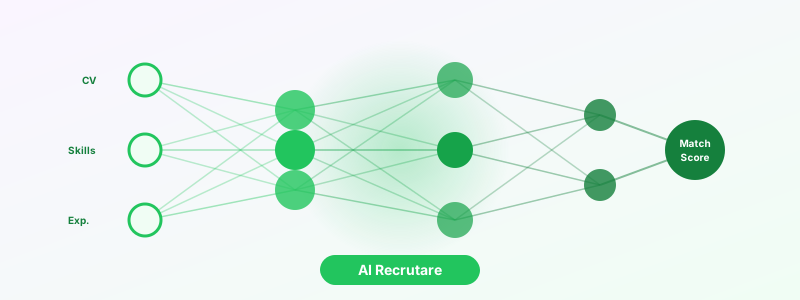
A personalised onboarding plan for every new hire used to take a full day of HR preparation: gathering role information from the hiring manager, creating milestone checklists, coordinating with IT, drafting the 30-60-90 day objective framework. AI produces an equivalent plan in under 30 seconds. The question for HR teams is not whether to use it, but how to build the human review and personalisation layer that makes AI-generated onboarding genuinely effective rather than generically adequate.
Why Onboarding Plans Are Usually Afterthoughts
Despite substantial research evidence that structured onboarding reduces time-to-productivity by 50% and increases new hire retention by over 80% in the first year, most organisations still treat onboarding plans as a post-offer administrative task rather than a strategic investment.
The reason is time. Creating a genuinely personalised 30-60-90 day plan — one that addresses the specific role's learning curve, the team's working style, the tools and systems the new hire needs to learn, and the relationships they need to build — takes time that HR teams and hiring managers typically do not have in the weeks between offer acceptance and start date. The result is a generic onboarding checklist that covers administrative tasks (complete payroll forms, collect laptop, read handbook) but provides little guidance on role-specific priorities or performance expectations.
Generic onboarding produces predictable outcomes: new hires feel underprepared, make preventable early mistakes, take longer to reach productivity, and disengage in the first 90 days at higher rates than those who received structured, personalised onboarding. The employee experience data is consistent — new hires with a clear plan and explicit milestones report significantly higher satisfaction with their onboarding experience and are measurably more likely to remain with the organisation at the 12-month mark.
The Cost of Poor Onboarding
SHRM estimates that replacing an employee who leaves within the first year costs 50–200% of their annual salary when accounting for recruitment costs, training time, and lost productivity during the vacancy period. The majority of early-tenure departures are attributable to poor onboarding experiences — specifically, lack of clear role expectations, poor integration with the team, and feeling underprepared for the demands of the role in the first 30 days. Structured onboarding plans directly address all three.
What AI-Generated Onboarding Plans Include
An AI-generated onboarding plan from Treegarden is structured around the standard 30-60-90 day milestone framework, with role-specific content generated from the job description, department context, and any additional input provided by the hiring manager during the plan generation step.
A complete AI-generated onboarding plan includes:
- Day 1 checklist: Administrative tasks, system access requests, introductory meetings, equipment setup, and initial orientation activities — standardised across the organisation with role-specific additions.
- Week 1 objectives: Immediate learning priorities, key relationships to establish in the first week, and the specific documentation or processes the new hire needs to understand before undertaking independent work.
- 30-day milestones: The specific knowledge, capabilities, and relationships the new hire should have established by day 30. Framed as observable outcomes rather than activities ("Can independently process customer returns without supervision" rather than "Learn the returns process").
- 60-day milestones: The transition from learning to contributing. By day 60, the new hire should be operating independently on core responsibilities and beginning to identify improvement opportunities. AI generates role-appropriate milestones based on the seniority level and function.
- 90-day milestones: The transition to full productivity and peer equivalence. Day 90 milestones define what "meeting expectations" looks like in the first performance review cycle — providing the new hire with a clear target and the manager with an explicit evaluation framework.
- Relationship map: Key internal stakeholders to connect with in the first 90 days, including suggested connection purposes (strategic context, operational dependency, cross-functional partnership).
- Required training and learning resources: System training, compliance training, and role-specific learning materials, with suggested completion timelines for each.
How the AI Generates Role-Specific Plans
Treegarden's AI onboarding generator uses the job description from the original ATS posting as its primary input, supplemented by department, seniority level, and any specific context provided by the hiring manager via a structured input form at the point of offer acceptance.
The AI model is trained on onboarding best practices across role functions and seniority levels, enabling it to distinguish between the appropriate 30-day milestones for a junior sales representative (learn the product, shadow three demos, complete sales methodology training) versus a senior marketing manager (conduct a channel performance audit, present a 90-day strategy plan to the VP, establish direct relationships with three key agency partners).
The generation process takes 20–30 seconds. The output is delivered as a structured document in the Treegarden HR module, pre-formatted and ready for review by the hiring manager or HR business partner. The hiring manager receives an email notification that the plan is ready for review, with a direct link to the editable document.
From ATS to Onboarding: Zero Data Re-Entry
Because Treegarden's onboarding module is integrated with the ATS, the AI plan generator has direct access to the job description, the successful candidate's profile, the offer letter details, and the hiring manager's information — all without HR needing to transfer data between systems. The transition from "offer accepted" to "personalised onboarding plan created" is automated, with human review and editing as the only required step before the plan is shared with the new hire.
Reviewing and Personalising AI Onboarding Output
The human review step is essential and should not be treated as a formality. AI-generated onboarding plans are high-quality starting points, not finished documents. The review process typically takes 15–30 minutes and addresses three categories of personalisation:
Role-specific accuracy: Does the plan accurately reflect the specific demands of this role in this organisation? The AI generates plausible milestones based on role type and seniority, but the hiring manager knows the actual priorities. A sales role at a SaaS startup has different 30-day expectations than a sales role at a large enterprise — and the AI may not capture those distinctions with precision.
Individual context: Does the plan account for what the hiring manager knows about this specific candidate? A new hire with strong industry experience may reach 60-day milestones in 30 days. A new hire who is changing functions may need extended time on role-specific learning in the first month. The AI does not know these individual factors — the hiring manager does.
Relationship specifics: The AI's relationship map identifies generic stakeholder categories. The reviewing manager should replace these with actual names, specific context for the relationships, and any nuance about internal dynamics that a new hire needs to be aware of to navigate successfully.
How Treegarden's AI Onboarding Generator Works
When a candidate's application status moves to "Hired" in the Treegarden ATS, the system automatically triggers the onboarding workflow. The hiring manager receives a prompt to complete a brief supplementary input form — five to eight questions covering the new hire's start date, immediate team context, first-week priorities, and any role-specific considerations the standard job description does not capture.
Submission of the input form triggers the AI generation. The plan is available in the Treegarden HR module within 30 seconds. The hiring manager reviews and edits the plan in an inline editor — no format conversion required. When the plan is approved, it is shared with the new hire directly via the platform, either before their start date as a pre-boarding document or on their first day.
Progress against milestones is tracked in the HR module. Managers mark milestones as complete throughout the 90-day period. HR business partners have visibility into onboarding progress across all new hires in their portfolio, enabling early identification of new hires who are falling behind their milestone plan — typically a signal of inadequate support that should trigger a manager check-in rather than a performance conversation.
| Onboarding Task | Manual HR Process | Treegarden AI Generator |
|---|---|---|
| 30-60-90 day plan creation | 4–6 hours of HR preparation | 30 seconds AI generation + 20 min review |
| Role-specific milestone development | Hiring manager meeting required | AI draft + input form + manager edit |
| Plan personalisation per hire | Full rebuild per hire | Review and edit of AI draft |
| Data transfer from ATS to HR system | Manual re-entry | Automatic (same platform) |
| Milestone progress tracking | Manual spreadsheet or email | In-platform manager completion |
Onboarding Automation: From ATS Hire to HR Onboarding
The value of integrating onboarding automation within the same platform as the ATS is the elimination of handoff failures. The most common onboarding breakdowns occur at the transition point between recruiting and HR: offer accepted, candidate details need to move from ATS to HRIS, onboarding documents need to be prepared, IT needs to know about the new hire, facilities needs a desk allocation, the hiring manager needs to brief their team.
In organisations using separate ATS and HR platforms, this handoff is typically manual — a recruiter exports candidate data, HR re-enters it in the HRIS, and the onboarding plan is created separately by HR or the hiring manager from scratch. Each step is a potential failure point and a time drain.
Treegarden's integrated model automates this sequence. When an application moves to "Hired" status, the platform automatically: creates the employee record in the HR module from ATS data, triggers the onboarding plan generation workflow, initiates the IT provisioning notification (configurable to your IT ticketing system), and sends the manager the onboarding preparation checklist. The manual handoff is replaced by automated orchestration, with HR and the hiring manager receiving the right notifications at the right time rather than managing a checklist of their own.
Free Calculators for This Topic
Save time with these free HR calculators — no sign-up required:
Frequently Asked Questions
What is a 30-60-90 day onboarding plan?
A 30-60-90 day plan is a structured onboarding framework that defines what a new hire should know, be able to do, and have accomplished at each of three milestones in their first 90 days. The first 30 days focus on learning — understanding the role, the team, the tools, and the organisation. Days 31–60 focus on contributing — applying what was learned to independent work. Days 61–90 focus on full productivity — operating at peer level and beginning to bring original value beyond baseline task completion.
How accurate are AI-generated onboarding plans?
AI-generated plans are high-quality starting points for most common role types. The accuracy is highest for well-defined functional roles (sales, marketing, engineering, finance) and lower for highly specialised or novel roles where the AI's training data is less representative. In all cases, human review and editing by the hiring manager is essential — the AI produces a plan that covers 70–80% of what is needed, and the manager's input completes the remaining 20–30% with role-specific and individual context.
When should a new hire receive their onboarding plan?
Best practice is to share the onboarding plan with the new hire before their start date — typically one to two weeks in advance as part of pre-boarding communications. This gives the new hire time to mentally prepare for the expectations of their first 30 days, reduces first-day anxiety, and signals organisational professionalism that reinforces offer acceptance decisions. Plans shared on day one are better than no plan, but earlier is consistently better according to new hire experience surveys.
Can onboarding plans be reused across similar roles?
Yes, with modification. Treegarden allows saving approved onboarding plans as templates by role type or department. When a new hire is created for a similar role, the template is used as the starting point for AI generation rather than starting from scratch. Over time, organisations build a library of role-specific templates that improve generation accuracy and reduce manager review time for subsequent hires in the same function.
How does AI onboarding integrate with the wider HR system?
In Treegarden, the onboarding module is fully integrated with the ATS and HR module. Candidate data from the ATS populates the employee record automatically at hire. Onboarding milestones connect to the performance management module, so the 90-day objectives become the basis for the first performance check-in. Completion status is visible to HR business partners across the organisation, providing oversight of onboarding quality without requiring individual follow-up with each hiring manager.
Onboarding is the first experience a new employee has of their manager, their team, and the organisation's operational standards. A generic checklist communicates that the organisation did not invest time in preparing for their arrival. An AI-generated, manager-reviewed, personalised 30-60-90 day plan communicates exactly the opposite. Treegarden makes this level of onboarding quality achievable for every hire — from the first day of a four-person startup to the hundredth hire of a scaling mid-market company. Book a demo to see the AI onboarding generator in action with a real role from your organisation.