
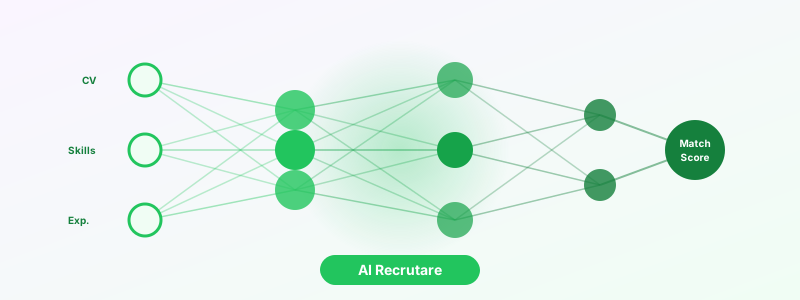
Most "AI recruitment tools" are dashboards with AI labels. They display analytics generated by machine learning models but still require human operators to execute every consequential action — scheduling a meeting, moving a candidate, sending a rejection. Treegarden's AI Recruiter is different: it executes actions. Type a natural language command and the system performs it.
What an AI Recruiting Assistant Actually Does
The distinction between AI-assisted recruitment and conversational AI recruitment is operational, not cosmetic. AI-assisted tools surface recommendations — "this candidate scores 87/100", "this stage has a two-day bottleneck". A human must then act on each recommendation individually: open the record, find the action button, execute the step.
A conversational AI recruiting assistant interprets natural language instructions and executes them directly against the recruitment database. "Schedule a first interview with Sarah Chen for the Marketing Manager role this Thursday at 2pm" is a complete instruction that, in a true AI assistant implementation, creates the calendar event, sends the invitation, and advances the candidate card on the Kanban board — without a human navigating any menus.
This represents a qualitative change in recruiter workflow, not an incremental improvement. The repetitive click-through work that consumes 30–40% of a recruiter's day — opening records, updating stages, sending templated communications — becomes conversational. The recruiter's attention stays at the strategic level rather than descending into data-entry mode dozens of times per hour.
Why Natural Language Matters for Recruiting
Recruiting is fundamentally a communication-heavy discipline. Recruiters think and communicate in language — "I need to move all the candidates from the phone screen stage who scored above 80 to first interview this week" — not in database queries or navigation paths. Natural language commands align the interface with the recruiter's mental model, reducing cognitive load and increasing throughput on administrative tasks.
Natural Language Commands: A Complete List of Actions
Treegarden's AI Recruiter, accessible via the @recruiter command within the platform, supports a comprehensive range of pipeline actions:
- Candidate advancement: "Move [candidate name] to the [stage name] stage for [role name]"
- Bulk advancement: "Advance all candidates in [role] who scored above [threshold] to [stage]"
- Interview scheduling: "Schedule an interview with [candidate] for [role] on [date/time]" — triggers calendar integration
- Rejection communications: "Reject [candidate] from [role] and send the standard decline email"
- Pipeline queries: "Show me all candidates for [role] who have been in the current stage for more than 5 days"
- Candidate search: "Find candidates in the Candidate DB with [skill] experience" — searches parsed CV content
- Assessment generation: "Generate interview assessment questions for [role] focused on [competency]"
- Status reporting: "What is the current pipeline status for all open roles?"
- Offer stage actions: "Move [candidate] to offer stage for [role] and notify [hiring manager]"
Each command is interpreted by a large language model trained on HR and recruitment domain knowledge, which means natural phrasing variations are understood. You do not need to memorise exact command syntax — a recruiter can phrase requests as they would to a human colleague and the AI interprets the intent accurately.
Scheduling Interviews via AI: How the Calendly Integration Works
Interview scheduling is one of the highest-friction administrative tasks in recruiting. A single interview requires an average of 4–6 email exchanges to confirm a mutual time — a process that typically takes 48–72 hours, during which a strong candidate may be progressing with competing employers.
Treegarden's AI Recruiter streamlines this through direct integration with Calendly, Outlook Calendar, and Google Calendar. When you issue a scheduling command, the system:
- Creates a scheduling link based on the interviewer's calendar availability
- Sends the candidate an automated invitation with the link embedded
- When the candidate selects a time, creates the calendar event for both parties automatically
- Advances the candidate card to the "Interview Scheduled" stage on the Kanban board
- Sends a confirmation with any pre-interview instructions specified in the role template
The entire sequence — from AI command to confirmed calendar event — takes under two minutes of recruiter time and under five minutes of elapsed wall-clock time if the candidate is available to respond. For a recruiter managing 15 active roles with 50 interviews per week, this automation recovers between four and six hours of scheduling coordination time every week.
Scheduling Time Recovery: The Real ROI
A recruiter handling 20 interview bookings per week, each requiring an average of five email exchanges at three minutes per exchange, spends five hours per week on interview coordination alone. AI-driven scheduling via calendar integration reduces this to under one hour per week for the same volume. Over a 48-week working year, that is 192 hours — equivalent to approximately five working weeks — redirected from administrative coordination to strategic recruiting activity.
Moving Candidates and Triggering Pipeline Actions
Pipeline stage transitions in traditional ATS platforms require multiple clicks: open the candidate record, find the stage selector, choose the new stage, confirm the action, then potentially navigate to a communications tab to send an update. This is four to eight interface interactions per candidate per stage move.
With the AI Recruiter, stage transitions are conversational: "Move [candidate] to final interview for [role]". The system executes the stage transition, triggers any automation associated with that stage (notifications, email templates, calendar events), and updates the Kanban board immediately. The recruiter receives a confirmation and the action is complete.
Bulk actions are particularly valuable. "Reject all candidates in the phone screen stage for [role] who scored below 50 and send the standard decline email" — a command that would require 30 minutes of individual record navigation in a traditional ATS — executes in seconds. The AI confirms the number of affected candidates before executing, providing a human review step before bulk actions complete.
AI-Generated Interview Assessment Frameworks
Beyond pipeline management, Treegarden's AI Recruiter generates structured assessment materials tailored to specific roles and competency requirements. This addresses a perennial challenge in hiring: interview quality is inconsistent across interviewers, and without structured assessment frameworks, hiring decisions rely heavily on interviewer intuition rather than comparable evidence.
When creating a new role or preparing an interview stage, recruiters can request AI-generated assessment frameworks: "Generate a structured interview assessment for a Senior Product Manager with focus on strategic thinking, stakeholder management, and data-driven decision making". The system produces:
- Competency-based behavioural questions mapped to each focus area
- Situational questions relevant to the role context
- Evaluation criteria for scoring responses on a defined scale
- Red flags to listen for in candidate responses
These frameworks are editable by the recruiter before distribution to interviewers, ensuring that AI-generated content is reviewed and approved before use. The generation step saves 30–60 minutes of framework development per role while producing more structured, consistently-applied assessments than most interview kits built from scratch.
Audit Trail: How Every AI Action Is Logged
A critical compliance requirement for AI-driven recruitment is the ability to explain every decision. Under UK GDPR's Article 22 and the Equality Act 2010, candidates have rights regarding automated decision-making in hiring processes. US employers face similar requirements under EEOC guidance on AI in employment and emerging state legislation (Colorado, Illinois, New York City) requiring audit capabilities for automated employment decisions.
Every action executed by Treegarden's AI Recruiter is logged with full attribution: timestamp, user who issued the command, the natural language command text, the action taken, and the candidates affected. This audit trail is retained according to configured GDPR data retention policies and is accessible to data controllers for subject access requests or regulatory enquiries.
When AI auto-advancement operates without a specific recruiter command — advancing candidates who exceed a score threshold automatically — the same logging applies. The system records the threshold, the candidate score, the stage advancement, and the timestamp. HR directors can produce a complete decision log for any candidate at any point in the hiring process, demonstrating both the criteria applied and the consistency of their application.
| Capability | Treegarden AI Recruiter | Standard ATS AI Features |
|---|---|---|
| Natural language command execution | ✓ Full conversational interface | ✗ Recommendations only |
| Interview scheduling via AI command | ✓ Calendar integration triggered | ✗ Manual scheduling required |
| Bulk stage advancement via command | ✓ With confirmation step | ✗ Individual record navigation |
| AI-generated interview frameworks | ✓ Role-specific generation | Varies by platform |
| Full audit trail for AI actions | ✓ GDPR and EEOC compliant logging | Partial, varies by platform |
| Candidate DB natural language search | ✓ CV content search via @recruiter | ✗ Form-based filters only |
When to Use AI Commands vs Manual Actions
The AI Recruiter is most effective for repetitive, high-volume actions where the instructions are clear and the consequences of an error are reversible. Bulk stage transitions, scheduling coordination, templated communications, and pipeline queries are all well-suited to AI command execution.
Manual actions remain appropriate for nuanced judgment calls: deciding whether a borderline candidate should advance despite a lower score, negotiating offer terms, managing a candidate who has expressed concerns about the role, or communicating a rejection to a candidate who had a particularly strong interview. These situations require human judgment and relationship sensitivity that natural language command execution cannot replace.
The practical rule: if you are about to perform an action you have performed identically more than five times this week, that is an AI command. If the action requires you to think about the specific individual and their situation, that is a manual action. Treegarden's design respects this boundary — the AI executes the repetitive and the human manages the consequential.
Free Calculators for This Topic
Save time with these free HR calculators — no sign-up required:
Frequently Asked Questions
What is an AI recruiting assistant?
An AI recruiting assistant is a system that interprets natural language instructions from recruiters and executes actions in an ATS on their behalf. This is distinct from AI features that provide recommendations or analytics — an AI assistant takes action. Treegarden's @recruiter command executes pipeline transitions, schedules interviews via calendar integration, generates assessment frameworks, and searches candidate databases based on plain English instructions from the recruiter.
Is AI in recruiting compliant with GDPR and Equality Act requirements?
AI-driven candidate decisions must comply with UK GDPR Article 22 (automated decision-making) and the Equality Act 2010 (non-discrimination). The key requirements are: human oversight for consequential decisions, audit trails that explain the basis of each decision, and criteria that do not create indirect discrimination by protected characteristic. Treegarden logs every AI action with full audit trail and ensures AI scoring criteria are human-configured and auditable.
Can the AI recruiter assistant search the candidate database?
Yes. Treegarden's AI Recruiter can search the Candidate DB using natural language queries against parsed CV content. "Find candidates with experience in SaaS sales and a background in financial services" returns relevant candidate profiles from your database without requiring the user to configure filter forms. This is particularly useful for recruiters building shortlists for new roles from an existing candidate pool.
How does AI interview scheduling differ from a standard scheduling tool?
Standard scheduling tools like Calendly require the recruiter to copy a link from one platform and paste it into an email. AI scheduling in Treegarden is triggered by a conversational command — the system generates the appropriate scheduling link from the interviewer's calendar integration and sends it to the candidate automatically, then updates the Kanban board when the interview is confirmed. The recruiter issues one instruction and the entire sequence completes without further navigation.
What happens if the AI Recruiter makes an error?
For bulk actions, Treegarden's AI Recruiter presents a confirmation step before execution — showing the number and names of affected candidates and the action to be taken. For individual actions, audit logs capture every change with timestamp and user attribution. Actions can be reversed by a user with appropriate permissions. The system is designed with human oversight as a structural requirement, not an optional safety net.
The AI Recruiter in Treegarden represents a genuine step change in how recruiting operations are managed — not a feature addition to an existing workflow, but a new interaction model where repetitive administrative execution is handled by AI and human attention is reserved for judgment and relationship work. If your recruiting team spends significant time on pipeline navigation, interview coordination, and manual stage transitions rather than on candidate conversations and hiring decisions, the AI Recruiter addresses that imbalance directly. Book a demo to see the @recruiter command in action on a real pipeline scenario.