
ChatGPT is a powerful writing tool. It is not a recruitment system. Conflating the two leads to real compliance risk, questionable output quality, and organisational processes that sound modern but are operationally fragile. Every recruiter is asking what to do with generative AI in their hiring process — the honest answer requires separating what ChatGPT genuinely does well from where it creates new problems that purpose-built ATS AI avoids entirely.
What ChatGPT Can Actually Do for Recruiters
ChatGPT and comparable large language models (Claude, Gemini, Llama) are text generation and transformation tools. When given well-structured prompts with relevant context, they produce grammatically fluent, contextually appropriate text at significant speed. This is genuinely useful for several repetitive, text-heavy tasks in the recruitment workflow:
- Job description drafting: Generating a first draft of a job description from a bullet-point brief. A recruiter can go from "here are the requirements for a Senior Product Designer" to a structured, well-written JD in two minutes rather than thirty. The draft requires review and adjustment, but the starting point saves real time.
- Candidate outreach: Personalised outreach messages for sourcing. Given information about the candidate's background and the role, ChatGPT can draft InMail or email messages that are more specific than templates. Quality depends heavily on the input provided.
- Interview question generation: Competency-based interview questions for specific roles, structured around STAR format or other frameworks. Useful for hiring managers who need question sets quickly without specialist input.
- Rejection communications: Drafting rejection emails that are courteous, legally neutral, and appropriately brief. This reduces the time cost of sending personalised rejections rather than generic templates.
- Summarising candidate notes: Taking recruiter or interview notes and producing a structured candidate summary for hiring manager review. This works well when the input notes are detailed and factual.
The Effective ChatGPT Prompt Structure for Recruitment
Effective recruiting use of ChatGPT requires structured prompting: specify the role, seniority level, industry, geographic market, and any specific requirements. "Write a job description for a Senior Software Engineer" produces generic output. "Write a job description for a Senior Software Engineer at a UK fintech startup, 7+ years experience, Python and Kubernetes essential, London-based with 2 days office/week, excluding age, gender, and nationality language" produces output that saves meaningful editing time. Quality of output scales directly with quality of input context.
Practical Use Cases: JDs, Outreach, Interview Questions, Rejections
Breaking down each practical application with realistic assessment of quality and risk:
Job Description Drafting: Practical Quality Assessment
ChatGPT-generated job descriptions are typically well-structured and grammatically correct. The consistent failure modes are: inclusion of language with potential bias implications (gendered adjectives, unnecessarily exclusive educational requirements), hallucinated industry-specific requirements that sound plausible but are factually incorrect, and generic language that does not differentiate your employer brand. Every AI-generated JD must be reviewed by a human for accuracy, bias, and brand voice before publication. The time saving is real; the review step cannot be skipped.
Candidate Screening via ChatGPT: Where It Breaks Down
Some teams are experimenting with pasting candidate CV content into ChatGPT and asking it to evaluate fit. This approach has significant practical problems: ChatGPT has no memory of previous conversations in standard deployment, meaning each evaluation is context-free and not comparable across candidates. There is no audit trail of decisions. The model can produce confident-sounding but factually incorrect assessments of niche technical skills. And there are material legal questions about using a third-party AI tool to process candidate personal data without appropriate data processing agreements. Purpose-built ATS AI solves these problems by design.
Where ChatGPT Creates Problems in Hiring (Bias, Hallucination, Legal Risk)
The risks of using general-purpose generative AI in recruitment are not theoretical. They have already produced documented outcomes at organisations that deployed AI tools without adequate governance:
Bias in generated content: LLMs are trained on internet text that reflects historical hiring patterns, including patterns of discrimination. Generative AI tools have been shown to produce job descriptions with gendered language, to generate interview questions that may disadvantage candidates from certain backgrounds, and to create screening criteria that correlate with protected characteristics without explicit instruction to do so. The responsibility for identifying and correcting these outputs sits with the recruiter.
Hallucination: LLMs produce confident, fluent text even when factually incorrect. A ChatGPT-generated job description for a regulated profession may hallucinate qualification requirements. A summary of a candidate's experience may include plausible but invented details. For compliance-sensitive hiring — healthcare, legal, financial services — this creates liability if AI-generated text is treated as authoritative without verification.
Data privacy risk: Inputting candidate CV data, personal information, or confidential salary information into ChatGPT sends that data to OpenAI's servers. Unless your organisation has a ChatGPT Enterprise agreement with appropriate data processing terms, this may violate GDPR (UK GDPR), your own data handling policies, or your candidates' reasonable expectations of privacy. This is not a theoretical risk — it is a routine practice at many organisations that have not reviewed the data implications.
Legal exposure in hiring decisions: In the US, the EEOC has issued guidance on AI in hiring, and several states (including New York City) have enacted regulations requiring bias audits of AI tools used in employment decisions. In the UK, the Equality Act 2010 applies to discriminatory outcomes regardless of whether they are AI-mediated. Using an unaudited general-purpose AI tool as part of a hiring decision process creates regulatory exposure that purpose-built, audited ATS AI is specifically designed to mitigate.
ChatGPT vs Built-In ATS AI: The Difference That Matters
| Dimension | ChatGPT (External) | Built-in ATS AI (e.g. Treegarden) |
|---|---|---|
| Candidate data handling | Sent to third-party servers | Processed within the ATS data environment |
| Audit trail | No decision logging | Every AI decision logged with timestamp |
| Comparative screening | No cross-candidate memory | Candidates scored against consistent criteria |
| Integration with hiring workflow | Manual copy-paste required | Embedded in pipeline — auto-advance or flag |
| Bias audit | Not audited for hiring bias | Designed and tested for fair screening |
| GDPR / EEOC compliance | Requires separate legal review | Built into platform compliance framework |
| Right to Work screening | Not supported | Auto-reject for ineligible candidates (UK) |
Compliance: Can You Use AI-Generated Content in Recruitment?
Using AI to generate recruitment content — job descriptions, outreach emails, rejection letters — is generally permissible, subject to human review and applicable law. Using AI to make or substantially influence employment decisions is subject to significantly more scrutiny:
UK: The UK GDPR and the ICO's guidance on automated decision-making requires that individuals are informed when automated processing is used in decisions that significantly affect them. Candidates have the right to request human review of automated decisions. Recruiters using AI screening must be able to explain the criteria used and demonstrate they are non-discriminatory under the Equality Act 2010.
US: The EEOC's technical assistance on AI in employment notes that employers are responsible for validating that AI-assisted hiring tools do not produce adverse impact on protected groups under Title VII, the ADA, and ADEA. OFCCP requirements for federal contractors impose additional obligations. Using ChatGPT as an ad-hoc screening tool — without bias validation, audit trails, or documented criteria — creates exposure under these frameworks.
Best practice: AI-generated content for non-decision stages (drafting, outreach, templates) requires human review before use. AI used in evaluation or screening must have audit trails, consistent criteria, and documented bias testing. General-purpose LLMs are not designed for this governance standard. Purpose-built ATS AI is.
How to Build AI Into Your Hiring Workflow Safely
A practical governance framework for using generative AI in recruitment covers four areas:
- Define permitted uses: Specify which stages of the recruitment workflow AI tools are permitted for (content generation, search, pipeline management) and which require human decision only (final selection, offers, rejection of qualified candidates).
- Establish review requirements: Any AI-generated content that will be seen externally (job descriptions, outreach emails, offer letters) requires human review before publication. Document that review.
- Manage data carefully: Candidate personal data should only be processed by AI tools with appropriate data processing agreements. ChatGPT's standard consumer interface does not meet this bar. ChatGPT Enterprise with appropriate DPA terms is a different product with different terms.
- Prefer integrated over ad-hoc: Where AI is used in evaluation, use purpose-built ATS AI with built-in audit trails, consistent criteria, and vendor bias testing rather than ad-hoc general-purpose tools.
Treegarden's Built-In AI vs ChatGPT: A Practical Comparison
Treegarden's AI features are designed for the specific tasks where AI delivers genuine value in hiring — not as a general-purpose LLM wrapper, but as purpose-built functionality embedded in the hiring workflow with appropriate governance.
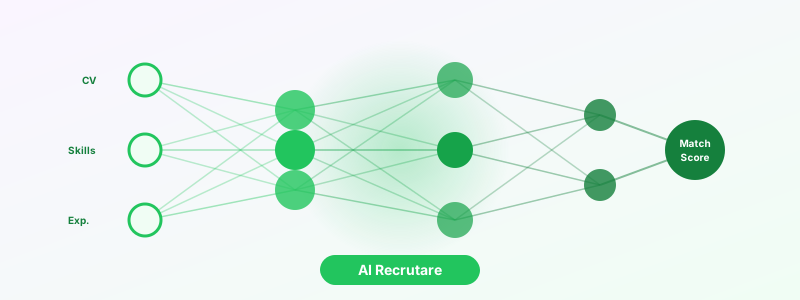
AI-powered candidate screening in Treegarden evaluates parsed candidate data against configurable job criteria, scores applicants against consistent rubrics, and automatically advances candidates who meet defined thresholds. Every decision is logged with a timestamp and the criteria applied — producing the audit trail that GDPR, EEOC, and internal compliance requirements demand. The screening operates within Treegarden's data environment, with no candidate data transmitted to external AI services outside the platform's DPA scope.
Auto-reject for Right to Work ineligibility (UK) removes applications that do not meet eligibility criteria before recruiters spend time reviewing them — applying a consistent, non-discriminatory criterion systematically rather than case-by-case. EEOC analytics (US) track demographic representation across the hiring funnel for every role, surfacing patterns that may indicate screening criteria requiring review.
Where ChatGPT excels — drafting JDs, generating outreach, writing interview guides — Treegarden complements rather than replaces it. Use ChatGPT with appropriate review for content generation. Use purpose-built ATS AI for screening, advancement, and compliance. The two serve different functions and combining them thoughtfully produces better outcomes than either alone.
Free Calculators for This Topic
Save time with these free HR calculators — no sign-up required:
Frequently Asked Questions
Is it legal to use ChatGPT to screen job applicants?
Using ChatGPT to evaluate candidate applications creates several legal risks. Under UK GDPR, processing personal data through a third-party AI tool requires appropriate data processing agreements that OpenAI's standard consumer terms do not provide. Under the Equality Act 2010 (UK) and Title VII/ADA (US), employers are liable for discriminatory outcomes from AI tools regardless of how they were generated. Using an unaudited general-purpose AI for screening decisions creates compliance exposure that purpose-built, audited ATS screening tools are designed to avoid.
Can ChatGPT write unbiased job descriptions?
ChatGPT can generate more inclusive job descriptions than untrained human drafters when given specific instructions to avoid gendered language, unnecessary exclusionary requirements, and jargon. However, it cannot guarantee bias-free output — LLMs can reproduce and amplify patterns from training data that correlate with historical discrimination. All AI-generated JDs should be reviewed using a bias-checking lens, and some organisations use dedicated JD bias-checking tools (like Textio or Applied) as an additional review step.
What is the difference between ChatGPT and ATS AI for recruitment?
ChatGPT is a general-purpose text generation tool. ATS AI is purpose-built for specific hiring tasks: scoring candidates against consistent criteria, maintaining audit trails of decisions, integrating with the hiring workflow, and operating within a compliant data processing environment. ChatGPT has no memory across sessions, no audit trail, no integration with your candidate data, and is not designed or audited for use in employment decisions. ATS AI addresses all these gaps by design.
Does GDPR allow using AI in recruitment?
Yes, with appropriate safeguards. The UK GDPR and EU GDPR permit AI-assisted processing in recruitment when candidates are informed of automated processing, human oversight is available for significant decisions, the processing has a valid lawful basis, and data is handled by processors with appropriate data processing agreements. Solely automated decisions that have significant effects on individuals require additional procedural safeguards including the right to human review. Recruitment platforms built with GDPR compliance by design — like Treegarden — incorporate these requirements into their workflows.
How should HR teams govern AI tool usage in hiring?
Effective AI governance in hiring requires: a written policy distinguishing permitted AI use cases from restricted ones; human review requirements for all externally-facing AI-generated content; data processing agreements for any AI tools that handle candidate personal data; audit trails for AI-influenced decisions; and periodic review of screening criteria for adverse impact on protected groups. Most importantly, the standard of evidence for an AI screening decision should be no lower than the standard you would apply to a human decision.
Generative AI is genuinely changing the efficiency of recruiting workflows — but the change is most valuable and most defensible when it is implemented with appropriate governance rather than as an ad-hoc productivity hack. ChatGPT belongs in the recruiter's toolkit for content generation tasks where human review follows. Purpose-built ATS AI belongs in the evaluation workflow where audit trails, consistent criteria, and data compliance are non-negotiable. Treegarden provides the latter with the speed and simplicity that lets growing teams take advantage of it from day one. Book a demo to see how compliant AI screening works in practice.