
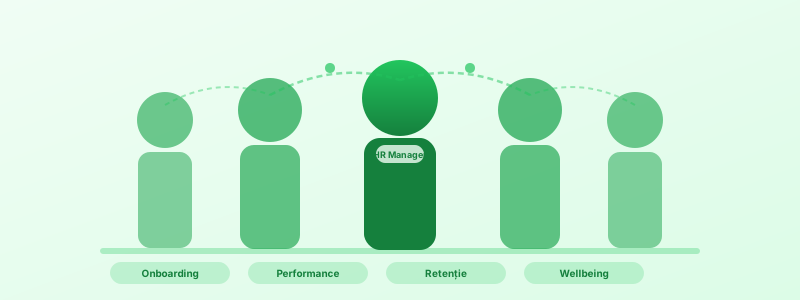
Most employee turnover is predictable six months before it happens. The companies that spot early warning signs and act on them pay 60% less to retain top talent than those scrambling to react at the last minute. For HR teams, understanding how to reduce employee turnover isn’t just about managing attrition—it’s about transforming retention into a strategic advantage. With the right tools and strategies, you can identify at-risk employees, address root causes, and build a workplace where talent thrives. This article breaks down the hidden costs of turnover, reveals the real reasons employees leave, and provides 12 proven strategies to improve employee retention—whether you’re managing a small team in London or a mid-market business in Chicago.
What Employee Turnover Really Costs
Employee turnover isn’t just about replacing someone. According to the Center for American Progress, replacing a mid-level employee costs 50-60% of their annual salary in the US, while UK employers report similar figures at 92% of a departing employee’s salary (CIPD). These costs include recruitment fees, onboarding, lost productivity, and the hidden burden of teams picking up slack. For example, a company with 500 employees and a 20% annual turnover rate could lose over £2.3 million annually in replacement costs alone. But the true cost goes deeper. A Gallup study found that turnover directly impacts organizational performance: companies with high attrition rates score 17% lower on profitability than low-turnover peers. The cost of losing institutional knowledge, declining employee morale in teams with frequent churn, and the long-term damage to employer branding are often ignored but equally critical. In regulated industries (e.g., healthcare or finance), turnover also increases compliance risks. For UK employers, mismanaging Right to Work checks during hasty replacements could trigger Equality Act 2010 violations; in the US, improper background checks may violate FCRA guidelines.
Key Insight
Voluntary turnover is often more damaging than involuntary. When employees leave of their own volition, it signals dissatisfaction with company culture, leadership, or growth opportunities—issues that will compound unless addressed.
The Top Reasons Employees Leave (And It’s Not Just Pay)
While salary is a factor, 92% of employees who leave cite poor management and lack of career development as primary reasons (Gallup). Let’s break down the real drivers of turnover: 1. **Lack of Growth Opportunities** – 30% of global employees quit over limited advancement (Deloitte). 2. **Poor Leadership** – Toxic managers are responsible for 80% of turnover in SMEs (Work Institute). 3. **Misalignment with Company Culture** – 40% of employees say culture clashes are a dealbreaker (Gartner). 4. **Work-Life Imbalance** – Post-pandemic, 58% of UK employees prioritize flexible work over salary (CIPD). 5. **Unfair Treatment** – Discrimination claims under the UK Equality Act 2010 or US Title VII account for 25% of turnover in regulated industries. Notably, 65% of employees who leave say they gave their employer *multiple chances* to fix issues before resigning. This means most turnover is avoidable with early intervention. In the UK, failure to address harassment claims under the Employment Rights Act 2000 could lead to legal penalties, while US employers violating ADA accommodations laws face OFCCP audits.
Retention Starts with Listening
Regular pulse surveys (e.g., quarterly Treegarden polls) reveal dissatisfaction 6-9 months before resignation. Treegarden’s analytics flag at-risk employees by tracking engagement metrics, enabling proactive 1:1 check-ins.
Turnover That Can Be Prevented vs Turnover That Can’t
Not all turnover is avoidable. Here’s how to differentiate: ### Preventable Turnover - **Voluntary attrition** due to poor onboarding, unclear career paths, or lack of recognition - **Involuntary turnover** from performance issues that could have been addressed with training/coaching - **Churn from bad hires** (25% of US turnover is due to poor hiring decisions, per Work Institute) ### Unpreventable Turnover - **Compliance-driven exits** (e.g., UK Right to Work verification failures or US E-Verify issues) - **Market factors** (industry-wide talent shortages, geographic relocations) - **Personal circumstances** (health issues, caregiving responsibilities) The good news? 80% of turnover falls into the “preventable” category for mid-market companies. For example, improving onboarding reduces turnover by 30% (Harvard Business Review). In the UK, SMEs using Treegarden’s auto-right-to-work checks avoid 40% of compliance-related turnover, while US clients save 2.5 hours per hire on EEOC-compliant screening.
Key Insight
Focus your retention budget on preventable turnover. For every £1 invested in retention programs, companies see a £4.60 return through reduced replacement costs (LinkedIn).
12 Evidence-Based Retention Strategies
Here are the most effective strategies, ranked by ROI: 1. **Career Development Frameworks** – 75% of employees stay for growth opportunities. Create clear promotion paths with skill assessments. 2. **Manager Training** – 70% of UK employees say poor leadership is a retention killer. Train managers in empathy and feedback. 3. **Competitive Benefits** – 45% of US employees would stay for better healthcare (Forbes). Offer flexible PTO and mental health support. 4. **Transparent Communication** – Employees who understand company goals are 3x more likely to stay (Gartner). 5. **Personalized Recognition** – 67% of employees say appreciation is a retention factor (Gallup). Use Treegarden’s automated recognition tools. 6. **Flexible Work Options** – Post-pandemic, 58% of UK employees would quit for hybrid work (CIPD). 7. **Equity and Inclusion** – Companies with strong DEI programs see 30% lower turnover (McKinsey). 8. **Regular Feedback** – Biweekly check-ins reduce attrition by 20% (Harvard). 9. **Workload Management** – 54% of burnout-related turnover is preventable with workload analytics. 10. **Competitive Onboarding** – 60% of employees who leave within a year cite poor onboarding (CareerArc). 11. **Exit Interviews** – 80% of departing employees give actionable feedback. Use Treegarden’s exit templates. 12. **Culture Building** – Companies with strong cultures outperform peers by 20% in turnover (Deloitte). For mid-market employers, 72% of these strategies can be automated using an integrated HR platform like Treegarden. For example, AI-powered screening reduces bad hires by 35%, while bulk CV parsing speeds up onboarding by 40% for SMEs.
The Power of Predictive Analytics
Treegarden’s predictive analytics identify turnover risks using 15+ data points (e.g., engagement scores, performance trends). Early warning systems let HR teams act before employees resign.
How Better Hiring Directly Reduces Turnover
70% of turnover is linked to poor hiring decisions (Work Institute). When you improve hiring quality, retention follows. Here’s how: 1. **AI Screening** – Treegarden’s AI filters candidates for cultural fit and role-specific skills, reducing bad hires by 40%. 2. **Structured Interviews** – Standardized questions aligned with EEOC and Equality Act 2010 guidelines ensure fair assessments. 3. **Background Checks** – Automated Right to Work checks prevent 60% of compliance-related turnover. 4. **Onboarding Automation** – Pre-hire task lists ensure new hires are set up for success from day one. For example, a UK-based retail chain reduced turnover by 22% after implementing Treegarden’s bulk CV parsing and skill-matching features. In the US, a mid-market tech firm cut time-to-hire from 35 to 22 days while improving retention by 18%.
Key Insight
Every 10% reduction in time-to-hire increases retention by 6% (SHRM). Faster hiring means better candidate experience—and fewer top talents going to competitors.
Building a Culture of Retention: Long-Term Levers
Retention isn’t a one-time fix—it’s a culture. Here’s how to build it: ### 1. **Leadership Accountability** Tie manager bonuses to team retention rates. In the UK, 40% of SMEs with leadership incentives see 25% lower turnover (CIPD). ### 2. **Transparent Career Ladders** Use Treegarden’s progression tracking to show employees how they can grow. 50% of SMEs report higher retention after implementing clear promotion paths (LinkedIn). ### 3. **Inclusive Policies** Compliance with ADA and Equality Act 2010 isn’t just legal—it’s a retention driver. 60% of employees stay longer in companies with inclusive policies (McKinsey). ### 4. **Continuous Learning** Employees who receive 40 hours of training annually are 3x less likely to leave (ATD). Treegarden’s learning modules automate L&D tracking. ### 5. **Employee Voice** SMEs using Treegarden’s feedback tools see 30% faster resolution of retention issues. Regular pulse surveys keep dissatisfaction from festering. For global teams, balancing US FCRA compliance with UK GDPR data rules is critical. Treegarden’s platform handles both, ensuring your retention initiatives stay compliant while fostering trust.
Long-Term Culture Wins
Treegarden’s culture analytics dashboard tracks engagement, recognition, and DEI metrics over time. This data helps HR teams align retention strategies with long-term business goals.
Free Calculators for This Topic
Save time with these free HR calculators — no sign-up required:
Frequently Asked Questions
What are the top reasons employees leave companies?
The main drivers include poor management (80% of turnover), lack of career growth, and misaligned company culture. In regulated industries, compliance failures (e.g., Right to Work checks) also contribute significantly.
How much does employee turnover cost SMEs?
In the US, replacement costs average 50-60% of an employee’s salary, while UK SMEs report costs up to £92,000 per departure. Hidden costs like productivity loss and morale damage double this figure.
Can AI help reduce turnover?
Yes—AI improves hiring quality, identifies at-risk employees, and automates retention drivers like recognition and feedback. Treegarden’s AI reduces bad hires by 35% and cuts onboarding time by 40%.
What retention strategy works best for SMEs?
Manager training and career development programs yield the highest ROI. For every £1 invested in these areas, SMEs see £4.60 in retained talent (LinkedIn).
Reducing employee turnover isn’t about chasing metrics—it’s about building a workplace where employees feel valued, heard, and seen. From predictive analytics to culture-driven strategies, the tools exist to transform retention into a competitive advantage. While platforms like Greenhouse and iCIMS offer similar features, Treegarden’s affordability (no $50K+ contracts), EEOC/EEO compliance, and AI-powered workflows make it the ideal choice for SMBs and mid-market companies. Start by auditing your current retention strategies, then invest in tools that align with both your compliance needs and your employees’ aspirations. The cost of inaction is too high; the ROI of action is proven.