
Use this 60-minute workshop to practise asking a consistent question, taking factual notes and explaining a rating against a behavioural anchor. A facilitator can run it with a group of three hiring managers or several groups working at once. The editable kit contains the same agenda, two distinct fictional exercises and calibration worksheet shown below. No email address or account is needed.
This is a workshop kit, not a complete guide to every interview stage. For the wider process, use our guide to conducting a job interview. If your team needs a reusable assessment form, start with the interview scorecard template and agree job-related criteria before interviewing.
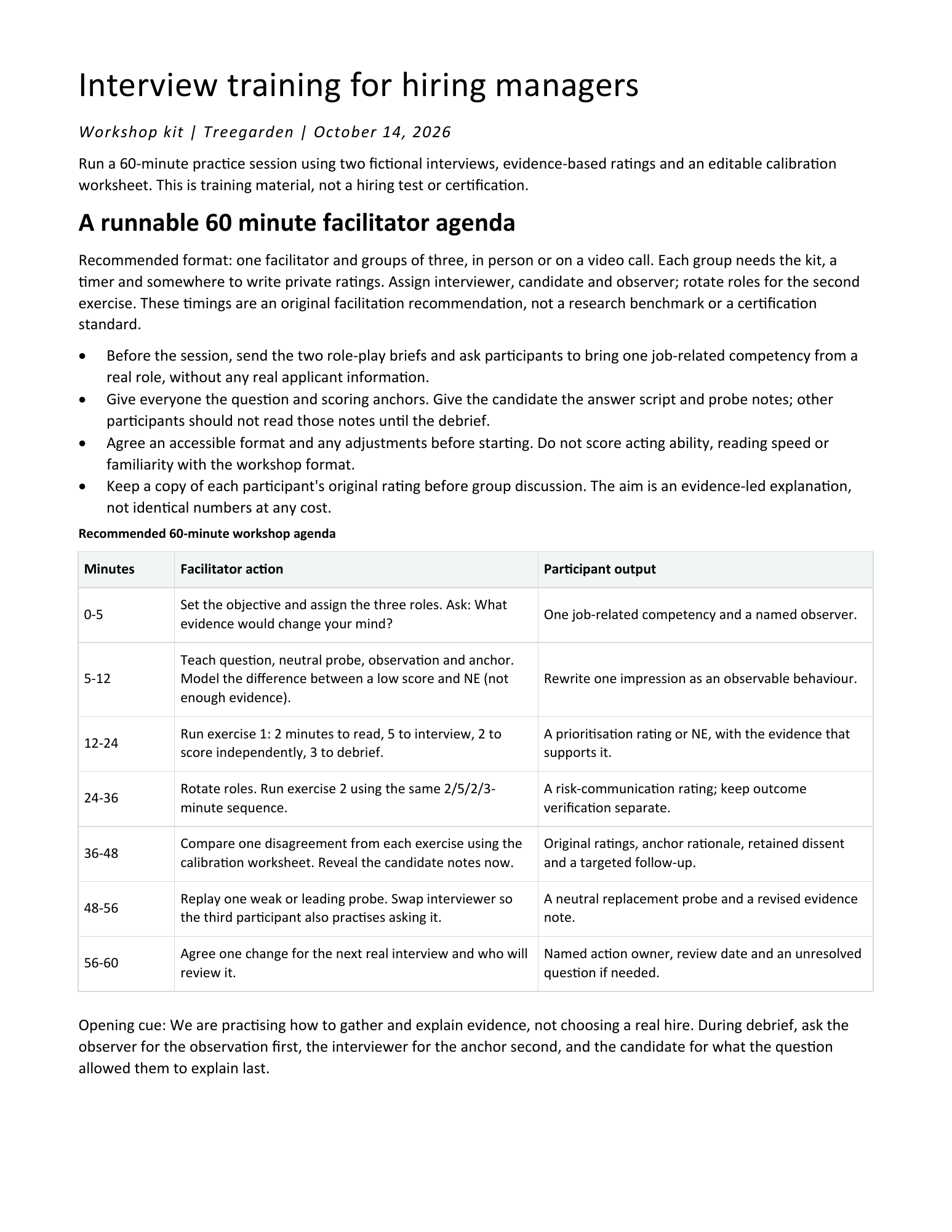
A runnable 60-minute facilitator agenda
Recommended format: one facilitator and groups of three, in person or on a video call. Each group needs the kit, a timer and somewhere to write private ratings. Assign interviewer, candidate and observer; rotate roles for the second exercise. These timings are an original facilitation recommendation, not a research benchmark or a certification standard.
- Before the session, send the two role-play briefs and ask participants to bring one job-related competency from a real role, without any real applicant information.
- Give everyone the question and scoring anchors. Give the candidate the answer script and probe notes; other participants should not read those notes until the debrief.
- Agree an accessible format and any adjustments before starting. Do not score acting ability, reading speed or familiarity with the workshop format.
- Keep a copy of each participant's original rating before group discussion. The aim is an evidence-led explanation, not identical numbers at any cost.
| Minutes | Facilitator action | Participant output |
|---|---|---|
| 0-5 | Set the objective and assign the three roles. Ask: What evidence would change your mind? | One job-related competency and a named observer. |
| 5-12 | Teach question, neutral probe, observation and anchor. Model the difference between a low score and NE (not enough evidence). | Rewrite one impression as an observable behaviour. |
| 12-24 | Run exercise 1: 2 minutes to read, 5 to interview, 2 to score independently, 3 to debrief. | A prioritisation rating or NE, with the evidence that supports it. |
| 24-36 | Rotate roles. Run exercise 2 using the same 2/5/2/3-minute sequence. | A risk-communication rating; keep outcome verification separate. |
| 36-48 | Compare one disagreement from each exercise using the calibration worksheet. Reveal the candidate notes now. | Original ratings, anchor rationale, retained dissent and a targeted follow-up. |
| 48-56 | Replay one weak or leading probe. Swap interviewer so the third participant also practises asking it. | A neutral replacement probe and a revised evidence note. |
| 56-60 | Agree one change for the next real interview and who will review it. | Named action owner, review date and an unresolved question if needed. |
Opening cue: We are practising how to gather and explain evidence, not choosing a real hire. During debrief, ask the observer for the observation first, the interviewer for the anchor second, and the candidate for what the question allowed them to explain last.
Teach the evidence rules before role-play
OPM's structured-interview guidance describes predetermined questions and common evaluation standards. Its guide discusses independent ratings and practice exercises. Apply that principle here: read the stated question, use the permitted neutral probes, note what was said, then score privately before talking. The exercises and anchors below are Treegarden's original training material, not OPM assessment instruments.
Use the anchor or mark NE
For this workshop, 1 means evidence supports the lower anchor, 2 the middle anchor, and 3 the stronger anchor for the named competency. NE means not enough evidence to choose an anchor. NE is not zero, a rejection or an averageable score. A low rating needs observed behaviour supporting the lower anchor; an unanswered or unasked question alone does not supply that evidence.
These numbers have no universal pass mark. Do not total them to approve a candidate or use them as hiring thresholds. Before real selection, the employer must establish job-related criteria and an appropriate assessment process. A named human decision owner reviews the evidence, gaps and dissent under that process.
Bias and accessibility guardrails
- Compare the answer with the role requirement, not another candidate, a confident delivery or your own preferred career path.
- Replace labels such as polished, like us or not leadership material with a specific observation and the relevant anchor. Do not infer competence from accent, eye contact or social similarity.
- Do not seek personal information unrelated to the job. Keep disability-related inquiries out of the pre-offer interview; route accommodation requests through the employer's appropriate process.
- Use a consistent opportunity to answer and a documented neutral-probe policy. Accommodations may change delivery without changing the job-related competency being measured.
- If an interviewer introduces a new criterion mid-discussion, stop and record the issue. Do not retrofit an anchor to favour an answer you liked.
EEOC guidance addresses job-related selection procedures, discrimination and reasonable accommodation. This US guidance is not a worldwide legal checklist, and completing this workshop does not establish that an employer's process is valid or legally compliant. Involve the appropriate HR, accessibility and legal specialists for the hiring location.
Practice rewrite: 'Very confident' becomes 'Named the incident owner and gave a specific update time.' 'No ownership' becomes 'The interviewer did not ask what the candidate personally did; use the agreed contribution probe before rating that competency.'
Exercise 1 Prioritising a service queue
Fictional scenario: a Customer Support Lead must triage a service queue. Competency: prioritisation using impact and urgency. All events, people and candidate answers in this exercise are invented for practice; they are not Treegarden customer results.
Interviewer brief
Ask: You inherit three tickets at 9am: one customer cannot process payroll due today, a second reports intermittent login failures, and a third wants a cosmetic dashboard change. What would you do first, what would you check, and how would you explain your priorities?
Permitted neutral probes: What information would change that order? What would you do personally? How would you keep the other customers informed? Ask only to clarify missing evidence; do not supply a preferred answer. Allow the candidate to finish before probing.
Candidate script and evidence notes
Read: I would check the payroll deadline and workaround first, and find out how many users the login issue affects. If payroll has no workaround and is due today, I would prioritise that, assign an owner and send the other customers an update time. If login is blocking everyone, I would reconsider the order.
Only if asked about personal action: I would verify the ticket details, contact the on-call lead and record who owns each incident. Only if asked what changes the order: wider login impact, an earlier deadline or a usable payroll workaround. Do not invent a successful resolution. Observer evidence: checks deadline, workaround and affected users; names conditional priorities, an owner and an update time. Actual incident resolution is not demonstrated.
| Rating | Behavioural anchor and fictional contrast |
|---|---|
| 1 | Keeps an order based only on arrival or who complains loudest, despite a neutral opportunity to consider impact. Contrast answer: I always handle the loudest customer first; the deadline would not change that. |
| 2 | Checks impact and urgency and explains an initial order. Contrast answer: I would check the deadline and affected users, then address the highest-impact urgent issue first. |
| 3 | Meets anchor 2 and explicitly states what would change the order, with an owner and update plan. The supplied script supports 3 for prioritisation, not proof of wider management skill. |
NE example: the interviewer runs out of time after asking only which ticket comes first. No reason or response to a neutral probe is captured. Record the gap rather than inventing a low score. Debrief: Which phrase supports your anchor? Did you reward speed instead of reasoning? What would you still need to assess in a real interview?
Exercise 2 Raising a release risk
Fictional scenario: an Implementation Coordinator must communicate a release risk to a colleague with a competing deadline. Competency: clear, constructive risk communication. This is a past-behaviour interview, unlike the hypothetical prioritisation exercise. Everyone and everything described is fictional.
Interviewer brief
Ask: Tell me about a time you raised a delivery risk with someone who wanted to keep the original deadline. What did you personally say or do, and how was the next step agreed?
Permitted neutral probes: What was the specific risk? What did you personally do rather than the team? How did the other person respond? How did you check what happened afterwards? Do not turn a probe into a suggestion such as You escalated it to the director, right?
Candidate script and evidence notes
Read: In a practice-project rollout, two import checks failed. I told the project lead which records could be affected and brought the check results. I proposed either holding that import or releasing the unaffected part. We agreed the lead would decide after a retest and I would send the results that afternoon. I cannot recall whether the final import passed.
Only if asked about the colleague's response: the lead wanted the full release but agreed to review the two options. Only if asked what you did personally: I wrote the risk note and ran the retest; the lead owned the release decision. Only if asked about verification: I did not record the final decision and do not know the outcome. Observer evidence: specific risk, supporting checks, options, a decision owner and an update time. No final outcome is evidenced.
| Rating | Behavioural anchor and fictional contrast |
|---|---|
| 1 | Uses blame or a vague warning without explaining the risk or a next action despite a neutral probe. Contrast answer: I told them it was their fault and left them to deal with it. |
| 2 | Explains a specific risk with supporting information and proposes a relevant next action. Contrast answer: I shared the failed checks and proposed a retest, but we did not agree who would decide. |
| 3 | Meets anchor 2 and explains workable options, how the colleague responded, and an agreed decision owner and update time. The script plus response probe supports 3 for risk communication. |
Keep competencies separate: if outcome verification is also a job requirement, this answer leaves it NE, not automatically 1. Do not reduce risk communication solely because the final result is unknown. Debrief: Did you distinguish the candidate's actions from the team's? Did the uncertain outcome cause you to ignore the communication evidence? Which agreed follow-up would resolve the gap?
An editable calibration worksheet
Use one copy per exercise during minutes 36-48. Preserve private ratings before revealing the candidate notes. Read one observation at a time and compare it with the agreed anchor. A changed rating needs a written reason; disagreement can remain unresolved without forcing consensus.
| Field | Complete during the workshop |
|---|---|
| Exercise and competency | Exercise: __________ Competency: ____________________ |
| Question and probe used | Question: _________________________________________ Probe: ___________________________________________ |
| Observed answer or action | What was said or done: ______________________________ _________________________________________________ |
| Private ratings before discussion | Interviewer 1/2/3/NE: ____ Observer 1/2/3/NE: ____ Keep both original notes. |
| Anchor rationale | Anchor: ____ Evidence supporting it: ___________________ What is observation versus interpretation? ______________ |
| Reason for disagreement | Observation / anchor interpretation / different criterion / missing evidence: __________________________________ |
| Evidence gap | What remains unknown? ______________________________ Does the gap concern this competency or a different one? ___ |
| Fairness check | Any leading probe, changed criterion or irrelevant impression? Correction or accessible adjustment: ___________________ |
| After calibration | Retained or revised rating / NE: ____ Reason and any dissent: ______________________________ |
| Next action and human review | Approved neutral follow-up: __________________________ Owner: __________ Review date: _____________________ Human reviewer: ___________________________________ |
Facilitator prompts: Are we disagreeing about what was said, what the anchor means, or what we wish we had asked? What evidence justifies changing the original rating? Is there a gap that needs follow-up rather than a vote? Keep the action proportionate; do not add an extra interview merely to seek agreement.
Use the answer key without forcing agreement
Fictional completed calibration example
Exercise 2, risk communication: the interviewer records 2 because the release outcome is unknown. The observer records 3 after the colleague-response probe. Both observed a specific risk, supporting checks, options, an owner and an update time. The disagreement concerns a criterion: outcome verification is not part of the stated risk-communication anchor.
After calibration, the interviewer records 3 and writes: Changed because I had added a final-outcome requirement that our anchor does not contain. Original 2 retained in the notes. Outcome verification remains NE as a separate requirement. If it matters for the real role, the named hiring manager should use an approved follow-up, not assume a successful release. No hiring decision or total pass score is inferred.
Replay and observe
- Replace You escalated it to the director, right? with What did you do next, and who made the decision? Replay only the missing part of the answer.
- Observer checks: the interviewer used the stated question, allowed the answer, used a neutral probe and recorded actions rather than personality labels.
- Check that the rating cites an anchor and that NE was kept separate from 1. Ask the candidate-role participant whether the probe led them towards a preferred answer.
- At the close, each manager names one change for the next interview, an owner and a review date. The facilitator records remaining disagreements and any need for HR review.
Transfer to the next interview
Blank action record: Role and competency: ____________________. Change to question, probe or note-taking: ____________________. Owner: __________. Review date: __________. Unresolved issue and human reviewer: ____________________. Keep real candidate records out of the training worksheet and follow your organisation's retention and access rules.
One workshop does not establish interviewer competence. Recommended follow-up: have an experienced colleague review the next interview plan and, with appropriate permission and safeguards, observe the questioning and evidence notes. Revise the training around recurring gaps rather than treating attendance as a qualification.
Sources and editorial approach
OPM Structured Interviews: Predetermined questions and common rating standards.
OPM Structured Interview Guide: Independent evidence-based ratings and interviewer training exercises, including Appendices D-F.
EEOC Employment Tests and Selection Procedures: Job-related selection, discrimination and reasonable accommodation in the US context.
Official sources opened on October 14, 2026. Treegarden authored the agenda, timing choices, scripts, anchors, checklist and worksheet as original recommendations and fictional examples; these are not validated assessment tools. Treegarden sells ATS and HR software and has a commercial interest in interview management. This workshop is practical vendor-authored training, not independent product research or legal advice.
Download the editable training kit
The ungated Word document mirrors the visible agenda, two exercises, candidate answer scripts, evidence notes, behavioural anchors and calibration worksheet. It includes blank fields plus a clearly fictional completed calibration example. It is editable and contains no macros or collection forms.
Connect the practice to your hiring process
Take the independent notes into an evidence-led interview debrief, where the human decision owner records gaps, dissent and next steps. For software evaluation, review Treegarden interview management and ask to see the workflow your team needs rather than assuming this kit describes a product function.