
Quick answer for buyers
How much does Personio cost in 2026?
Personio does not publish pricing; it sells on a quote-based, per-employee-per-month (PEPM) model across two published tiers, Core and Core Pro. Third-party estimates disagree substantially on the base rate. tinyteam.io's aggregated third-party data (25 June 2026) puts Core at roughly $2.96-4 per employee per month and Core Pro at $4.56 or more per employee per month. Vendr's real deal data (February 2026) tells a different story: buyers at around 25 employees report paying in the low five figures per year, and buyers at around 150 employees report paying in the mid-to-high five figures per year, both notably higher than a simple PEPM-times-headcount calculation would suggest. Recruiting and payroll are separate add-on modules on top of either tier, estimated by third-party sources at roughly EUR 1-3 and EUR 3-8 per employee per month respectively. Treat every figure here as a third-party estimate, not a Personio list price, and get a written quote for your exact headcount and module selection.
- Source of figures: Capterra Personio pricing listing, Vendr Personio deal data, and tinyteam.io Personio pricing analysis.
- What to negotiate: renewal increase cap, mid-year headcount adjustment rules, and future module prices before signing.
- Key contract risk: Vendr's deal data shows a 12-month minimum contract term, with longer commitments reported to unlock better rates. Personio does not publicly document its cancellation notice window; confirm the exact figure in your contract before signing.
- Compare with: Personio alternatives if recruiting depth or transparent pricing is the priority.
Last updated: August 21, 2026. Personio's official pricing overview confirms the Core and Core Pro plan structure, optional apps, and custom quotes, but it does not publish a rate card. Dollar figures in this guide are therefore third-party estimates only and retain their source dates. Key sources: Personio pricing overview, Capterra Personio pricing, Vendr Personio data, tinyteam.io Personio pricing analysis.
Why Personio Does Not Publish Pricing
Personio has maintained a no-list-price policy since its early growth years, and this is a deliberate business strategy rather than an administrative oversight. The company's own pricing page at personio.com/pricing directs all prospective buyers to a demo request, and there is no way to get a number without entering a sales conversation. This approach allows Personio to price each deal based on what the market will bear for that specific buyer, headcount, and module selection, rather than leaving money on the table with published rates that every competitor can see.
The practical consequence for you as a buyer: every pricing figure that circulates online is derived from one of three sources. First, buyer reports shared on review platforms such as G2 and Capterra. Second, aggregated procurement transaction data from SaaS purchasing intermediaries such as Vendr. Third, estimates published by independent SaaS pricing research sites such as tinyteam.io and PeerSpot. None of these are official Personio rate cards. They reflect what real buyers have reported paying, which is useful information but meaningfully different from a published price.
This article is explicit about that distinction throughout. Where a figure comes from Vendr's transaction data, it says so. Where a figure is a third-party estimate, it says that too. You should treat every number here as a credible market range that frames what to expect and how to negotiate, not as a guaranteed quote.
Personio's scale and market position in 2026
Personio is not a small vendor taking experimental positions on pricing. As of 2025-2026, the company reports approximately EUR 415 million in annual recurring revenue and serves around 15,000 customers across Europe, according to Contrary Research's company analysis. The dominant geography is Germany, which accounts for roughly 86% of its customer base according to 6sense market data. The majority of Personio customers are in the 100-249 employee range. This matters for pricing: Personio is a well-resourced vendor with significant negotiating experience, and you should approach the pricing conversation knowing they have seen every buyer tactic many times over.
The broader context also matters: the European HR software market was valued at approximately USD 4.8 billion in 2025 and is projected to grow at around 7.6-10% per year through 2033, according to Market Data Forecast's European HR Technology Market Report. Personio is one of the primary beneficiaries of that growth in the SMB segment, which gives it pricing power that reflects genuine market demand rather than vendor desperation.
Personio Plan Structure in 2026: What Each Tier Actually Covers
Personio organises its platform around a tiered base subscription plus separately priced add-on modules. Personio's published tier names are Core and Core Pro, a two-tier structure. (Older or third-party material sometimes refers to "Essential," "Professional," or "Enterprise" tiers; those names are not part of Personio's current published tier structure and should not be relied on.) Recruiting and payroll are sold as separate add-on modules on top of either base tier, per third-party estimates; Personio does not publicly state whether either module is ever bundled into a specific tier, so confirm that in writing before you assume it.
Core: The Base HRIS Subscription
Core is Personio's entry-level tier. Based on Personio's public product marketing and buyer accounts, Core covers core HR administration: employee profiles and organisational structure, absence and time-off management with European holiday calendar defaults, onboarding and offboarding task workflows, document management, employee self-service (time-off requests, profile updates, document access) in multiple languages, GDPR data-handling tooling, and standard headcount and absence reporting. Personio does not publish an exhaustive, binding feature list, so confirm exact inclusions in your written quote.
Third-party PEPM estimates for Core disagree substantially. tinyteam.io's aggregated third-party data (25 June 2026) puts Core at roughly $2.96-4 per employee per month. Vendr's real deal data (February 2026) implies a materially higher effective cost at small headcounts: buyers at around 25 employees report annual spend in the low five figures, well above what a simple per-employee-rate calculation would predict, likely reflecting contract minimums, bundled modules, or multi-year terms not captured in a flat PEPM figure. Neither number is a Personio list price. Get a written quote for your exact headcount before budgeting against either one.
Core Pro: Personio's Higher Tier
Core Pro is Personio's higher published tier. Personio does not publicly document the exact feature delta between Core and Core Pro, and third-party sources are not consistent on this point, so this article does not assert a specific feature list for Core Pro. Ask Personio for a written, line-item comparison of what moves from Core to Core Pro for your account before you sign, rather than relying on any third-party summary, including this one.
tinyteam.io's aggregated third-party data puts Core Pro at approximately $4.56 per employee per month or more, with no published upper bound. Vendr's deal data reports that buyers at around 150 employees pay in the mid-to-high five figures annually. As with Core, these two data points use different methodologies (an aggregated per-employee rate versus actual closed-deal totals) and should not be mechanically combined into a single figure.
Recruiting and Payroll as Add-On Modules
Recruiting and payroll are sold as separate add-on modules on top of either Core or Core Pro, according to third-party estimates: recruiting at roughly EUR 1-3 per employee per month, and payroll at roughly EUR 3-8 per employee per month. These are third-party estimates, not Personio-published rates, and the actual price depends on your existing contract terms and the negotiation at the point of activation.
One consistent pattern in buyer accounts on G2: adding modules mid-contract is possible but typically at the current full market rate rather than any discount you negotiated on your original contract. If you know you will want recruiting or payroll in year two, negotiate that module price at initial contract signing. The pre-contract conversation is where you have leverage. Mid-contract activation negotiations happen on Personio's terms, not yours.
Estimated Costs by Headcount: Two Data Sources That Disagree
Personio does not publish a rate card, so there is no single authoritative table of cost by headcount. The two best available third-party sources, an aggregated per-employee-per-month (PEPM) estimate and real closed-deal data, use different methodologies and do not agree with each other. Both are shown below so you can see the actual spread rather than a single collapsed number.
| Headcount | Illustrative model: Core (tinyteam.io PEPM × headcount) | Illustrative model: Core Pro (tinyteam.io PEPM × headcount) | Vendr real-deal data (annual) |
|---|---|---|---|
| ~25 employees | $74-100 / mo (illustrative) | $114+ / mo (illustrative) | Low five figures / yr |
| ~50 employees | $148-200 / mo (illustrative) | $228+ / mo (illustrative) | Not published by Vendr |
| ~100 employees | $296-400 / mo (illustrative) | $456+ / mo (illustrative) | Not published by Vendr |
| ~150 employees | $444-600 / mo (illustrative) | $684+ / mo (illustrative) | Mid-to-high five figures / yr |
| ~200 employees | $592-800 / mo (illustrative) | $912+ / mo (illustrative) | Not published by Vendr |
Source note and how to read this table: The "illustrative model" columns are a simple PEPM-times-headcount calculation using tinyteam.io's aggregated third-party PEPM estimate (25 June 2026) and are not Personio-quoted figures. The "Vendr real-deal data" column uses Vendr's actual closed-deal data (February 2026) at the two headcounts Vendr reports publicly. Note the gap: at around 25 employees, the illustrative PEPM model implies roughly $888-1,200 per year, well below Vendr's real-deal "low five figures" anchor. That gap suggests contract minimums, add-on modules, or negotiated terms push real spend meaningfully higher than a flat per-employee rate would predict, especially for smaller teams. Treat both columns as directional, not as a quote, and confirm your own number with Personio sales.
An Illustrative Modelled Scenario: 120-Person Tech Company in Germany
The following is a hypothetical, illustrative scenario built entirely from third-party pricing estimates. It is not a real customer case and not a Personio quote. It exists to show how the pieces of a Personio contract fit together and, just as importantly, to show how differently two legitimate third-party estimation methods can land on the same headcount. Every figure is labelled by source and method so you can substitute your own numbers.
Setup: 120 employees, Germany-based, Core Pro tier, adding the DATEV payroll integration as a separate add-on, paying annually, standard single-country implementation with no complex custom workflow builds.
Method 1, bottom-up PEPM estimate: tinyteam.io's aggregated third-party data puts Core Pro at $4.56 or more per employee per month, with no published upper bound. At 120 employees, that is at least $547 per month ($4.56 × 120), with no reliable ceiling from this source alone.
Method 2, top-down real-deal estimate: Vendr's real closed-deal data (February 2026) reports that buyers at around 150 employees, the closest published anchor to this scenario, pay in the mid-to-high five figures annually, which we interpret here, for illustration only, as very roughly $50,000-90,000 per year. Scaled proportionally down to 120 employees, that implies roughly $40,000-72,000 per year, or approximately $3,300-6,000 per month. This scaling is our own rough interpretation for modelling purposes, not a Vendr-published figure for this exact headcount, and Vendr's total may already include add-on modules or multi-year terms that a bottom-up PEPM figure would not.
The two methods disagree by roughly an order of magnitude. That gap is a real finding, not a modelling error: it suggests the bottom-up PEPM rate should be treated as a soft floor for the base subscription only, and Vendr's real-deal data as the more realistic planning anchor for total contract value at this headcount.
DATEV payroll integration add-on: The DATEV connection integrates with DATEV LODAS and Lohn und Gehalt for monthly payroll processing, as documented in Personio's own DATEV integration documentation. The integration itself is priced as a separate add-on; third-party estimates put payroll add-ons at roughly EUR 3-8 per employee per month, so approximately EUR 360-960 per month for 120 employees. Personio does not publish this rate, and sources do not consistently distinguish USD from EUR pricing, so treat this as an order-of-magnitude planning figure, not a quote.
Implementation: Third-party secondary sources (not Personio-published) put one-time implementation cost at roughly $1,000-5,000 or more, depending on configuration complexity. For a standard single-country rollout at this scale, the lower half of that range is a reasonable planning assumption, but confirm scope and cost in writing before signing.
Year one, illustrative range: Combining the Vendr-anchored subscription estimate (~$3,300-6,000/month) with the payroll add-on (~EUR 360-960/month, treated here as roughly comparable to USD given the currency ambiguity in the sources) and a one-time implementation cost of ~$1,000-3,000, year one lands very roughly in the $45,000-87,000 range for this 120-person scenario. That is a wide band because the underlying sources are wide and disagree with each other; it is not a number to take to a budget committee without your own quote.
Renewal risk in year two: Here the sources also disagree, and this article shows both rather than picking one. Vendr's deal data reports standard contractual renewal escalators in the 3-5% range. Buyer reviews on G2 describe actually experiencing renewal increases of 10-20%, well above the contractual escalator, on accounts that did not negotiate a written cap. Applied to a round $60,000 year-one figure within the illustrative range above (chosen for ease of calculation, not as a specific prediction), a 4% contractual increase would add roughly $2,400 in year two, while a 15% experienced increase would add roughly $9,000. That gap, even within a single illustrative scenario, is why a written renewal cap is worth negotiating before you sign rather than after the first renewal notice arrives.
Five Variables That Move Your Personio Quote
1. Headcount and Volume Bands
Personio's base pricing is per employee per month, and volume-based rate reductions at higher headcounts are typical of this pricing model generally. Personio does not publicly document the specific headcount thresholds at which its own per-employee rate changes, so this article does not state one. If your headcount is near a round number, ask Personio directly whether you qualify for a better per-employee rate, and get any band boundaries in writing so you understand what triggers a rate change.
One structural trap that buyer accounts on G2 describe: Personio contracts typically do not allow downward seat adjustments during the contract term. If headcount falls during the year, you continue paying for the licensed seat count until renewal. This means headcount forecasting at contract signing has real financial consequences, not just administrative ones; some buyers report being billed for more seats than their actual headcount following organisational changes, though the sources reviewed for this article do not support a specific typical percentage. Negotiate the mid-year true-up mechanism explicitly, and get both the upward and downward adjustment rules documented in the contract rather than relying on verbal assurances from the sales representative.
2. Module Selection: Base Tier vs. Apps
The demo Personio shows prospective buyers typically displays the full platform with all modules active. The first quote sent after the demo may cover only the base tier. This gap between what you see in the demo and what is included in the initial quote is a frequent source of confusion and post-signing frustration.
Before any follow-up discussion, request a line-item written quote that specifies exactly which modules are included at what price. The relevant add-ons to ask about explicitly: Recruiting (ATS and candidate pipeline), Performance and Goals (review cycles and goal management), Compensation Management, Employee Surveys, Advanced Analytics, Payroll integration (country-specific connectors such as DATEV for Germany), and premium support. Each of these may be shown in the demo but not included in the quoted subscription price.
3. Contract Length and Payment Terms
Vendr's deal data (February 2026) shows a 12-month minimum contract term, with longer commitment terms reported to unlock better per-employee rates. Vendr does not publish an exact discount schedule by contract length, so this article does not state one; ask Personio directly what a longer commitment is worth against your specific quote. The trade-off with any multi-year commitment is reduced flexibility to change vendors or renegotiate; mid-term cancellation typically forfeits the remaining contract balance.
The practical advice: a longer commitment with annual prepayment is generally how buyers access Personio's better per-employee rates, but only makes sense once you have completed a proper evaluation and are genuinely ready to commit. A one-year term is appropriate if your organisation is in a period of significant change or you are not yet certain the platform is the right long-term fit, even though Vendr's data suggests you pay more per employee for that flexibility.
4. Geographic Complexity
Single-country deployments (Germany, Netherlands, UK, France as standalone examples) are priced and implemented at one complexity level. Multi-country setups that require localised compliance defaults, separate national holiday calendars, country-specific payroll connectors, or different employment law configurations for each jurisdiction are quoted at a higher price point. They also typically require a professional services engagement beyond standard onboarding, adding both time and cost to the initial deployment.
If your team spans multiple EU countries from day one, budget explicitly for this. A 150-person team split across Germany, the Netherlands, and Spain is a meaningfully different implementation project than 150 employees in one country, and the pricing and timeline reflect that difference.
5. Support Tier
Standard Personio support is included in the base contract: email and chat support with standard response SLAs, access to the knowledge base and community, and an onboarding manager for the initial setup period. A premium support tier with dedicated customer success, faster escalation paths, and priority response SLAs is available as a paid add-on.
For teams that will rely heavily on Personio for day-to-day HR operations across dozens or hundreds of employees, the cost of premium support relative to the operational risk of slow issue resolution is worth modelling explicitly before signing. A payroll integration failure or absence management bug during a critical period costs more in HR team time than the incremental cost of premium support.
Hidden Costs That Buyer Reviews Consistently Identify
This section focuses on costs and contract terms that buyers report discovering after signing rather than before. These are not fabrications: they appear repeatedly in buyer accounts on G2, Capterra, PeerSpot, and Vendr's buyer research. They are documented here so you can address them before signing rather than after.
Renewal Increases: The Most Consistent Negative Surprise
The single most consistent theme in Personio buyer feedback across review platforms is the renewal price increase that was not clearly communicated during initial contract negotiations. Buyer reviews on G2 describe experiencing renewal increases of 10-20% above the prior year's rate. Vendr's deal data reports a standard contractual renewal escalator in the 3-5% range. The gap between what the contract technically allows and what buyers say they actually experienced is itself worth flagging to your negotiator: it suggests the contractual escalator is a floor, not a ceiling, for accounts without a negotiated cap.
Buyer accounts on review platforms describe cases of receiving a renewal increase, rejecting it, and having to formally decline to renew before the contract auto-renewed at the new price. Personio does not publicly document a standard notice period for this, and third-party sources do not agree on one, so this article does not state a specific number of months. What is consistent is the mechanism: if you miss whatever notice window applies to your contract, you are locked into another full term at the new price.
The protection against this is contractual and must be negotiated before signing. Request a written clause in the contract that specifies the maximum percentage by which the annual subscription price can increase at each renewal, for example "renewal pricing shall not exceed the preceding year's rate by more than 5%," which sits close to the top of Vendr's reported contractual escalator range. Personio sales teams resist this clause. Experienced SaaS procurement teams include it anyway and hold the position through the negotiation. This is a standard and legitimate request; resistance does not mean it is off-limits.
Auto-Renewal, Contract Minimums, and the Cancellation Notice Window
Personio contracts include auto-renewal clauses and, per Vendr's February 2026 deal data, a 12-month minimum contract term; Vendr also reports that longer commitment terms tend to unlock better per-employee rates. Personio does not publicly document its standard cancellation notice window, and third-party sources do not agree on a specific figure, so this article does not state one.
The practical implication: confirm the exact notice period in your specific contract at signing, in writing, rather than relying on any third-party estimate. Set a calendar reminder for the cancellation notice deadline as soon as you have it in writing. If you are planning a vendor switch or a renegotiation, start that process well before the notice deadline, not in the weeks before renewal.
Implementation for Non-Standard Configurations
Standard Personio onboarding for a straightforward single-country setup is typically included or priced as a low one-time fee. Multi-country configurations with localised compliance requirements, DATEV or other payroll integrations, complex approval workflow builds, custom integration development via the API, or migrations from legacy HR systems involve professional services that are quoted separately. Multiple secondary third-party sources (not Personio-published) put one-time implementation cost in the range of roughly $1,000 to $5,000 or more for more complex deployments, and sources do not consistently distinguish USD from EUR pricing.
Before signing, request a written definition of what is included in standard onboarding versus what is charged as professional services. The ambiguity between "included" and "chargeable" at implementation is a documented source of unexpected cost for buyers who did not get this defined in writing before signing.
Payroll Customisation and Integration Fees
Personio's payroll functionality works best in Germany, where the DATEV integration is mature and well-documented. Users in other countries consistently report that payroll requires additional configuration, workarounds, or integration with external payroll providers. Third-party sources put the payroll add-on module itself at roughly EUR 3-8 per employee per month; this article did not find a reliably sourced figure for one-off customisation fees beyond that add-on rate, so it does not state one. For companies with complex compensation structures, variable pay, or multi-country payroll requirements, budget separately for payroll integration work beyond the base platform cost and get the add-on rate confirmed in writing.
Mid-Contract Module Activation at Full Rate
Activating a module mid-contract, for example moving from Core to Core Pro or adding a recruiting or payroll add-on to an existing subscription, is possible but typically occurs at the current full market rate. Any discount negotiated on the original modules at contract signing does not automatically extend to modules added later. If your team's roadmap includes recruiting, payroll, or a Core Pro upgrade within the next two years, negotiate the price for those modules at the initial contract signing when your leverage is highest, even if you do not plan to activate them immediately.
Where Personio Earns Its Price: GDPR and EU Compliance Infrastructure
An honest review of Personio pricing cannot skip the compliance dimension. For European HR teams, the GDPR posture is a genuine, documented, technical advantage that reduces legal and operational risk in ways that translate to real cost savings when weighed against the compliance burden of using alternatives.
Specifically: Personio stores all customer data in EU data centres, specifically on AWS infrastructure in Frankfurt, according to HROpsLab's independent review. Personio holds ISO 27001 certification with annual third-party audits, and its GDPR alignment has been audited by Bitkom Consult, Germany's leading digital association. The Article 28 Data Processing Agreement is included in the standard Personio contract rather than requiring separate negotiation. Consent management, data retention policy enforcement, right-to-erasure workflows, and data subject request handling are built into the product architecture, not bolted on through configuration.
For a company managing employees across Germany, France, and the Netherlands, Personio's architecture removes the need for Standard Contractual Clauses or Binding Corporate Rules that would be required when transferring employee data to a US-primary platform. The legal work to establish SCCs for employee data transfers with a US-headquartered vendor, and to keep them current as regulations evolve, is not a trivial ongoing cost. Personio eliminates that category of work and compliance risk for European teams.
These are not marketing claims. They are architectural and contractual facts that a legal or compliance team assessing vendor risk can verify directly in the contract documentation and through Personio's public compliance disclosures. The question for each buyer is whether this compliance value justifies the cost premium over alternatives in their specific context. For most European mid-market companies, especially those subject to works council oversight in Germany, strict data protection enforcement in France, or GDPR compliance requirements under their own customers' contracts, the compliance infrastructure is a genuine feature worth paying for. For companies where the primary use case is recruiting depth or cost predictability rather than HRIS compliance, the calculus may be different.
How Personio Pricing Compares to Alternatives
This comparison table uses buyer-reported and publicly published data for each platform. Source notes are included for each row. The goal is to give you a frame of reference for your buying decision, not a definitive ranking.
| Platform | Pricing model | Estimated cost at 200 employees | EU data residency | Recruiting included | Source |
|---|---|---|---|---|---|
| Personio Core | Per-employee, custom quote | $592-800 / mo (illustrative model, 200 employees) | Yes, AWS Frankfurt | Add-on module | tinyteam.io |
| Personio Core Pro | Per-employee, custom quote | $912+ / mo (illustrative model, 200 employees) | Yes, AWS Frankfurt | Add-on module | Vendr / tinyteam.io |
| HiBob | Per-employee, custom quote | USD 1,600-2,800 / mo (estimate) | Available | Separate add-on | Vendr HiBob data |
| BambooHR Core | Per-employee, custom quote | USD 2,000 / mo (est., $10/emp) | US-primary | Separate add-on | SaaS Price Pulse |
| Workable Standard | Headcount-based, published | ~USD 500-800 / mo (published) | Available | Core product | G2 Workable pricing |
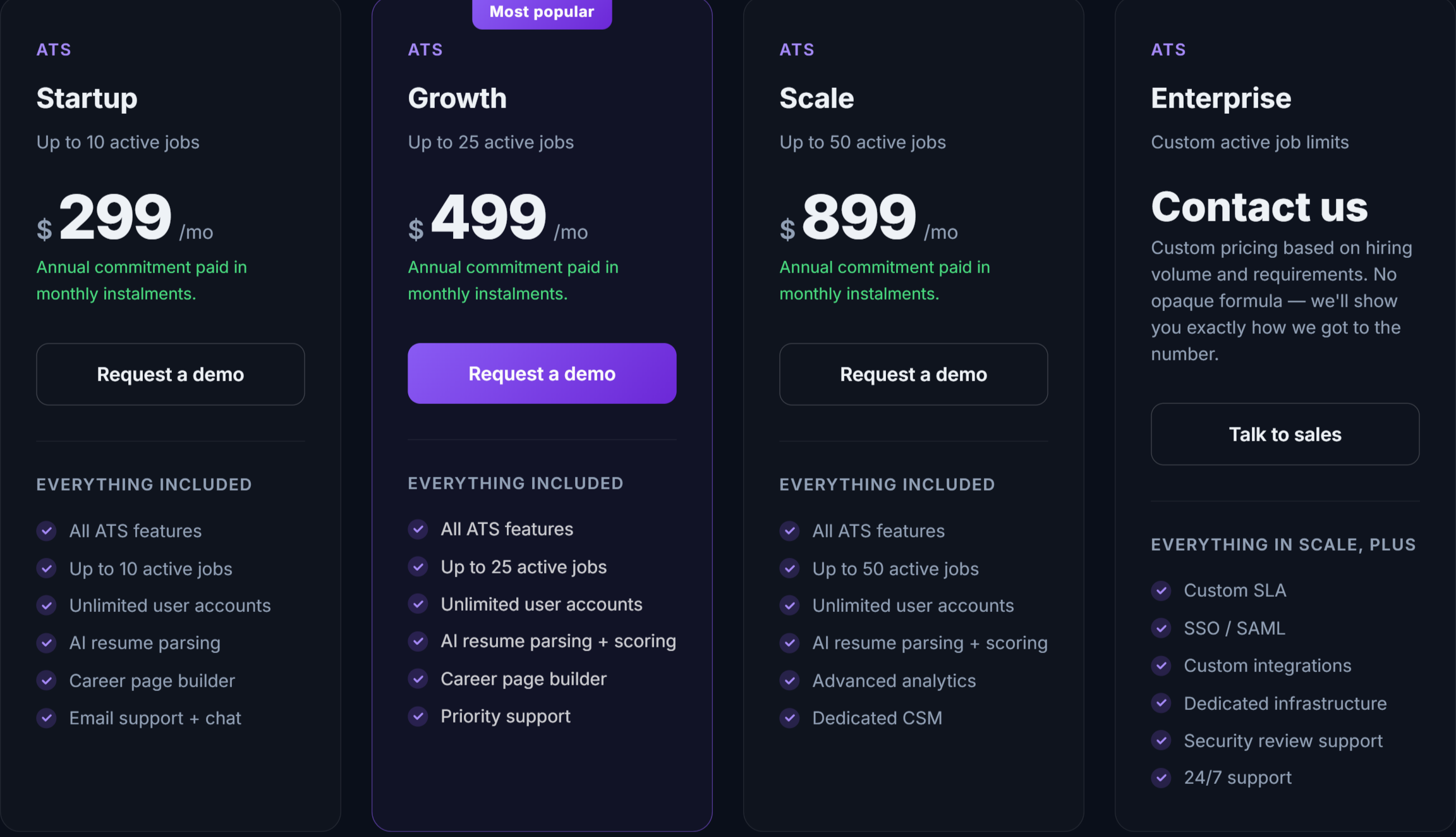
| Treegarden (ATS / ATS + HR) | Modular job-based ATS & employee-tier HR, published | USD 499-899 / mo ATS (or $998-$1,798 / mo ATS + HR bundle) | Available | Core product | treegarden.io/pricing |
Competitor estimates based on Vendr transaction data, third-party buyer reports, and publicly published rates where available. The Personio rows are an illustrative PEPM-times-headcount model built from tinyteam.io's estimate, not a Personio-quoted figure; Vendr's real-deal data suggests actual contract value can run well above this model (see the cost-by-headcount table above). All non-published figures are estimates. Treegarden pricing is published at treegarden.io/pricing. Currency conversion at approximate 2026 rates.
Personio vs. HiBob
HiBob is the closest direct competitor to Personio in the European mid-market HRIS space. Both are quote-only. HiBob earns strong user ratings, with 4.5 stars on G2 and 4.6 on Capterra, and is particularly well-regarded for its user interface and employee experience features. Vendr's HiBob pricing data places typical contract values at a similar range to Personio Core Pro, though HiBob's per-employee rate tends to run higher at smaller headcounts. Buyers comparing the two most commonly cite Personio's deeper European employment law defaults versus HiBob's more modern UI as the key differentiation. Implementation timelines for HiBob are reported at 4-8 weeks for standard single-country deployments, per reviewer accounts.
Personio vs. BambooHR
BambooHR is a strong HRIS for North American companies that has expanded internationally. Buyer-reported pricing from SaaS Price Pulse puts BambooHR Core at approximately $10 per employee per month, Pro at around $17, and Elite at around $25, with a minimum of $250 per month that makes it expensive for very small teams. BambooHR's data primary residency is US-based, which means European companies managing BambooHR would need Standard Contractual Clauses for GDPR compliance. For companies where EU data residency is a hard requirement, BambooHR is typically not on the shortlist. For North American companies with European offices, it is often already in place and worth evaluating whether Personio's GDPR advantage justifies a switch.
Personio vs. Workable
Workable is ATS-first with HR features added. Its pricing is published and headcount-based: Standard starts at $299/month for teams up to 20 employees, Premier at $599/month, and Enterprise at $719/month annually, according to G2's Workable pricing page. Workable is a strong recruiting tool and a meaningfully weaker HRIS than Personio. If your primary need is hiring pipeline management and your secondary need is basic HR administration, Workable is a cost-effective option. If your primary need is multi-country European HRIS compliance with recruiting as secondary, Personio is the better-suited tool.
Getting the Best Price: What the Procurement Data Shows
Personio pricing is negotiable. Vendr's deal data shows negotiated outcomes vary widely by preparation, headcount, and contract length, though Vendr does not publish a single typical discount percentage, so this article does not state one. The moves that actually produce results are well-documented in procurement research and buyer accounts.
Time the Deal to End of Quarter
Personio's sales teams operate on quarterly quotas. Deals signed in the final two to three weeks of a fiscal quarter close with better terms, larger discounts, and faster approvals than deals signed mid-quarter. This is not speculation: it is a documented pattern in enterprise SaaS procurement across most vendors, and it applies to Personio. Plan your evaluation timeline with this in mind. If you enter the demo in early quarter and allow the evaluation process to run for six to eight weeks, you will arrive at the contract conversation in a natural end-of-quarter position.
Negotiate the Renewal Cap Before You Sign
This is the single highest-value negotiating move available to you. The time to negotiate renewal terms is before you sign the initial contract, not at renewal time. Request specific contract language that caps year-over-year renewal increases: for example, "the subscription fee at each annual renewal shall not exceed the immediately preceding year's fee by more than 5%." Personio's sales team will push back on this. The resistance is normal, not a signal that the clause is unreasonable. Experienced procurement teams hold the position, accept that the negotiation will take an extra cycle, and include the clause before closing the deal.
The financial impact of this single clause, calculated over a two to three year contract, is often larger than the impact of any other negotiating concession. Model it explicitly for your headcount and present that number to your internal budget holder as the case for holding the position.
Run a Genuine Competitive Evaluation
Personio responds to documented competitive pressure from HiBob, BambooHR, and Workday for larger teams. A competitive evaluation that is real, where you have genuine quotes from alternatives and are prepared to walk away, creates a structurally different negotiating context than a single-vendor evaluation. The alternatives that Personio most often responds to in European mid-market deals are HiBob and BambooHR. If your team is US-headquartered with European offices, Rippling and BambooHR are credible alternatives. Having actual quotes from at least two alternatives, not hypothetical references to competitors, gives you meaningful leverage.
Lock In Future Module Prices at Signing
If your roadmap includes recruiting, payroll, or a Core Pro upgrade within the next two years, negotiate those prices at initial contract signing even if you will not activate them immediately. The pre-contract conversation is where your leverage is highest: you are a prospective customer with alternatives, and the sales team is closing a deal. Mid-contract activation negotiations happen when you are already a paying customer with switching costs, which is a structurally weaker position. Get written price commitments for future modules, not just verbal assurances.
Clarify Headcount Rules in Writing
Ask the following questions explicitly and confirm the answers in writing in the contract, not just verbally from the account executive: What happens if headcount grows by 20 employees mid-contract? What if it drops by 20? How are contractors, part-time workers, or alumni records counted? Is there a quarterly true-up mechanism or does all adjustment happen only at renewal? Are inactive employee records included in the license count?
Buyer accounts on G2 and PeerSpot report being surprised by these rules in both directions: unexpected charges when headcount grew, and inability to reduce licensed seats when headcount contracted. The time to understand and negotiate these terms is before signing, when you can push for quarterly true-up mechanisms and written flexibility.
Pay Annually to Access Better Rates
Monthly billing is typically available but at a premium over the annual equivalent rate; third-party sources do not agree on a specific premium percentage, so this article does not state one. Annual prepayment is the standard that unlocks the better per-employee rates described in most third-party pricing analyses. If cash flow allows, annual prepayment is almost always the right decision for an initial Personio contract: the rate advantage is real and the financial risk of early termination exists regardless of payment cadence, since mid-contract cancellations typically forfeit the remaining contract value.
Personio pricing checklist: what to verify before signing
Use this as a structured pre-signature review. Each item corresponds to a known source of cost uncertainty or post-signing regret identified across G2 reviews, Capterra reviews, PeerSpot buyer accounts, and Vendr procurement research.
| Item to verify | What to ask for | Why it matters |
|---|---|---|
| Line-item module breakdown | Written quote specifying each module separately: core HRIS, recruiting, performance, payroll integration, analytics, premium support | The demo shows the full platform; the initial quote often covers only the base tier |
| Renewal increase cap | Written contract clause: "renewal pricing shall not exceed the preceding year's rate by more than X%" | Buyer reviews on G2 document experienced renewal increases of 10-20% above prior year, well above Vendr's reported 3-5% contractual escalator; a cap protects you from that gap |
| Cancellation notice window | Exact number of days or months required to submit cancellation before auto-renewal triggers | Personio does not publicly document its notice window and third-party sources disagree on typical length; missing whatever window applies locks you into another full term at the renewed price |
| Headcount adjustment rules (upward) | Written mechanism for how mid-year headcount growth is billed: immediately at current rate, at next quarterly true-up, or at renewal only | Unexpected mid-year charges for headcount growth are a documented buyer complaint |
| Headcount adjustment rules (downward) | Written confirmation of whether and when you can reduce licensed seat count and the process to do so | Contracts typically do not allow downward adjustments mid-term; buyers report paying for more seats than their actual headcount following downsizing |
| Future module pricing | Written price commitments for modules you plan to activate in years two or three of the contract | Mid-contract module activation is billed at the current full market rate, not your negotiated rate |
| Implementation scope | Written definition of what is included in standard onboarding versus charged as professional services | Multi-country setups, payroll integrations, and complex workflows are often chargeable professional services not covered in standard onboarding |
| Contractor and alumni record counting | Written explanation of how contractors, part-time workers, and former employees on notice are counted against licensed seats | Ambiguity in how records are counted produces unexpected charges; get the definition in writing |
Sources: G2 Personio verified buyer reviews, Capterra Personio reviews, Vendr Personio buyer data, tinyteam.io Personio pricing analysis, PeerSpot buyer experience reports.
Where Personio Genuinely Delivers Value
This article focuses heavily on pricing risk and hidden costs because that is what buyers need to understand before signing. But a fair assessment of Personio also requires acknowledging where the platform is genuinely strong.
Comprehensive European HRIS Out of the Box
Personio ships with European employment law defaults, multilingual interfaces, country-specific holiday calendars, and GDPR workflows built into the standard product rather than requiring localisation work at implementation. For a German company bringing on French or Dutch employees, the compliance scaffolding is already in place. This is a meaningful time saving versus US-headquartered HRIS platforms where European localisation often requires significant configuration effort, partner support, or third-party add-ons.
Employee Self-Service That Reduces HR Admin Volume
Users on G2 consistently cite the self-service portal as a genuine productivity win. Employees request time off, update personal records, access documents, and complete onboarding tasks without routing through HR. For an HR team managing dozens of recurring administrative requests per week, automating that volume has measurable impact on capacity. The quality and intuitiveness of the self-service experience is repeatedly cited as one of Personio's strongest product attributes.
Approval Workflows and HR Process Automation
Personio's workflow engine handles absence approval chains, onboarding task assignments, document signature requests, and off-boarding checklists without requiring custom development or middleware. For teams running these processes manually via email chains or spreadsheets, the transition to structured automated workflows is often the highest-ROI aspect of the Personio deployment. This is not a differentiated feature in the abstract, but Personio's implementation of workflow automation is rated consistently well by actual users for reliability and ease of configuration.
Integration Depth for German Payroll
The DATEV integration, documented in detail on Personio's support documentation, connects with DATEV LODAS and Lohn und Gehalt for monthly payroll processing and allows importing payslips and payroll documents back into Personio from DATEV. For German companies using DATEV for payroll accounting, this integration removes a significant manual data transfer task. It is the most mature payroll integration Personio offers, and for German-primary teams it is a practical feature rather than a theoretical benefit.
Where Personio Has Real Limitations
Personio is not the right choice for every European HR team. The platform has documented limitations that matter for certain buying contexts.
Recruiting Depth for High-Volume Hiring Teams
Personio's ATS module covers the basics of applicant tracking effectively. It does not match the pipeline management depth, structured interview tooling, or analytics capability of dedicated ATS platforms built by companies where recruiting is the core product. For teams doing ten to thirty hires per year across a few roles, the Personio ATS is adequate. For teams running continuous high-volume hiring across multiple departments, structured interview processes, or sophisticated candidate experience workflows, the ATS limitations become a real constraint. Reviews on G2 that score Personio lower tend to come from recruiting-heavy users who find the ATS too basic for their volume and process complexity.
Payroll Outside Germany
Personio's payroll functionality is strongest in Germany. Users in other countries consistently report needing workarounds, external integrations, or manual processes to handle country-specific payroll requirements. A company with employees primarily in Germany plus smaller headcounts in France, Spain, or Eastern European countries will likely need to manage non-German payroll outside Personio and sync data in. This adds integration overhead and operational complexity that is not obvious from the demo.
Reporting and Analytics at Scale
Standard Personio reporting covers headcount, absence, and basic HR metrics effectively. Advanced analytics, custom report building, and workforce planning analytics are available only in higher tiers or as add-on modules. For HR teams that rely heavily on data for workforce planning or business partner reporting, Personio's out-of-box analytics at the Core tier may require supplementing with external tools or upgrading to Core Pro.
Treegarden as a Personio Alternative: Where We Fit and Where We Do Not
I run Treegarden, so I will be direct about where we are the right choice and where we are not. Transparency on this point matters because the honest answer is that Treegarden and Personio serve meaningfully different primary use cases, and a buyer who gets that wrong will be disappointed regardless of which platform they choose.
Personio is an HRIS platform with recruiting added as a module. Treegarden is an ATS platform with an HR module added. That architectural difference is not cosmetic. If your primary bottleneck is European HRIS compliance across multiple countries, payroll integration, and HR administrative process management for a mid-sized team, Personio is built for that use case and is more mature at it than Treegarden. If your primary bottleneck is hiring pipeline management, structured candidate workflows, hiring manager collaboration, and offer process management, Treegarden is built for that use case and the HR module covers the administrative HR needs that recruiting-led teams have.
The comparison becomes relevant when your team needs both recruiting and HR administration at a predictable, transparent cost. Treegarden publishes its pricing: Startup at $299/month, Growth at $499/month, and Scale at $899/month, all including unlimited user accounts and the core ATS. The HR module adds a per-employee component on top of the ATS plan. There are no mid-year true-ups that surprise you, no opaque renewal negotiations, and no per-seat charges for hiring managers, admins, or recruiters. If your Personio quote has grown to a number where the renewal risk and hidden cost potential are a meaningful budget concern, that is the conversation we can have on a demo.
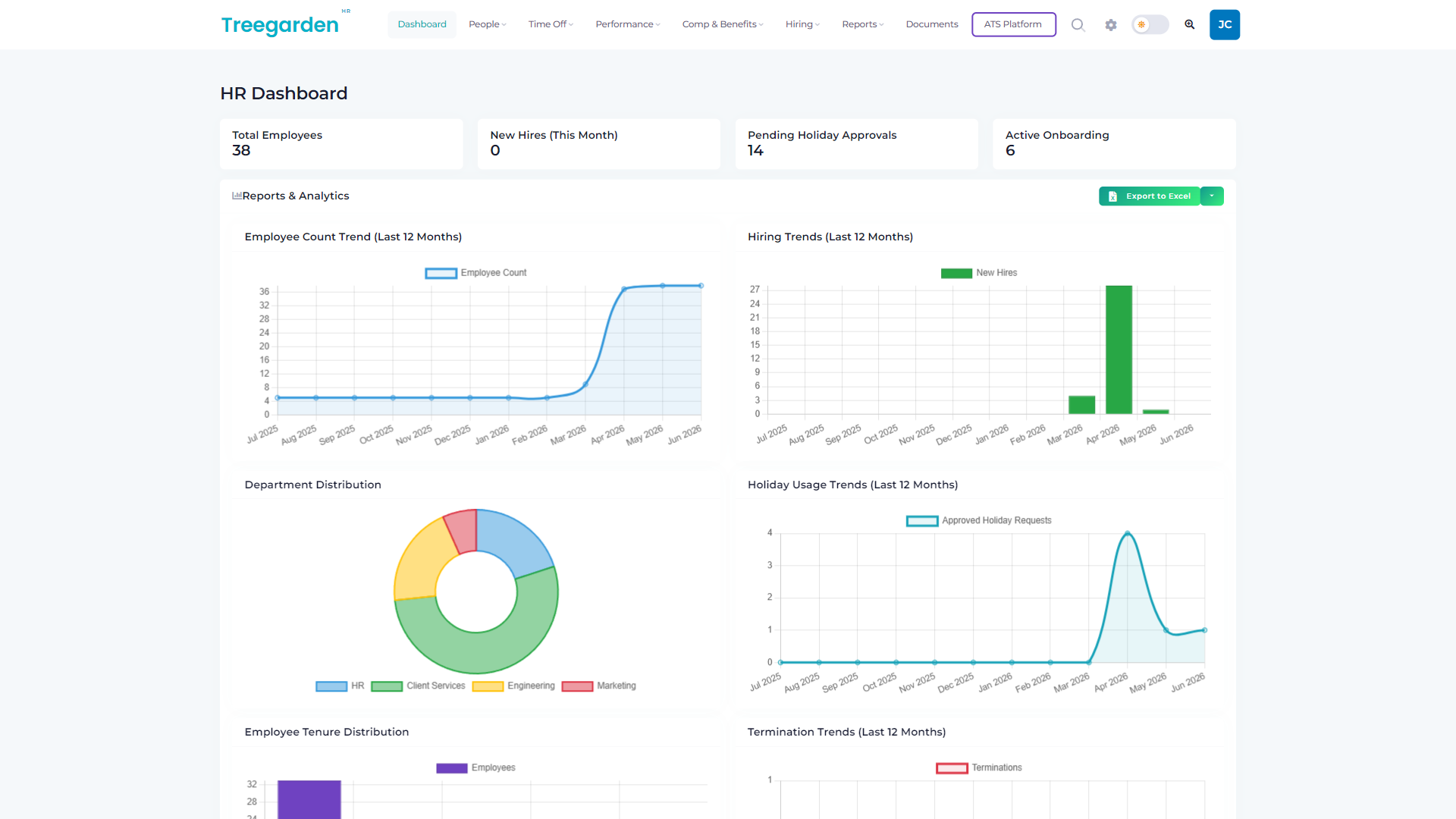
Treegarden does not replace a full HRIS suite, payroll system, or IT management platform. It is an ATS-first product with an HR module that covers the practical HR administration needs of teams focused on hiring. If you need full multi-country HRIS compliance, sophisticated payroll integration across EU jurisdictions, or enterprise HR analytics at scale, Personio is the more complete answer. If you need excellent recruiting tooling with solid HR administration at a predictable published price, book a demo and we will show you what that looks like for your specific team size and hiring volume.
See exactly what Treegarden costs for your team
Published annual plans, no renewal surprises, unlimited users. Startup: $299/mo. Growth: $499/mo. Scale: $899/mo. All features included. Bring your Personio quote to a demo for a direct comparison.
View transparent pricingRelated pricing and alternative articles
These articles are part of the Treegarden HR software pricing research hub. Each covers a different angle of the same buying decision you are working through.
Last updated: August 21, 2026. Methodology: Personio's official pricing overview was rechecked on August 21, 2026. It confirms Core, Core Pro, optional apps, and custom quotes, but no public rate card; every dollar figure on this page is therefore a third-party estimate, attributed inline and cross-checked across independent sources where possible. Conflicting estimates are shown as ranges rather than collapsed into one number, and retain their original source dates. Key sources: Personio pricing overview, Capterra, Vendr, and tinyteam.io. See also our ATS pricing comparison, Workable pricing, and Rippling pricing.
Frequently Asked Questions About Personio Pricing
How much does Personio cost for 100 employees in 2026?
Personio does not publish list prices, so every figure here is a third-party estimate. tinyteam.io's aggregated data (25 June 2026) puts Core at roughly $2.96-4 per employee per month and Core Pro at $4.56 or more, which on a simple per-employee calculation would put a 100-employee company at roughly $296-400 per month for Core or $456 or more for Core Pro. Vendr's real deal data (February 2026) suggests actual contract value runs meaningfully higher than that calculation predicts once minimums, add-ons, and negotiated terms are included; Vendr's nearest published anchors, low five figures per year at around 25 employees and mid-to-high five figures per year at around 150 employees, both imply a higher effective cost than the PEPM estimate alone. Recruiting and payroll are separate add-on modules, estimated by third-party sources at roughly EUR 1-3 and EUR 3-8 per employee per month respectively. Get a written quote for your exact headcount rather than relying on any single estimate here.
Is Personio pricing negotiable, and by how much?
Yes. Vendr's deal data (February 2026) shows negotiated outcomes vary by preparation, headcount, and contract length, though Vendr does not publish a single typical discount percentage. What is well documented is which levers matter: annual prepayment, a genuine competitive evaluation with real alternative quotes, and timing the deal to the end of Personio's fiscal quarter. The single most durable move is securing a written renewal cap before signing: Vendr's data shows a standard contractual escalator of 3-5% per year, while buyer reviews on G2 describe actually experiencing increases of 10-20% on accounts without a negotiated cap. Combined, these moves produce materially better contract terms than any single lever alone.
Does Personio offer EU data residency and GDPR compliance?
Yes. Personio stores all customer data in EU data centres (AWS Frankfurt), holds ISO 27001 certification with annual third-party audits, and has its GDPR alignment audited by Bitkom Consult. The Article 28 Data Processing Agreement is included in the standard Personio contract. For European HR teams managing employee records across multiple EU member states, this removes the need for Standard Contractual Clauses or other international transfer mechanisms that would be required when using US-primary platforms. The GDPR posture is one of the most consistently cited reasons European HR buyers select Personio over US-headquartered alternatives, and it is a genuine architectural feature, not a marketing claim. Sources: HROpsLab independent review, OutSail HRIS analysis.
What is the difference between Personio Core and Core Pro plans?
Personio's two published tiers are Core and Core Pro. Personio does not publicly document the exact feature delta between them, and third-party sources are not consistent on this point, so this article does not assert a specific feature list; request a written, line-item comparison from Personio sales for your account. Recruiting and payroll are sold as separate add-on modules on top of either tier, not necessarily bundled into Core Pro. On price, tinyteam.io's aggregated third-party data (25 June 2026) puts Core at roughly $2.96-4 per employee per month and Core Pro at $4.56 or more, though Vendr's real deal data suggests actual contract value can run well above a simple per-employee calculation. Always request a written line-item breakdown of what is included in your specific quote before signing any contract.
What is the cancellation notice period for Personio contracts?
Personio contracts include auto-renewal clauses and, per Vendr's February 2026 deal data, a 12-month minimum contract term. Personio does not publicly document its standard cancellation notice window, and third-party sources do not agree on a specific figure, so this article does not state one. If you miss whatever notice window applies to your contract, you are locked into another full term at the renewed rate. Confirm the exact notice period in your specific contract documentation at signing, get it in writing, and set a calendar reminder for the deadline. If you are planning a vendor switch or renegotiation, begin that process well before the notice deadline, not in the weeks before renewal.
Does Personio include payroll or is it a separate add-on?
Payroll is a separate add-on regardless of which Personio plan tier you are on. The platform provides payroll preparation tools and integrations with payroll processors, but does not run payroll natively. The most mature integration is with DATEV for German companies, as documented in Personio's DATEV integration documentation. The DATEV connection handles monthly payroll data transfer, payslip import, and salary data synchronisation with DATEV LODAS and Lohn und Gehalt. Payroll integrations for other countries are available but are rated significantly less mature than the DATEV integration by users in those markets. Third-party sources estimate the payroll add-on at roughly EUR 3-8 per employee per month, though Personio does not publish this rate; budget for it separately from your base subscription when modelling total cost.
How long does it take to implement Personio?
Implementation timelines vary significantly by configuration complexity. Single-country standard deployments at typical SMB scale (50-200 employees, Germany, Netherlands, or UK as examples) typically take 4-8 weeks from contract signing to go-live, according to buyer accounts on review platforms. Multi-country DACH deployments or configurations with complex payroll integrations, custom approval workflows, or data migrations from legacy systems take 8-16 weeks. Large multi-country European deployments can run longer. These timelines assume active participation from your HR team in the configuration and data migration work: Personio implementation is not a purely vendor-driven process. Budget internal HR team time alongside the implementation cost when planning the deployment.