
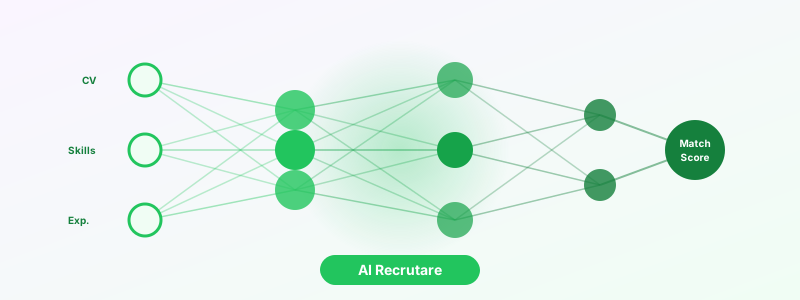
AI parsing is good enough to save hours — it is not good enough to replace human judgment. Resume parsing software has advanced significantly over the past five years, but the practical gap between what vendors claim in demos and what teams experience with real-world CVs remains meaningful. Understanding what parsing actually extracts, where it fails, and how to select a parser that fits your hiring volume and candidate pool is the prerequisite for deploying it effectively.
What Resume Parsing Is and How It Works
Resume parsing software is technology that automatically reads the text content of a CV or resume, identifies the meaning of different sections, and extracts structured data — names, contact details, work history, education, skills — into a standardised format that can be stored and searched in an applicant tracking system or candidate database.
Modern parsers operate using a combination of techniques. Rule-based parsing identifies patterns — date ranges that signal employment periods, formatting cues that delineate sections — and has been the foundation of commercial parsers since the early 2000s. Machine learning parsers train on large datasets of annotated CVs and learn to identify semantic meaning rather than just format patterns. The best commercial parsers in 2026 combine both approaches, using ML to handle ambiguous or non-standard formatting and rule-based logic to enforce structured output schemas.
The parsing pipeline for a typical ATS integration works as follows: the candidate uploads a PDF or Word document; the parser converts the document to plain text; the NLP engine segments the text into logical sections (contact information, summary, experience, education, skills, certifications); entity recognition extracts specific data points within each section; and the structured output is mapped to the ATS candidate profile schema. The entire process takes seconds per document.
Parser Performance Benchmarks
Leading commercial CV parsers achieve 85–95% accuracy on structured, standard-format CVs from native English speakers. Accuracy drops to 65–80% on complex formatting (multi-column layouts, tables, graphics-heavy documents), non-English CVs, or candidates from professions with non-standard CV conventions (creative portfolios, academic CVs). Understanding your candidate pool's typical CV format is critical for realistic accuracy expectations.
What Data Gets Extracted (And What Doesn't)
Parsers extract data reliably from well-structured CVs. The core extraction categories that commercial parsers handle with high confidence include:
- Contact information: Name, email, phone number, and location are the most reliably extracted fields across all major parsers. Accuracy here typically exceeds 95% even on poorly formatted CVs.
- Employment history: Job titles, company names, and employment date ranges are extracted with high reliability from standard chronological CVs. Role descriptions and bullet points under each position are captured as text blocks, though semantic interpretation of those descriptions varies by parser.
- Education: Degree name, institution, and graduation year are reliably extracted from standard education sections. Modules, dissertations, and non-standard qualifications (professional certifications integrated into the education section) are handled inconsistently.
- Skills: Named skill extraction works well for hard skills with standardised terminology (Python, AutoCAD, SQL). Soft skills are extracted by keyword matching but the semantic accuracy is low — "excellent communicator" and "strong written communication" may or may not map to the same skill entity depending on the parser's taxonomy.
What parsers consistently struggle with:
- Inferring seniority level from ambiguous titles across different industries
- Distinguishing side projects from substantive employment
- Extracting data from tables and multi-column layouts
- Interpreting non-standard date formats or employment gaps
- Understanding context-dependent role scoping (a "Manager" at a 5-person startup vs a FTSE 100 company)
How Parsing Accuracy Varies by CV Format
The single biggest determinant of parsing accuracy is CV format, not parser quality. A standard single-column PDF with clear section headers will parse with 90%+ accuracy on virtually every commercial platform. The same information presented in a two-column InDesign template with embedded graphics may parse at 50–60% accuracy on the same parser.
| CV Format | Typical Parse Accuracy | Common Issues |
|---|---|---|
| Standard single-column PDF | 88–95% | Minimal; occasional date parsing errors |
| Standard Word document (.docx) | 85–93% | Formatting-dependent; header/footer capture issues |
| Multi-column PDF layout | 60–78% | Column order misinterpretation; section boundary errors |
| Graphic-heavy creative CV (PDF) | 45–70% | Embedded text in images not parsed; section detection fails |
| Academic CV (long-form) | 70–85% | Publications and conferences often mislabelled |
| Scanned document (image PDF) | 30–60% | OCR-dependent; quality varies significantly |
When Parsing Errors Become Compliance Risks
A parsing error that misassigns a candidate's years of experience is an inconvenience. A parsing error that incorrectly reads a candidate's demographic data — if that data is collected for EEOC purposes in the US, or inadvertently included in a CV from a market where candidates include photos or dates of birth — creates data quality problems that affect both compliance reporting accuracy and the integrity of AI-powered screening decisions. Always verify parsed data for roles where specific qualification criteria carry legal weight.
CV Parsing vs Resume Parsing: UK vs US Terminology
The terminology is geography-dependent, not product-dependent. In the United Kingdom, Ireland, Australia, and most of Europe, the standard term for the document a candidate submits for a job is a "CV" (curriculum vitae). In the United States and Canada, "resume" is the standard term. The documents themselves have differences in convention — UK CVs are typically longer and may include a personal profile section; US resumes are typically one or two pages with a tight focus on quantifiable achievements — but modern parsers handle both formats.
When evaluating parsing software marketed as "CV parsing software" or "resume parsing software," the terminology is marketing geography rather than a meaningful functional distinction. Verify that the parser you are evaluating has been trained on CVs from the geographic markets where your candidates are based — a parser trained primarily on North American resume formats will perform less accurately on UK or German CVs with different formatting conventions and section names.
Treegarden's parser is trained on CV and resume formats from both UK and US markets, handling the practical differences in section naming (Personal Statement vs Summary, Modules vs Coursework, Date of Birth inclusion in some markets) without requiring template-specific configuration.
How Parsed Data Feeds Your Candidate Database
The value of a CV parser is not the extraction itself — it is what happens to the structured data after extraction. A parser integrated into a searchable candidate database transforms a collection of uploaded documents into a searchable talent pool. Instead of re-reading CVs for every new requisition, recruiters can run structured searches: "candidates with 5+ years in digital marketing, based in London, with a degree in a relevant subject" — and surface relevant candidates in seconds.
The quality of your candidate database search is directly constrained by the quality of your parser's output. A parser that reliably extracts skill terminology using a consistent taxonomy enables precise skill-based search. A parser that captures skills as free-text fragments produces a database that is difficult to search systematically.
Bulk Parsing for High-Volume Hiring
Teams running high-volume campaigns — graduate recruitment, retail seasonal hiring, tech graduate programmes — often receive hundreds of CVs in a short period. Parsing these individually as candidates apply is standard, but some platforms also support bulk upload parsing: uploading 20, 50, or more CV files simultaneously and parsing them all in one operation. Treegarden supports bulk CV upload and parsing of up to 50 files simultaneously, creating searchable candidate profiles for each. This is particularly valuable for building talent pools from referrals, LinkedIn exports, or direct email submissions that arrive outside standard application workflows.
Tips for Candidates: How to Format a CV for ATS Parsing
HR teams frequently ask how to advise candidates on CV formatting to improve parse accuracy. The guidance is straightforward:
- Use standard section headers: "Work Experience," "Education," "Skills" — not creative alternatives like "Where I've Been" or "My Journey." Parsers are trained on conventional terminology.
- Avoid tables and columns: Multi-column layouts, particularly in PDFs, frequently break parsers. A clean single-column layout processes reliably across all platforms.
- Submit as PDF or DOCX: PDFs preserve formatting; DOCX documents expose structured text. Both are widely supported. Avoid HTML, RTF, or image-format files.
- Use standard date formats: "January 2022 – March 2024" or "01/2022 – 03/2024" parse reliably. Vague dates ("Early 2022") or missing end dates cause errors.
- Name skills explicitly: "Python, SQL, Tableau" is more parseable than "experience with programming languages and data visualisation tools." Explicit skill naming feeds structured databases.
Treegarden's Resume Parsing in Practice
Treegarden's CV and resume parsing is integrated directly into the ATS and candidate database workflow. When CVs are uploaded — individually or in bulk batches of up to 50 — the parser extracts structured data and populates candidate profiles automatically. Parsed profiles are immediately searchable by experience, skills, location, and education, and are surfaced in the Candidate DB with filterable column views.
The parser handles both UK CV conventions (including personal profiles, module listings, and the date of birth fields that some international candidates include) and US resume conventions (tight one-to-two page formats, quantified achievement bullets). Where parsing confidence is below a threshold, Treegarden flags the field for human review rather than silently populating with uncertain data.
AI-powered screening in Treegarden takes parsed candidate data as its input — comparing extracted qualifications, experience tenure, and skill matches against configured job criteria, and automatically advancing candidates who meet thresholds or flagging those that require human review. This combination of accurate parsing and downstream AI screening is what makes bulk processing of 50 CVs practically viable: the recruiter reviews a ranked shortlist rather than 50 individual documents.
Free Calculators for This Topic
Save time with these free HR calculators — no sign-up required:
Frequently Asked Questions
What is the most accurate resume parsing software in 2026?
Parsing accuracy is primarily format-dependent rather than platform-dependent for standard CV types. For standard single-column PDF and DOCX CVs, all major commercial parsers achieve 85–95% accuracy. For complex formats — multi-column PDFs, creative design CVs, scanned documents — accuracy varies significantly. Treegarden's parser is optimised for both UK and US formats. Sovren, Textkernel, and Affinda are dedicated parsing providers with strong reputations for accuracy on complex formats when accessed via API by enterprise platforms.
Can resume parsing software read CVs with photos or graphics?
Graphics, logos, and photos embedded in PDF CVs are typically ignored by text-based parsers. Text that is embedded within graphics (rather than as document text) will not be extracted. Candidates who use heavily designed templates with text in image layers will have significantly degraded parse accuracy. OCR (optical character recognition) can recover some text from image-based PDFs, but OCR quality varies and the accuracy remains substantially below standard text extraction.
Is resume parsing legal under GDPR and UK data protection law?
Resume parsing itself is a data processing activity and is subject to GDPR (UK GDPR post-Brexit) obligations. The lawful basis for processing candidate data during recruitment is typically legitimate interest or the steps necessary to enter a contract. Recruiters must ensure that candidates are informed their CV will be processed automatically, that data is retained only for as long as necessary, and that candidates have rights of access and erasure. ATS platforms with native GDPR compliance (including Treegarden) handle consent workflows, retention policies, and erasure requests within the platform.
How does resume parsing differ from AI candidate screening?
Parsing and screening are sequential, not interchangeable. Parsing extracts structured data from the CV document — converting unstructured text into searchable fields. AI screening uses that structured data to evaluate candidates against job criteria, score applications, and recommend advancement or rejection. You need accurate parsing as the foundation for effective AI screening. Poor parsing quality undermines downstream screening accuracy regardless of how sophisticated the screening model is.
Does resume parsing work for non-English CVs?
Performance varies significantly by language and parser. Major commercial parsers support the principal European languages (German, French, Spanish, Dutch, Portuguese) with reasonable accuracy on standard formats. Support for Central and Eastern European languages, Arabic, Mandarin, and other non-Latin script languages is more variable. If your candidate pool includes significant non-English CV volumes, verify language support explicitly during evaluation and request accuracy benchmarks for the specific languages you will process.
Resume parsing software is a productivity multiplier, not a replacement for judgment. When implemented well — with a parser calibrated for your candidate pool's typical formats, integrated into a searchable candidate database, and connected to AI screening that uses parsed data meaningfully — it transforms the front end of your hiring process from hours of manual data entry into a structured, searchable pipeline that finds the right candidates faster. Treegarden's integrated parsing and AI screening is designed precisely for this workflow. Book a demo to see how it handles your actual CV volumes in practice.