
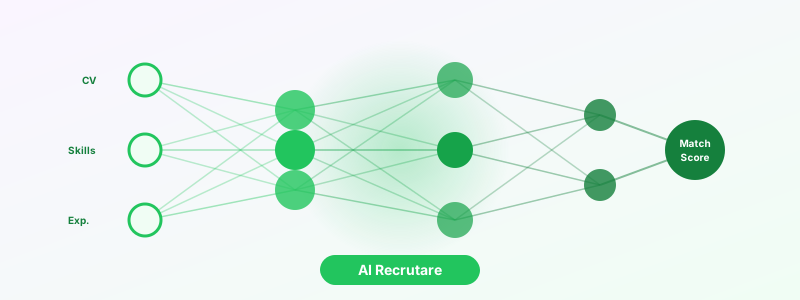
AI candidate screening software automatically evaluates, scores, and ranks job applications as they arrive - ensuring that no qualified candidate gets buried in an unread pile while eliminating hours of manual first-pass review. The technology has matured significantly: modern systems consider context, synonyms, and skill adjacency rather than rigid keyword matching, making AI screening genuinely useful for the first time.
How AI Candidate Scoring Actually Works
How We Evaluated This Topic
This article was developed by reviewing how leading ATS platforms implement automated scoring, drawing on Gartner's HR technology research on AI recruitment tools, SHRM's practitioner guidance on selection procedures, and G2's buyer reviews across the ATS category. Evaluation criteria focused on CV parsing accuracy, threshold configurability, audit logging for compliance, and documented outcomes from teams using AI screening in volume hiring environments.
Findings are most directly applicable to mid-market and enterprise organisations (50-5,000 employees) hiring at moderate-to-high volume in English-speaking markets. AI screening regulations differ significantly by jurisdiction, the US, UK, and EU each impose distinct obligations, and this content should be calibrated accordingly. Specific product capabilities referenced relate to Treegarden's implementation; other platforms vary in their scoring architecture.
Primary sources: SHRM Talent Acquisition Resources; Gartner HR Technology Research; G2 ATS Category Reviews
The mechanics of AI candidate scoring vary between platforms, but the most effective implementations share a common architecture. When a job is created in the ATS, the hiring team defines the role requirements: required skills, preferred experience level, education requirements, and any mandatory criteria (certifications, right to work, specific qualifications). The AI model uses this definition as a scoring rubric.
When a candidate applies and their CV or resume is parsed, the system evaluates:
- Skills match - does the candidate possess the skills listed as required? Does the system recognise equivalent terms (e.g., "machine learning" and "ML", "JavaScript" and "JS")?
- Experience relevance - how closely does the candidate's career history match the role requirements? Years of experience in adjacent fields may count positively.
- Education alignment - where education is a requirement, does the candidate meet it?
- Knockout criteria - if mandatory criteria are not met (right to work eligibility, specific required certification), the candidate is automatically flagged for recruiter review before any progression decision is made.
- Seniority calibration - is the candidate significantly over or under-qualified? A Senior VP applying for an entry-level role scores lower because the fit is poor in both directions.
The output is a numeric score or rank that allows recruiters to prioritise their review queue. Candidates above a configurable threshold are surfaced at the top of the queue for faster human review. Candidates scoring below a configurable threshold are flagged for human review, allowing recruiters to make the final call on whether to progress or decline them.
The Parsing Foundation
AI scoring quality depends directly on CV parsing accuracy. If the parser incorrectly extracts experience data - misreading dates, attributing skills to the wrong employer, or failing to parse non-standard CV formats - the scoring model works from corrupted data. Evaluating any AI screening tool requires testing parsing accuracy across a diverse sample of real CVs, including non-standard formats, non-native language CVs, and career change profiles.
Configurable Thresholds: Score-Based Advancement and Review
The most important operational characteristic of AI screening is configurability. A system that applies a fixed scoring model across all roles is less valuable than one that allows threshold adjustment per job - because hiring requirements vary enormously between roles.
Effective threshold configuration involves:
Advancement threshold: the minimum score at which a candidate is surfaced at the top of the recruiter queue for priority review (typically moving to phone screen or hiring manager stage). Setting this too high means strong candidates who present differently are missed. Setting it too low reduces the benefit of AI prioritisation. Most teams find an initial threshold of 70-75 out of 100 appropriate, adjusted after the first 50 applications.
Review threshold: the score below which a candidate is flagged and deprioritised for human review rather than surfaced in the priority queue. This should be set conservatively - 30-40 is typical - so that genuinely low-fit candidates are clearly separated from strong ones, while a recruiter always makes the final progress or decline decision.
Middle band: candidates between the review threshold and advancement threshold land in a manual review queue. A recruiter reviews these candidates. This preserves human judgment for ambiguous cases while ensuring AI scoring concentrates recruiter attention on the strongest profiles first.
Setting Thresholds for the First Time
When deploying AI screening for the first time, resist the temptation to set aggressive thresholds immediately. Start with a wide manual review band and narrow it after you have calibrated the system against your actual candidate quality expectations. Two to three weeks of data - typically 50-100 applications - provides enough signal to confidently tune thresholds for your specific roles and candidate pool.
What AI Scoring Does Better Than Manual Review
Several recruitment problems are structurally better solved by AI than by humans, even highly skilled ones.
Consistency. A human reviewing 50 CVs in one sitting applies different standards at position 10 than at position 45. Cognitive fatigue, recency bias, and order effects all introduce variation into manual screening. AI applies the same criteria identically to the first and the five hundredth application.
Speed at volume. A recruiter can thoroughly review 15-20 CVs per hour. AI scores 500 in seconds. For roles attracting large application volumes - entry-level positions, well-known employers, high-demand fields - manual screening is simply not fast enough to avoid significant time-to-hire delay.
Pattern recognition across the full pool. AI screening considers the entire applicant pool simultaneously. A human recruiter working through a queue may not notice that the third-highest scoring candidate missed the threshold by one point and is worth a second look. An AI system can flag near-threshold candidates for review automatically.
Audit trail. Every AI scoring decision is logged with the criteria applied. This creates a defensible record of screening decisions - critical for organisations that need to demonstrate non-discriminatory hiring practices under EEOC (US) or Equality Act 2010 (UK) obligations.
Where AI Screening Still Needs Human Oversight
AI screening handles volume and consistency well. It handles nuance poorly. Recognising where human judgment is irreplaceable prevents over-reliance on automated scoring.
Career changers and non-linear paths. Candidates transitioning from adjacent industries - a military officer moving into operations management, a teacher moving into corporate training - may have highly transferable skills that do not surface clearly in a skills-match scoring model. These candidates often require human review of the full CV, not just a score.
Contextual achievement. A CV that lists "increased sales by 30%" scores differently depending on context: was this in a startup or a Fortune 500? In an expanding market or a contracting one? AI cannot assess this context without structured data that most CVs do not contain.
Cultural and team fit signals. Communication style, thoughtfulness of cover letter content, and interpersonal skills visible only through human interaction are not assessable by an AI model reviewing a CV. Human screening for these dimensions remains essential.
Senior and executive roles. For Director, VP, and C-suite roles where the hiring decision has significant organisational impact, AI screening should be used as a prioritisation tool only, not as a gating mechanism. Every applicant at this level warrants human review.
The 80/20 Rule for AI Screening
In practice, AI screening handles the easy 80% of application review by prioritisation: clearly strong candidates are surfaced at the top of the recruiter queue, clearly low-fit candidates are flagged for deprioritised review, and the middle band receives focused human attention. The human effort concentrates on the 20% where context and judgment matter most. This is the correct division of labour - not AI replacing recruiter judgment, but AI ensuring recruiter time goes to the profiles where that judgment adds most value. Every progress or decline decision remains with the recruiter.
Setting Up Auto-Advancement Rules in Your ATS
Auto-advancement configuration typically happens at the job level, with the option to set company-wide defaults. A practical setup workflow:
- Define the job requirements precisely - vague job descriptions produce vague screening. "Strong communication skills" is not scorable. "3+ years of client-facing account management, B2B environment" is.
- Configure knockout questions separately from scoring - eligibility requirements (right to work, minimum qualifications) should be knockout questions, not scoring inputs. A candidate who does not meet a legal employment requirement should be rejected before scoring, not ranked low.
- Set initial thresholds conservatively - use wider manual review bands initially and narrow them as data accumulates.
- Review the below-threshold flagged pool periodically - sampling 10% of candidates flagged below the review threshold for the first month confirms that your thresholds are not incorrectly deprioritising qualified candidates before a recruiter has seen them.
- Audit for disparate impact - check whether your advancement rates differ significantly across demographic groups. If they do, review your scoring criteria for potential proxies for protected characteristics.
Treegarden's AI Auto-Advancement: Configurable by Job or Company-Wide
Treegarden's AI screening module operates on a per-job basis with company-level defaults. When a job is created, the recruiter or hiring manager defines requirements and the AI model generates initial threshold recommendations based on the role category. These can be accepted, adjusted, or overridden.
| Configuration Level | Treegarden Capability | Use Case |
|---|---|---|
| Company-wide defaults | Set baseline thresholds applied to all new jobs | Consistent first-pass screening across all roles |
| Per-job configuration | Override thresholds, requirements, and knockout criteria per role | Senior roles with full manual review, high-volume entry-level with tight priority thresholds for recruiter focus |
| Knockout questions | Mandatory right-to-work and eligibility screening before scoring | UK right to work, US work authorisation, required certifications |
| Bulk CV processing | AI scores up to 50 CVs uploaded simultaneously | Job fair CV piles, agency submissions, campus recruitment |
| Audit logging | Every screening decision logged with criteria applied | EEOC/Equality Act compliance documentation |
The Bias Question: Is AI Screening Fair?
The bias question in AI screening is legitimate and requires a direct answer. AI models trained on historical hiring data can encode the biases of past hiring decisions - if your company historically hired primarily from certain universities or with certain career paths, a model trained on those hires will perpetuate those patterns.
The regulatory landscape is evolving rapidly. In the US, the EEOC has issued guidance on AI in employment that requires employers to monitor for disparate impact - the same standard applied to all selection tools. New York City's Local Law 144 (effective 2023) requires annual bias audits of AI employment tools and public disclosure of audit results.
In the UK, the Equality Act 2010 prohibits both direct discrimination and indirect discrimination - meaning a screening criterion that is applied equally to all candidates but disproportionately disadvantages a protected group is unlawful unless objectively justified.
Best practices for fair AI screening:
- Use AI scoring as a prioritisation tool, not the sole screening mechanism
- Ensure demographic data is never an input to the scoring model
- Audit advancement rates by demographic group quarterly
- Maintain a human-review path for candidates below the advancement threshold who are flagged as borderline
- Document your screening methodology for audit purposes
Free Calculators for This Topic
Save time with these free HR calculators - no sign-up required:
Frequently Asked Questions
Does AI screening automatically reject candidates?
The AI never rejects anyone - it is purely advisory, scoring and ranking applicants and flagging low-scoring ones for human review. The only automatic rejections in Treegarden happen under optional rules an employer sets when creating a job, based on criteria and thresholds they define - the AI never rejects anyone on its own, a human review queue is available as a gate, and every AI-influenced decision is audit-logged. See the full governance model on the AI recruitment software page. This design is fully compliant with GDPR Article 22, which prohibits solely automated decisions with significant effects on individuals.
Is AI candidate screening legal?
Yes, with appropriate configuration and oversight. In the US, AI screening tools must comply with EEOC guidelines on employment selection procedures, including monitoring for adverse impact. In New York City, employers using AI tools in hiring must conduct and disclose annual bias audits. In the UK, AI screening must comply with GDPR (automated decision-making provisions) and the Equality Act 2010. Treegarden's AI screening is designed with these compliance requirements in mind.
Can AI screening disadvantage candidates with non-standard CVs?
Poorly designed AI screening can. The risk is greatest for candidates with career gaps, non-linear career paths, or CVs in formats that parse badly. Best-in-class systems use robust parsing that handles diverse CV formats, and maintain a manual review buffer for candidates near the threshold. Regular auditing of below-threshold candidates flagged for recruiter review identifies and corrects any systematic parsing failures.
How is AI scoring different from keyword matching?
Keyword matching looks for exact or near-exact term matches. AI scoring considers context, synonyms, skill adjacency, and experience relevance. A keyword matcher might reject a Python developer whose CV lists "data science" instead of "Python" explicitly. An AI model recognises the skill adjacency. AI scoring also considers the totality of a candidate's profile rather than counting keyword occurrences.
How quickly does AI screening process applications?
Modern AI screening processes individual applications in seconds and bulk CV uploads (50 CVs) in under a minute. From the recruiter's perspective, a scored and ranked candidate queue is available immediately after each application is received - there is no batch processing delay.
Making AI Screening Work for Your Hiring Process
AI candidate screening is not a replacement for recruiter judgment - it is an amplifier of it. Used correctly, it ensures that the candidates recruiters spend time on are the ones worth spending time on, and that no qualified candidate is overlooked simply because the application volume was too high to review manually.
Treegarden's AI screening is configurable by job, auditable for compliance, and integrated with bulk CV parsing to handle any application volume. The AI is always advisory - it scores and prioritises candidates within criteria your team defines, and every progress or decline decision remains with your recruiters. The AI never automatically rejects candidates - the only automatic declines come from knockout rules you define yourself at job creation - which keeps AI-driven decisions within GDPR Article 22.
Book a demo to see AI scoring configured live for a role typical to your hiring programme.
Sources
- The Impact of Generative AI on Human Resources (McKinsey), talent acquisition holds the largest AI value potential in HR; data on AI use in job posting, screening, and skills-based hiring
- Recruiters Shift Toward Responsible AI in Talent Acquisition (HR Dive), 2025 survey showing 67% of TA leaders plan to increase tech spending with growing focus on fairness and transparency
- How AI Will Affect Work Across Industries (World Economic Forum), industry leaders on AI reshaping talent strategies, citing WEF Future of Jobs 2025 findings on role creation and displacement