
A candidate experience survey asks applicants how the hiring process worked for them, not whether they deserved the outcome. Use a short questionnaire after an interview milestone, rejection or withdrawal, then connect the feedback to a specific process change. Below are three original, copy-ready questionnaires, an editable analysis worksheet and a clearly fictional worked example.
Published and updated: . Sources checked on October 14, 2026. By Treegarden. The questions, timing suggestions and examples are original recommendations, not validated scales, universal benchmarks or customer results.
Download the candidate experience survey templates
The ungated Word pack contains all three questionnaires with blank answer spaces, distribution instructions, a blank analysis worksheet and the fictional example below. The CSV contains the same question bank and response options, blank worksheet fields and labeled fictional aggregate records. It is a plain-text planning template, not a survey application or an automatically calculating workbook. No email address is needed to download either file.
Choose the group before you send
Decide what you want to improve: preparation, communication, interview participation or closure. Do not collect a satisfaction score without an owner who can act on it. Your candidate experience process should specify who communicates each milestone, what candidates are told and how feedback reaches the person responsible for that step.
For this template, assign each application to one group at the survey snapshot. Rejected means the employer ended the application; withdrawn means the candidate ended it. Use interviewed for candidates who completed at least one interview and are in neither of those groups, including those continuing or hired. Give rejection or withdrawal status priority over interview attendance. Record the stage reached separately, so an early rejection is not silently compared with a final-stage rejection.
Use one invitation per application in the reporting period. If you intentionally run a longitudinal programme, identify the separate waves and do not count the same application as several independent candidates. These templates use the application as the reporting unit; disclose that choice if one person can apply for several roles.
Three copy-ready candidate questionnaires
The first four rating questions and two open questions are identical in all versions. Keep their wording, order and scale stable if you want to track changes. Pew Research Center's question-writing guidance explains how wording and question order can affect answers and why pretesting matters. Pilot your chosen version with people who can check its meaning, mobile layout and completion burden before sending it broadly.
Opening text for every version
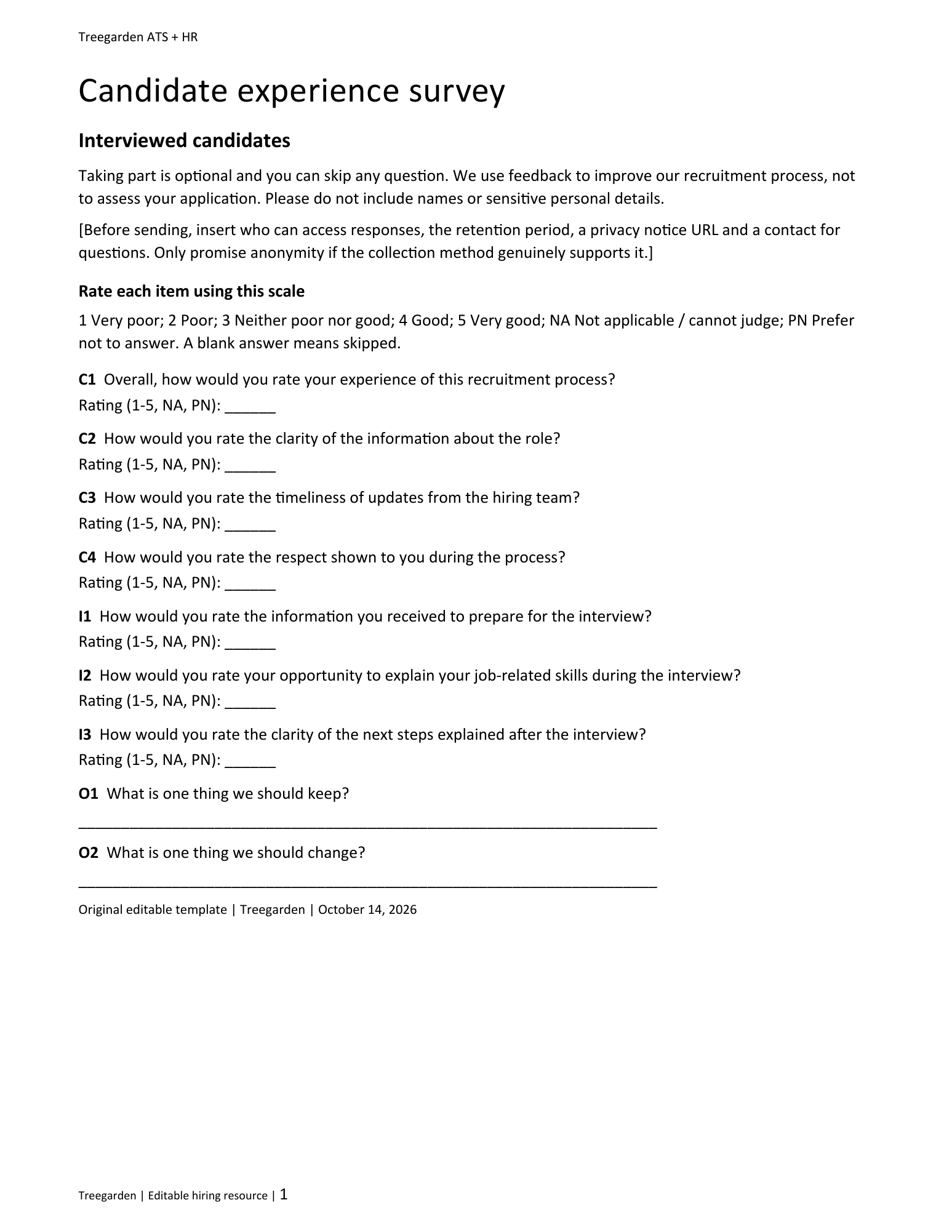
Taking part is optional and you can skip any question. We use feedback to improve our recruitment process, not to assess your application. Please do not include names or sensitive personal details.
[Before sending, insert who can access responses, the retention period, a privacy notice URL and a contact for questions. Only promise anonymity if the collection method genuinely supports it.]
Use this opening only after putting the stated separation from selection decisions into practice. Do not give interviewers identifiable feedback while they are deciding an application. If you cannot separate access, collect feedback after that decision instead.
Response scale for every rating question
1 Very poor; 2 Poor; 3 Neither poor nor good; 4 Good; 5 Very good; NA Not applicable / cannot judge; PN Prefer not to answer. Every question is optional. A blank answer means skipped, not neutral. For the feedback-usefulness question, choose NA if no feedback was received. Text questions accept an optional written response. The withdrawal-reason question is single choice and has its own options.
Interviewed candidates
| ID | Question | Response options |
|---|---|---|
| C1 | Overall, how would you rate your experience of this recruitment process? | Rating: 1-5, NA or PN. Use the scale above. |
| C2 | How would you rate the clarity of the information about the role? | Rating: 1-5, NA or PN. Use the scale above. |
| C3 | How would you rate the timeliness of updates from the hiring team? | Rating: 1-5, NA or PN. Use the scale above. |
| C4 | How would you rate the respect shown to you during the process? | Rating: 1-5, NA or PN. Use the scale above. |
| I1 | How would you rate the information you received to prepare for the interview? | Rating: 1-5, NA or PN. Use the scale above. |
| I2 | How would you rate your opportunity to explain your job-related skills during the interview? | Rating: 1-5, NA or PN. Use the scale above. |
| I3 | How would you rate the clarity of the next steps explained after the interview? | Rating: 1-5, NA or PN. Use the scale above. |
| O1 | What is one thing we should keep? | Optional written response |
| O2 | What is one thing we should change? | Optional written response |
Rejected candidates
| ID | Question | Response options |
|---|---|---|
| C1 | Overall, how would you rate your experience of this recruitment process? | Rating: 1-5, NA or PN. Use the scale above. |
| C2 | How would you rate the clarity of the information about the role? | Rating: 1-5, NA or PN. Use the scale above. |
| C3 | How would you rate the timeliness of updates from the hiring team? | Rating: 1-5, NA or PN. Use the scale above. |
| C4 | How would you rate the respect shown to you during the process? | Rating: 1-5, NA or PN. Use the scale above. |
| R1 | How would you rate the clarity of the message communicating our decision? | Rating: 1-5, NA or PN. Use the scale above. |
| R2 | How would you rate the usefulness of any feedback you received? | Rating: 1-5, NA or PN. Choose NA if no feedback was received. |
| O1 | What is one thing we should keep? | Optional written response |
| O2 | What is one thing we should change? | Optional written response |
Withdrawn candidates
| ID | Question | Response options |
|---|---|---|
| C1 | Overall, how would you rate your experience of this recruitment process? | Rating: 1-5, NA or PN. Use the scale above. |
| C2 | How would you rate the clarity of the information about the role? | Rating: 1-5, NA or PN. Use the scale above. |
| C3 | How would you rate the timeliness of updates from the hiring team? | Rating: 1-5, NA or PN. Use the scale above. |
| C4 | How would you rate the respect shown to you during the process? | Rating: 1-5, NA or PN. Use the scale above. |
| W1 | How would you rate the clarity of the expected time commitment for the process? | Rating: 1-5, NA or PN. Use the scale above. |
| W2 | How would you rate the response to your withdrawal? | Rating: 1-5, NA or PN. Choose NA if you cannot judge the response. |
| W3 | What was the main reason you chose to withdraw? | Accepted another role | Role was not a match | Pay or benefits | Location or working arrangement | Time required by the process | Lack of updates | Personal circumstances | Other | Prefer not to answer |
| O1 | What is one thing we should keep? | Optional written response |
| O2 | What is one thing we should change? | Optional written response |
For rejection feedback, ask about the clarity of the communication and usefulness of any feedback, not whether the candidate agrees with the decision. For withdrawal, keep a neutral list of possible reasons and let people decline to answer. A reason such as another offer is context, not proof that one team caused the withdrawal.
Distribute without adding pressure
Use the following as an operating recommendation, not a research-backed optimum: send the invitation one or two business days after the relevant milestone, leave it open for ten days, and send at most one reminder after five to seven days. Test whether that schedule fits your volume and candidate communications. Keep the trigger and window consistent when comparing periods.
- Interviewed: send after the agreed interview milestone. If the application remains active, explain the separation from the selection decision and restrict access accordingly.
- Rejected: communicate the decision first. Send the optional survey separately; the survey must not be the first indication that the application has ended.
- Withdrawn: acknowledge the withdrawal first. Invite feedback without asking the candidate to defend their choice or re-enter the process.
- Coverage: invite every eligible application in your defined cohort, or document a sampling rule before seeing responses. Do not handpick candidates who seemed happy.
- Delivery: use an accessible external survey tool or manual collection method. Test the link, keyboard navigation, screen-reader labels and mobile view. Offer an alternative response channel where feasible.
- Privacy: collect only what is needed. Email reply surveys and individually tracked links are not automatically anonymous. Check whether the tool records identity, IP addresses or link tokens; explain actual access and retention before launch.
- Follow-up: use a monitored contact for urgent concerns. Do not ask for health details or other sensitive information in open comments. Restrict and redact identifying comments before sharing themes.
Editable invitation
Subject: Optional feedback on our recruitment process
Thank you for the time you spent in our recruitment process. We would welcome feedback about the process itself. Taking part is optional, and you can skip any question. Your feedback will not be used to assess your application.
Survey: [survey link]
Closes: [date]
Who can access responses and how long we keep them: [details]
Privacy notice and questions: [URL and monitored contact]
Please do not include names or sensitive personal details. Thank you for helping us identify what to keep and what to change.
Remove every placeholder and test the collection method before sending. Keep the invitation separate from marketing consent, referral requests and sales messages. A feedback invitation is not a new lead-capture opportunity.
Analyse with explicit denominators
AAPOR's survey best practices emphasise clear questions, suitable response options, transparent methods and care with respondent confidentiality. These candidate questionnaires are voluntary operational feedback, not a probability sample. They describe respondents; they do not establish what all candidates think.
Operational response rate
Response rate = unique responding applications / unique eligible invited applications. A responding application submitted at least one rating of 1-5, a withdrawal reason other than PN, or a nonblank open response. A submission containing only NA, PN or blanks is not a response under this definition. Partial substantive submissions count once. Opening the link does not count.
Keep eligible invitations with bounced or undeliverable messages in this denominator and report that delivery count separately. Deduplicate reminders and repeated submissions using a rule fixed in advance, such as retaining the latest substantive submission per application. This is our operational definition, not a claim to an AAPOR-standardised response-rate estimate. If your tool cannot deduplicate without linking identities, choose and disclose the trade-off rather than promising both perfect anonymity and unique-response enforcement.
Item favorable rate
Favorable rate for one rating item = responses of 4 or 5 / valid responses of 1-5 to that item. Exclude NA, PN, blanks and invalid values from that item's denominator, but report each excluded count. Keep neutral responses of 3 in the denominator. Do not turn NA into a zero, infer that a blank is dissatisfaction or carry a score forward from another item.
Report the five rating counts as well as the favorable fraction. If an item has no valid ratings, show not calculable, not 0%. Do not average percentages across groups; add the item numerators and valid denominators if a combined figure is genuinely useful, and still show the groups. Keep open comments and withdrawal reasons separate from the rating calculation.
Blank analysis worksheet
Complete one copy for each cohort and rating item. Invitation and respondent counts belong to the cohort; do not add them across item worksheets. The downloadable CSV uses these same field names and leaves the entry column blank.
| Field | Blank entry | Instruction |
|---|---|---|
| Reporting period and questionnaire version | ________________ | Record invitation dates, closing date, wording version and collection method. |
| Cohort and stage reached | ________________ | Use one snapshot group; record stage and process version for like-for-like comparisons. |
| Unique eligible invited applications | ________________ | Include bounced invitations; do not count reminders twice. |
| Undeliverable invitations | ________________ | Report separately without removing them from eligible invited applications. |
| Unique responding applications | ________________ | At least one rating of 1-5, a withdrawal reason other than PN, or a nonblank open response; include partial substantive submissions once. NA/PN-only submissions do not count. |
| Operational response rate | ________________ | Respondents divided by eligible invited applications; not calculable if denominator is zero. |
| Rating item ID | ________________ | Use the stable question ID, such as C3; complete one worksheet per cohort and item. |
| Counts for ratings 1 through 5 | ________________ | Record all five counts, including zero counts. |
| NA count | ________________ | Not applicable / cannot judge; exclude from valid ratings. |
| PN count | ________________ | Prefer not to answer; exclude from valid ratings. |
| Missing and invalid counts | ________________ | Record each separately; exclude from valid ratings and investigate invalid entries. |
| Favorable numerator | ________________ | Count ratings of 4 or 5 for this item only. |
| Valid rating denominator | ________________ | Count ratings of 1 through 5 for this item only. |
| Item favorable rate | ________________ | Favorable numerator divided by valid rating denominator; not calculable if denominator is zero. |
| Themes and limitations | ________________ | Code optional comments separately; note coverage, stage mix, small samples and missing voices. |
| Action owner and review date | ________________ | Record evidence to inspect, a concrete change, the owner and a review date. |
Small samples and missing voices
There is no universal favorable-rate target or safe minimum sample size in this pack. With five valid ratings, one person's answer changes the favorable rate by twenty percentage points. Report the count and avoid league tables for such small groups. Choose disclosure and aggregation rules with your privacy owner before sharing results; a tiny team or distinctive comment can identify someone even without a name.
Low or uneven response rates can leave important experiences unheard. A high rate does not by itself prove representativeness. Compare only similar stages and process versions, review the invitation coverage, and look for patterns in operational records such as update timestamps. Do not claim a margin of sampling error for an opt-in feedback collection, or treat a change between two small cohorts as proof that an intervention caused it.
Fictional worked analysis
All applications, counts and outcomes in this example are fictional. They are neither Treegarden customer data nor a hiring benchmark. Imagine a reporting period with one invitation per application and three mutually exclusive groups under the snapshot rule above. All 120 invitations were deliverable, and 48 applications submitted at least one substantive answer.
| Group | Responses / invited | C3 ratings 1 / 2 / 3 / 4 / 5 | NA / PN / missing / invalid | C3 favorable / valid |
|---|---|---|---|---|
| Interviewed | 20 / 40 = 50.0% | 2 / 3 / 4 / 6 / 3 | 1 / 0 / 1 / 0 | 9 / 18 = 50.0% |
| Rejected | 18 / 60 = 30.0% | 4 / 3 / 2 / 4 / 2 | 1 / 1 / 1 / 0 | 6 / 15 = 40.0% |
| Withdrawn | 10 / 20 = 50.0% | 3 / 2 / 1 / 1 / 1 | 1 / 0 / 1 / 0 | 2 / 8 = 25.0% |
The overall operational response rate is 48 / 120 = 40.0%. For C3, the timeliness of updates, the combined item favorable rate is 17 / 41 = 41.5%, not 17 / 48. The seven excluded C3 answers comprise three NA, one PN and three missing answers. This combination is a summary of respondents to one item, not a verdict on all candidates or a substitute for the separate groups.
On R2, feedback usefulness, the 18 rejected respondents gave five valid ratings: 1 Very poor, 1 Poor, 1 Neither poor nor good, 1 Good and 1 Very good. Ten chose NA, one chose PN and two skipped the question. The favorable rate is 2 / 5 = 40.0%, but a five-answer denominator is too fragile for a confident ranking. NA can mean no feedback or an inability to judge; the questionnaire does not distinguish those explanations.
For W3, the ten withdrawn respondents selected another role (4), role not a match (2), time required by the process (2), lack of updates (1), and PN (1). There are nine substantive reason answers. These counts describe the responding withdrawn applications only, not all twenty invited applications. Do not recode PN as a business reason or assume each withdrawal had only one cause because the question requested the main reason.
Turn feedback into specific actions
In the fictional example, C3 deserves investigation because the ratings point to update timing across groups, while R2 has a particularly small valid denominator. Investigate before naming a cause. The following actions are recommendations, not promised improvements.
- Recruiting operations owner: audit promised update dates against sent-message timestamps for the reporting period. Separate missed updates, messages that failed delivery and updates sent on time that candidates found unclear. Record what evidence supports each explanation.
- Hiring manager and recruiter: agree an update owner and a realistic next-update date at every interview milestone. Use the interview debrief agenda to record who will contact the candidate even when the decision is still pending.
- Candidate communications owner: review the rejection message and feedback policy. Check whether feedback is offered consistently at the same stage. Do not conclude that the ten NA answers mean ten people were denied feedback.
- Process owner: inspect the workload behind the two time-commitment withdrawal reasons. Check whether the expected interview and exercise time was explained before asking candidates to commit. Do not change the entire assessment on two responses alone.
- Survey owner: log the change, owner and review date. Run the next comparable cohort with the same questions and report counts, response coverage and limitations again. Review operational delivery evidence alongside ratings; an apparent percentage increase alone does not establish success.
Blank action record
Evidence to inspect: [blank]
Process change: [blank]
Owner and review date: [blank]
Keep survey answers out of individual candidate scorecards. Job-related interview evidence belongs in the selection record: OPM's structured-interview guidance uses predetermined questions and consistent rating standards, and its practical guide covers developing and administering that process. The EEOC's selection-procedure guidance addresses job-related selection and discrimination risks. A satisfaction survey is not a substitute for a review of selection fairness.
Treegarden sells ATS and HR software and has a commercial interest in recruitment workflows. These templates can be used with a separate survey tool or manual collection. This article does not claim Treegarden includes native candidate surveys. Review interview management for the adjacent interview workflow and ask to see any required capability before relying on it.
Sources and editorial notes
- AAPOR: Best Practices for Survey Research supports questionnaire design, transparent collection and careful reporting. Our operating formulas and timing choices are explicitly defined recommendations, not AAPOR-certified measures.
- Pew Research Center: Writing Survey Questions supports pretesting and attention to wording, response options and order effects. The questions in this pack are Treegarden originals, not a validated Pew instrument.
- OPM: Structured Interviews and Structured Interviews: A Practical Guide support the distinction between structured job-related assessment and process feedback. The guide is dated September 2008, not new research from 2026.
- EEOC: Employment Tests and Selection Procedures is US guidance on selection procedures. This article is practical process guidance, not a jurisdiction-specific legal assessment.
All linked primary-source pages were opened on October 14, 2026. The questionnaires, invitation, worksheet, fictional numbers and action plan were created for this article. No competitor downloads, customer testimonials, industry-average scores or universal hiring thresholds were used.