
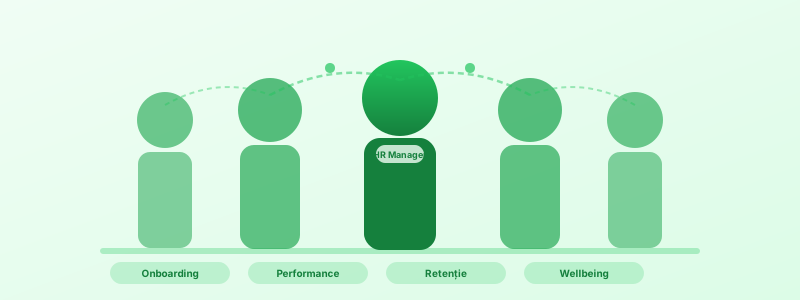
Employee engagement software is one of the most crowded categories in HR technology, and one of the most misunderstood. Buyers often expect a single platform to measure sentiment, fix culture, run hiring, and manage day-to-day people operations. In reality these are different jobs handled by different tools. This guide explains what engagement software actually is, what the evidence says about whether it moves the metrics that matter, and where an ATS plus HR platform like Treegarden fits honestly into the picture. To be clear up front: Treegarden is an applicant tracking system with an HR module, not a dedicated engagement or pulse-survey product, and the sections below are careful about that distinction.
The context is real. Gallup's State of the Global Workplace: 2024 report found that only 23% of employees worldwide are engaged, while 62% are not engaged and 15% are actively disengaged. Gallup estimated that low engagement and lost productivity cost the global economy about $8.9 trillion, equivalent to roughly 9% of global GDP. Those numbers explain why the category exists. They do not, on their own, tell you which tool to buy.
What Employee Engagement Software Actually Is
Dedicated employee engagement software is built around one core job: measuring how committed, motivated and supported employees feel, then helping managers act on what the data shows. The established products in this space, such as Culture Amp, Glint and Officevibe, typically share a recognisable feature set:
- Engagement and pulse surveys. Recurring questionnaires, from short weekly pulses to annual census surveys, that track sentiment over time.
- Driver analysis. Statistical breakdowns that show which factors, such as workload, recognition or manager support, correlate most strongly with overall engagement.
- Manager dashboards and action planning. Team-level views that let a manager see their own results and document follow-up commitments.
- Recognition and feedback feeds. Lightweight tools for peer recognition and continuous feedback between formal review cycles.
- Benchmarking. Comparison of scores against an industry or company-size reference group.
This is a distinct category from an applicant tracking system, which manages hiring, and from a core HR system or HRIS, which manages records, leave and onboarding. A platform can do one of these jobs well without doing the others. Treegarden sits in the ATS plus HR space: it does not ship a pulse-survey engine or a driver-analysis dashboard, and this article will not pretend otherwise.
Where Treegarden fits
Treegarden is an ATS plus HR platform, not a survey tool. It shapes the parts of the employee experience that hiring and onboarding own: a fast, transparent candidate journey, structured interviews, AI candidate matching, and a clean onboarding handoff. For recurring engagement measurement, pair it with a dedicated survey product.
Does Engagement Software Actually Move the Needle?
The honest answer is: sometimes, and mostly because of what people do with the data, not the data itself. The single most robust finding in engagement research is about managers. Gallup concluded that managers account for at least 70% of the variance in team engagement scores, a finding published in its analysis of what drives engagement across business units. In other words, the differences in engagement between teams in the same company are explained mostly by who the manager is, not by perks, pay band or the survey tool in use.
This has a blunt implication for buyers. Software that collects sentiment but never reaches the manager who can act on it tends to produce dashboards, not change. The platforms that help are the ones that close the loop: they put team-level results in front of the relevant manager and make follow-up visible. A tool is necessary infrastructure for measuring at scale, but the measured improvement comes from the management response, not the questionnaire.
Key Insight
Per Gallup, managers account for at least 70% of the variance in team engagement. Any engagement investment that does not route data to managers and hold them accountable for follow-through is addressing the smaller part of the problem.
The Engagement Metrics Worth Tracking
If you do adopt a dedicated engagement tool, a few metrics carry more signal than a generic satisfaction score. Employee net promoter score (eNPS) captures willingness to recommend the employer. Intent to stay is a direct, leading indicator of voluntary turnover. Manager support and workload sustainability are among the strongest engagement drivers and are specific enough to act on. Recognition frequency is a useful behavioural proxy because it can be observed rather than self-reported.
The trap to avoid is measuring everything and changing nothing. A short survey that a team actually discusses and acts on beats a long survey that produces a report nobody opens. Whatever tool you choose, judge it on whether it makes the next management conversation easier, not on the size of its question bank.
How Engagement Connects to Retention and Hiring
Engagement and recruitment are linked in both directions. High turnover forces constant re-hiring, and the cost of replacing an employee is widely estimated at one-half to two times the role's annual salary, a range Gallup and others cite when quantifying attrition. Reducing avoidable departures is therefore one of the clearest financial cases for taking engagement seriously.
The link runs the other way too. The employee experience starts before day one, in the hiring process, and a slow, opaque or disrespectful candidate journey sets a poor tone that onboarding then has to repair. This is the part of engagement that an ATS genuinely owns. Treegarden's contribution here is concrete rather than aspirational: structured interviews that keep evaluation fair and consistent, AI candidate matching and scoring through Edera AI to surface relevant applicants faster, a Kanban pipeline that keeps candidates moving instead of stalling, bulk CV upload to cut administrative drag, and custom career pages that present the employer honestly. A smoother hire and a clean onboarding handoff do not replace an engagement programme, but they remove early friction that quietly erodes it.
Choosing the Right Tools for Your Stack
For most UK and US small and mid-sized businesses, the practical answer is a small stack of focused tools rather than one platform that claims to do everything. A dedicated engagement product handles recurring surveys and driver analysis. An ATS plus HR platform handles hiring, onboarding and core people operations. Integrating the two gives you the sentiment data and the operational data without forcing either tool to do a job it was not built for.
Treegarden is built for the second role. It is aimed at companies of roughly 10 to 500 employees and combines applicant tracking with an HR module under transparent pricing. Plans start at $299 per month (Startup), $499 per month (Growth) and $899 per month (Scale), with UK pricing at £235, £395 and £710 per month and custom pricing for Enterprise. There is no free plan; evaluation is a guided demo with a sandbox available on request, so you can see the product against your own workflow before committing.
What Treegarden actually does
AI candidate matching and scoring (Edera AI), a Kanban hiring pipeline, bulk CV upload, custom career pages, structured interviews, an HR module, and GDPR-compliant data handling. It is an ATS plus HR platform, not a pulse-survey or engagement-analytics tool.
The point is not that one tool is better than another, but that the categories are different. Asking an ATS to run your engagement survey programme, or asking a survey tool to run your hiring, leads to disappointment in both directions. Match the tool to the job.
Building an Engagement Strategy That Outlasts Any Software
Software is infrastructure, not strategy. Because managers explain most of the variance in engagement, the highest-leverage work is rarely a procurement decision. It is clarifying expectations for managers, giving them their own team's data, and holding them accountable for acting on it. A survey tool can surface a declining workload-sustainability score, but only the manager and the organisation around them can change the workload.
A sensible sequence is straightforward. Establish a baseline before buying anything, so you can tell later whether a tool helped. Keep surveys short enough that teams actually discuss the results. Make managers, not HR, the primary owners of the follow-up, with HR setting the framework and supplying the data. And treat the candidate and onboarding experience as part of the same system, since engagement does not begin on an employee's first day of work but during the process that brought them in. Done in that order, the tooling supports the strategy instead of standing in for it.
Free Calculators for This Topic
Save time with these free HR calculators - no sign-up required:
Calculating the ROI of Engagement Work
Engagement is often dismissed as a soft investment, hard to justify on a balance sheet. The return is more quantifiable than that reputation suggests, provided you tie it to the right output metrics. The primary financial lever is voluntary turnover reduction. Because replacing an employee typically costs between one-half and two times their annual salary, even a few percentage points off your attrition rate can fund a measurement tool several times over for a company of a couple hundred people. The exact figure depends on your roles and salaries, so model it with your own numbers rather than a borrowed headline.
Productivity is the second lever. Gallup's Q12 meta-analysis of more than 112,000 teams found that highly engaged business units deliver 14% to 18% higher productivity and 23% higher profitability than disengaged ones. Those are correlations across many organisations rather than a guaranteed result for any single company, but they show why the category attracts investment: the gap between an engaged and a disengaged team is large and measurable.
Build the business case the same way regardless of which tools you choose. Establish a baseline first, including your current voluntary turnover rate and whatever productivity or quality measures fit your context. Then track the same metrics quarterly for a year. The discipline of measuring before and after is what separates a defensible investment from a hopeful one, and it works whether the improvement comes from a survey platform, a hiring process change, or better management.
Manager Effectiveness Is the Central Variable
The most consistent finding across engagement research is that manager quality explains more variance in employee engagement than any other single factor. As noted above, Gallup attributes at least 70% of the variance in team engagement scores to the direct manager. The implication for buyers is direct: an engagement investment that does not reach managers and change how they lead is addressing the smaller part of the problem, no matter how sophisticated the software.
This is also where measurement and accountability meet. Useful engagement tools give managers visibility into their own team's results, not just company-wide aggregates. When a manager can see that their team's workload-sustainability score has slipped over two months, they have something specific to act on. But the tool only surfaces the issue; the manager and the organisation around them have to respond. That response, not the dashboard, is what moves the score.
Design any engagement programme so that managers, not HR, own the outcomes for their teams. HR sets the framework, supplies the data and provides the tools. Managers own the conversations, the action plans and the follow-through. This ownership model is consistently associated with more sustained improvement than HR-run programmes that managers take part in passively. It is a management practice supported by tooling, not a tooling problem solved by procurement.
Frequently Asked Questions
What is employee engagement software?
It is a category of HR tooling built to measure how committed and motivated employees feel, usually through pulse surveys, annual engagement surveys, recognition feeds and analytics dashboards. It is distinct from an ATS or core HR system: a dedicated engagement platform specialises in sentiment measurement, while an ATS plus HR platform like Treegarden focuses on hiring, onboarding and core people operations.
Does Treegarden include a pulse-survey or engagement-survey engine?
No. Treegarden is an ATS plus HR platform for UK and US small and mid-sized businesses, not a dedicated engagement-survey tool. It improves the candidate and new-hire experience through structured hiring, AI candidate matching, a Kanban pipeline and an HR module, but it does not ship a pulse-survey engine. If you need recurring engagement surveys, pair Treegarden with a specialist survey product.
How much does Treegarden cost?
Pricing starts at $299 per month (Startup), $499 per month (Growth) and $899 per month (Scale) in USD, with UK pricing at £235, £395 and £710 per month. Enterprise pricing is custom. There is no free plan; evaluation is a guided demo plus a sandbox on request.
Employee engagement matters, but the tooling around it is often oversold. The evidence is clear that managers explain most of the variance in engagement, which means the highest-leverage work is management practice supported by the right tool, not the tool by itself. Choose a dedicated engagement product for surveys and driver analysis, and an ATS plus HR platform for hiring, onboarding and people operations. Treegarden is built for the second job: structured hiring, AI candidate matching, a Kanban pipeline and an HR module for UK and US small and mid-sized businesses, with transparent pricing from $299 per month and no free plan. If that is the part of the employee experience you are trying to improve, book a demo to see it against your own workflow.