
A hiring-manager intake meeting aligns the recruiter and manager on what a new hire must achieve, which requirements matter and how the team will evaluate candidates. Use the agenda and blank form below before sourcing begins. Finish with named owners, approved compensation parameters, interview responsibilities and a clear feedback timetable rather than an unprioritized wish list.
Published and last verified: October 14, 2026. Prepared by Treegarden. The templates and completed scenario are original examples, not customer records or legal advice.
What the intake meeting should decide
The intake is a working discussion about the role, not a substitute for headcount or budget approval. Resolve approval through your existing process; see the separate job-requisition approval workflow for that intent.
Prepare the role's business reason, reporting line, work location, compensation parameters and draft requirements. Identify what is already approved and what still needs an owner decision. Do not advertise unresolved terms as settled facts.
A practical 40-minute meeting agenda
| Time | Discussion | Output |
|---|---|---|
| 0-5 minutes | Why the role exists; approval status; reporting line. | Business reason and unresolved approvals. |
| 5-15 minutes | First 90-day outcomes; required versus trainable skills. | Prioritized outcomes and job-related criteria. |
| 15-22 minutes | Location, schedule, compensation budget and candidate questions. | Approved parameters and escalation owner. |
| 22-32 minutes | Interview stages, assessment evidence and team responsibilities. | Stage owners and evidence to collect. |
| 32-37 minutes | Sourcing hypotheses, process constraints and feedback expectations. | Initial search direction and response timetable. |
| 37-40 minutes | Read back decisions and remaining questions. | Named actions, dates and next review. |
The timing is an illustrative facilitation plan, not a benchmark. Shorten it for a familiar role or schedule a second discussion when important decisions remain open.
Intake questions for recruiters and hiring managers
Role outcomes and requirements
- What problem must this person solve, and why now?
- What would successful work look like after 30, 60 and 90 days?
- Which skills are necessary on day one, and which can be learned?
- What evidence would distinguish adequate from strong performance?
- Are degrees, years of experience or specific employer backgrounds genuinely necessary for the work?
Working conditions and compensation
- Where is the work performed, and what schedule or travel is actually required?
- What compensation budget is approved, who can approve changes and what can be communicated externally?
- Which requirements or disclosures vary by the job's US location?
- Who will answer candidate accommodation or process-access questions?
Interview and decision responsibilities
- Which interviewer owns each criterion, and which questions will collect relevant evidence?
- What will the team record before discussing candidates together?
- Who makes the final decision, and how are conflicting assessments resolved?
- When must interviewers return feedback, and who follows up when it is missing?
- Who tells candidates about next steps, delays or decisions?
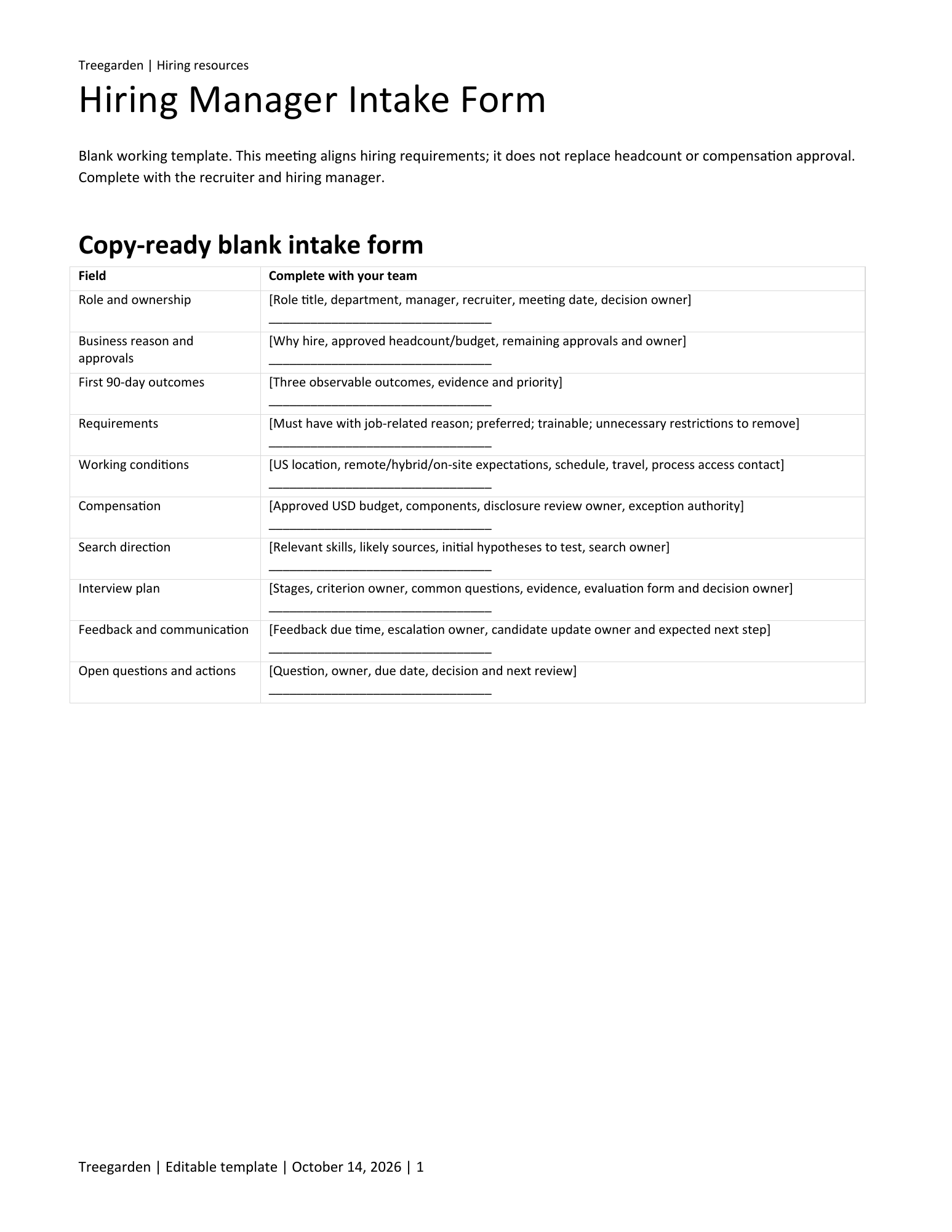
Copy-ready blank intake form
| Field | Complete with your team |
|---|---|
| Role and ownership | [Role title, department, manager, recruiter, meeting date, decision owner] |
| Business reason and approvals | [Why hire, approved headcount/budget, remaining approvals and owner] |
| First 90-day outcomes | [Three observable outcomes, evidence and priority] |
| Requirements | [Must have with job-related reason; preferred; trainable; unnecessary restrictions to remove] |
| Working conditions | [US location, remote/hybrid/on-site expectations, schedule, travel, process access contact] |
| Compensation | [Approved USD budget, components, disclosure review owner, exception authority] |
| Search direction | [Relevant skills, likely sources, initial hypotheses to test, search owner] |
| Interview plan | [Stages, criterion owner, common questions, evidence, evaluation form and decision owner] |
| Feedback and communication | [Feedback due time, escalation owner, candidate update owner and expected next step] |
| Open questions and actions | [Question, owner, due date, decision and next review] |
Fictional completed intake example
Illustrative only: Harbor Desk is an invented US business hiring a customer-support team lead. The budget, responsibilities and time expectations below are example inputs, not salary benchmarks, customer outcomes or Treegarden commitments.
- Ownership: Customer Support Team Lead; hiring manager Alex; recruiter Morgan; final decision by the support director.
- Business reason: establish consistent queue ownership and coaching for a growing support team. Headcount and example budget are approved; travel expectations require confirmation before advertising.
- 90-day outcomes: document escalation ownership; run a weekly coaching review; present a baseline queue report with agreed definitions. No invented percentage improvement is promised.
- Must have: evidence of handling escalations and coaching colleagues. Preferred: familiarity with the team's ticketing tool. Trainable: the specific product. A particular degree or previous employer is not required in this scenario.
- Working conditions: US-based remote role with an agreed Eastern Time overlap; final schedule wording to be checked with HR.
- Compensation: fictional approved base budget of $85,000-$100,000 USD per year, excluding benefits. HR reviews applicable location disclosures; the director owns exceptions.
| Stage | Owner and evidence | Feedback expectation |
|---|---|---|
| Recruiter conversation | Morgan confirms role expectations, availability and candidate questions. | Record factual notes and unanswered questions. |
| Structured manager interview | Alex asks common escalation and coaching questions; records examples against anchored criteria. | Complete the evaluation form before the debrief; fictional target: next business day. |
| Role-related scenario | Panel discusses an ambiguous queue escalation using the same brief and scoring anchors. | Separate observed evidence from assumptions; offer a process-access contact. |
| Decision discussion | Support director reviews criterion-level evidence and unresolved risks. | Human decision recorded with rationale; Morgan owns candidate communication. |
Disagreement example: Alex initially requests experience with one exact software brand. Morgan asks what task requires it. The team agrees that diagnosing an escalation is required, while the software interface is trainable. The intake record captures that decision so sourcing and interviewing use the same criterion.
Keep requirements job-related and review local obligations
OPM's structured-interview guidance supports consistent questions and evaluation linked to job-related competencies. Use the intake to define those criteria before interviews, then use the same framework for candidates in the same process.
The EEOC explains employer responsibilities for selection procedures. Avoid criteria unrelated to the role and have your HR/legal owner review the process, accommodations and applicable pay-disclosure obligations. This form is not a legal-compliance certification.
Turn the discussion into a hiring workflow
- Share the agreed record with the recruiter and interviewers; identify unresolved items instead of silently filling them in.
- Align the job description and sourcing brief with required outcomes and approved working conditions.
- Assign each criterion to an interview stage and use a consistent evaluation form.
- Set a check-in after initial candidate evidence to challenge requirements that are unclear or unsupported.
- Record approved changes and tell everyone affected; do not change the evaluation standard mid-process without review.
Use the interview evaluation form and debrief agenda for the next stages. Treegarden's interview-management page describes the product workflow; the intake document itself is an editable planning resource, not a claim of native intake-form functionality.
Frequently asked questions
What is a hiring-manager intake meeting?
It is a working discussion between the recruiter and hiring manager to agree role outcomes, job-related requirements, approved parameters, interview ownership and feedback expectations before sourcing begins.
Is an intake meeting the same as requisition approval?
No. Requisition approval authorizes the role and budget. Intake translates approved needs into a sourcing and assessment plan and identifies decisions that still need approval.
How long should the meeting take?
The example agenda uses 40 minutes. Adapt it to the role and schedule follow-up when important requirements remain unresolved; this is not a universal duration.
What should the completed intake form contain?
Record role ownership, business reason, approvals, 90-day outcomes, requirements, working conditions, compensation parameters, search direction, interview responsibilities, feedback expectations and outstanding actions.
Sources and methodology
Primary sources checked October 14, 2026: OPM structured interviews and EEOC employment tests and selection procedures. The agenda, form and scenario were written for this guide. Treegarden sells ATS and HR software; no real candidate data, customer results or independent product-testing claims are used.