
About the author and conflict of interest disclosure
Calvin Botez is the founder of Treegarden, an ATS and HR platform serving employers beyond a single region. Treegarden competes with several vendors in this guide, so its inclusion is not independent. The scores reflect an editorial judgment, not hands-on testing of every competitor; use the linked first-party pricing pages and request written quotes for your own employee count and modules. Treegarden does not include native payroll or the people analytics depth of dedicated HRIS platforms.
Quick answer
What is the best HRIS software in 2026?
The best HRIS in 2026 depends primarily on three variables: your company size, your geographic base, and whether active recruiting is a primary workflow or an afterthought. No single platform is the right answer for every buyer. The segmentation below reflects how the market actually breaks down:
- Under 50 employees, US-based: Gusto ($49/mo base + $6/person/mo Simple plan) if payroll comes first; BambooHR Core if HR records and onboarding come first (flat $250/mo at 25 or fewer employees, then per-employee pricing)
- 50-200 employees, US-based: BambooHR Pro (starting at $17.50/employee/mo above 25 employees, with volume discounts) or Rippling if IT management also matters
- 50-200 employees, Europe-based: Personio for EU-focused HR workflows; request a quote for your headcount and modules. Evaluate Treegarden separately if an ATS and HR module are both needed.
- 100-500 employees, people analytics-first: HiBob (~$8-$14/employee/mo) with the strongest engagement and retention analytics in the mid-market
- Multi-country, global workforce: Deel HR (free under 200 employees, $5/employee/mo above) especially where EOR is needed
- 500+ employees, enterprise: Workday, SAP SuccessFactors, or Dayforce -- not the right tools below this headcount threshold
Hiring 30 to 100 people a year? Use our focused ATS + HRIS comparison for mid-market hiring teams to assess whether one suite or a connected specialist stack fits the work.
The 2026 HRIS Market: Why This Decision Is Harder Than It Looks
The global HR technology market reached approximately $47.5 billion in 2026 and is forecast to grow at a 10.35% compound annual rate through 2031, according to HRStacks market research. Cloud-based deployments now represent more than 88% of revenue in the segment. That growth has translated into a genuinely crowded buyer market: HRIS alone accounts for roughly 27% of the HR software category, with HRMS at 25%, HCM platforms at 21%, and ATS tools at 12%.
For a buyer, this proliferation makes the decision harder, not easier. A decade ago, the mid-market HRIS shortlist was short: BambooHR in North America, Personio in Europe, and a handful of legacy on-premise systems everyone was trying to migrate off. Today, every vendor in this space has expanded aggressively into adjacent product categories. Payroll vendors have built HR modules. HRIS vendors have built hiring modules. ATS vendors have built employee record management. Global EOR providers have built full HRIS platforms. The result is that almost every vendor's marketing page claims to do everything, and the actual product quality in any given module varies enormously.
The evaluation framework in this article is structured around company size because that is the variable that most reliably predicts which platforms are worth evaluating at all. A 30-person company evaluating Workday is wasting its procurement effort. A 400-person company still running on a spreadsheet for time-off management has a different problem. Each size band has a genuinely different set of right answers.
Evaluation Methodology
I assessed platforms on five dimensions, applied with the same scoring logic to every platform including Treegarden:
- Core HR coverage - employee records, org chart, time-off management, onboarding document management, e-signatures, HR reporting. This is table-stakes functionality; every platform on this list passes the basic bar.
- Recruiting capability - pipeline stage management, structured interview kits, multi-recruiter collaboration, offer letter workflow, recruiting analytics including time-to-fill, source attribution, and funnel conversion. This is where platforms diverge most sharply between "basic hiring module" and genuine ATS.
- Payroll and compliance depth - native payroll capability and geographic coverage; integration quality with third-party payroll providers where native payroll is absent; compliance workflows for relevant legal jurisdictions.
- People analytics - beyond headcount: attrition modelling, compensation equity analysis, engagement measurement, DEI dashboards, workforce planning. This is where HiBob leads the mid-market cohort by a meaningful margin.
- Total cost of ownership at 150 employees - a planning example, not a quote. Public list prices can be calculated where available; quote-only products and Treegarden above 100 employees need written vendor pricing.
Scores are my judgment. Weight the five dimensions according to your own priorities before using the table below.
Platform Scoring Summary (1-5 scale, 150-employee benchmark)
| Platform | Core HR | Recruiting | Payroll / Compliance | People Analytics | TCO at 150 emp | Avg Score |
|---|---|---|---|---|---|---|
| BambooHR | 5 | 2 | 3 (US only) | 3 | 3 ($2,625/mo Pro before discounts) | 3.2 |
| Personio | 5 | 3 | 4 (EU markets) | 3 | 3 (~EUR 750-EUR 1,800/mo) | 3.6 |
| HiBob | 4 | 2 | 2 (integration only) | 5 | 3 ($1,200-$2,100/mo) | 3.2 |
| Rippling | 4 | 2 | 5 (global) | 3 | 2 ($2,250-$3,300+/mo) | 3.2 |
| Gusto | 3 | 1 | 4 (US-centric) | 2 | 4 (~$1,880/mo Plus) | 2.8 |
| Deel HR | 3 | 2 | 5 (global EOR) | 3 | 5 (free under 200 emp) | 3.6 |
| Treegarden | 4 | 5 | 2 (integration only) | 3 | Quote required above 100 employees | Not scored at 150 employees |
| Workday | 5 | 4 | 5 (global) | 5 | 1 ($15,000+/mo) | 4.0* |
*Workday's average score reflects product capability, not buyer fit. For companies under 500 employees, the TCO score of 1 reflects a cost structure designed for organisations at 1,000-plus employees. See the Workday section below. Scores reflect one evaluator's judgment; weight these dimensions according to your own priorities.
HRIS, ATS, HCM, Payroll: What You Are Actually Buying
The HR software market uses overlapping acronyms to describe meaningfully different product categories. A buyer who conflates HRIS with HCM will either overpay for enterprise infrastructure they cannot use, or underinvest in a tool that cannot handle the workflow volume they need. Here is a precise breakdown of what each term actually means.
HRIS (Human Resource Information System)
The system of record for your workforce. An HRIS stores and manages employee personal data, employment history, compensation records, reporting-line relationships, time-off balances and accruals, onboarding documents, and HR policy acknowledgements. It is the single source of truth that your payroll system, benefits provider, and performance tool should read from.
Every company above 50 employees benefits from a proper HRIS. Below 50, a well-maintained spreadsheet and shared drive can often serve the same purpose. Above 50, the compliance exposure and data management burden of the spreadsheet approach accumulates faster than most founders expect. A missed data subject access request under GDPR, or an employment tribunal where you cannot produce accurate records of a termination decision, demonstrates the cost of that approach more efficiently than any software vendor's pitch deck.
ATS (Applicant Tracking System)
A separate product category that manages the recruiting workflow: job requisition approval, job board distribution, inbound application collection, pipeline stage tracking, interview coordination, structured scorecard collection, and offer letter generation. The boundary between HRIS and ATS is intentionally blurred by vendor marketing. Most HRIS vendors include a "hiring module" and describe it as an ATS. It is not.
A hiring module handles inbound applications and basic offer letters. A genuine ATS handles multi-recruiter pipeline management, structured interview kits with per-role question sets, recruiting analytics covering time-to-fill by role, source attribution, and funnel conversion rates, as well as simultaneous management of 20 or more active requisitions. According to SHRM's 2025 Recruiting Benchmarking report, the average cost per hire for non-executive US roles stands at $4,425 with executive hires averaging $35,879. At those cost figures per hire, the quality difference between a basic hiring module and a purpose-built ATS is measurable in dollars across a year's recruiting volume.
HCM (Human Capital Management)
A marketing umbrella term vendors use to position their products as more comprehensive than a point solution. True HCM suites - Workday, SAP SuccessFactors, Oracle HCM - include HRIS, ATS, payroll, performance management, learning management, and workforce planning in a unified platform. They are enterprise products priced for enterprises. When BambooHR, Personio, and HiBob describe themselves as HCM platforms, they mean HRIS with a hiring module add-on and some performance management features. That is a more honest description of the product you are evaluating.
Payroll software
Handles gross-to-net pay calculation, tax filing, benefits deductions, and payroll compliance reporting. Payroll is heavily geography-dependent. A system that handles US federal and state tax filings correctly may be entirely useless for a German company running payroll under German social insurance and works council rules. Some HRIS platforms include native payroll (Rippling in the US and selected markets, Gusto for US, Personio for selected EU countries). Most require integration with a dedicated payroll provider.
Always verify local compliance coverage explicitly before relying on a vendor's general claim of "payroll support" or "international payroll." The specific EU countries covered, the specific US states supported, and the specific compliance workflows automated are the questions to ask - not whether a global payroll checkbox is ticked on a feature matrix.
For most mid-market companies in the 50-500 employee range, the practical buying decision is which HRIS to use, and whether to run a dedicated ATS alongside it or rely on the HRIS vendor's hiring module. The section below addresses that decision by company size before moving to vendor-by-vendor assessments.
Best HRIS by Company Size: The Segmented Shortlist
Company size is the strongest single predictor of which platforms belong on your shortlist. The headcount bands below reflect genuine capability and pricing inflection points, not arbitrary categories.
Companies Under 50 Employees: Keep It Simple
Below 50 employees, the HRIS decision is almost always a payroll decision that has been extended into HR records management. The primary pain at this size is compliance: W-2s in the US, PAYE in the UK, social insurance filings in Germany and France. Get the payroll right first. Everything else follows.
The realistic shortlist for sub-50 companies:
- Gusto Simple or Plus - US-based teams where payroll reliability is the primary requirement. The Simple plan at $49/month + $6/employee/month gives you unlimited payroll runs, employee self-service, and basic onboarding. For 30 employees this is $229/month, a genuinely affordable starting point. The Plus plan at $80/month + $12/employee/month adds time tracking and multi-state payroll. At 30 employees this is $440/month. Both are verified on Gusto's public pricing page as of June 2026.
- BambooHR Core - teams that need structured employee records, onboarding and time-off management. BambooHR's FAQ lists $250/month for 25 or fewer employees, then a starting rate of $10.25/employee/month with volume discounts for larger teams. At 30 employees, the undiscounted starting-rate calculation is $307.50/month.
- Deel HR Core - free for up to 200 employees for teams that include international contractors or remote workers across multiple countries alongside direct employees. The free tier includes employee records, PTO management, and org charts. This makes Deel HR Core worth evaluating as a default starting point for any internationally distributed team, given that the cost is zero while under 200 employees.
- Treegarden - if recruiting is a core workflow and you also need HR records, compare the two modules. HR-only covers 30 employees on the $499/month-equivalent Growth tier; a Growth ATS + HR bundle is $998/month equivalent for up to 25 active jobs and 50 employees. Both are annual commitments, with monthly instalments available.
At this size, avoid mid-market platforms that are priced for complexity you do not yet have. Personio, HiBob, and Rippling are all well-designed products for their target market. That target market is not a 30-person company.
Companies with 50 to 200 Employees: The Broadest Decision Range
The 50-200 employee band has the widest variance in HRIS requirements of any size range. A 55-person engineering-first tech startup growing at 80% annually has completely different needs from a 180-person professional services firm with stable headcount and complex multi-country compliance requirements. Geography, industry, and growth rate matter enormously in this band.
The primary filter is geography:
US-headquartered companies should evaluate BambooHR Pro if employee records, time off and performance reviews are priorities. Its FAQ lists a starting rate of $17.50/employee/month above 25 employees, with automatic volume discounts; at 100 employees the undiscounted calculation is $1,750/month. Ask for a written quote at your projected headcount and confirm the hiring capacity of the selected plan.
European-headquartered companies: Personio has achieved a similar dominant position in DACH (Germany, Austria, Switzerland), the UK, the Netherlands, Spain, and Ireland. EU data residency, GDPR-native data architecture, and pre-built compliance workflows for European labour law are genuine differentiators. The pricing page requires a custom quote; market benchmarks from Vendr consistently show Essential tier at approximately EUR 5-8/employee/month and Professional tier at EUR 8-12/employee/month. At 100 European employees on a mid-tier Personio deployment, budget EUR 700-1,200/month for core HRIS with the recruiting add-on.
The secondary filter is recruiting volume:
Companies hiring fewer than 10 people per year: the built-in hiring modules in BambooHR and Personio are sufficient. Use them.
Companies actively filling 15-50 roles per year with a dedicated recruiting team: a dedicated ATS or a platform built ATS-first is worth the separate evaluation. A best-of-breed stack (Greenhouse at ~$15,000-$40,000/year plus BambooHR Pro at ~$24,000-$40,000/year for a 100-200 person team) costs significantly more than a combined platform, but each tool does its job better in isolation. The integration overhead between them is real and consistently underestimated.
Companies scaling headcount aggressively (hiring 30+ people per year while growing from 60 to 200 employees): assess ATS and HR needs separately. Treegarden offers both modules, but a team above 100 employees needs a custom HR quote. Confirm the post-hire data handoff in a product demo rather than assuming employee records are created automatically.
Companies with 200 to 500 Employees: The Mid-Market Core
Above 200 employees, per-employee pricing on mid-tier HRIS platforms starts to represent a significant fraction of the total HR operations budget. At 300 employees on BambooHR Pro, the monthly subscription alone is $5,100. This is the band where flat-rate and modular pricing alternatives start to look more attractive, and where the people analytics investment begins to generate meaningful return through reduced attrition cost.
According to Fortune Business Insights' HR Technology market research, the HR technology market for mid-market companies is among the fastest-growing segments, with cloud HR adoption rates exceeding 74% in this employee band. The investment is real and the switching costs are high, making the initial platform decision consequential.
Primary platforms for this band:
HiBob is the strongest platform in this band for companies where employee engagement, retention analytics, DEI reporting, and compensation management are primary pain points. Buyer-reported pricing from CheckThat.ai puts mid-market HiBob contracts in the $8-$14/employee/month range for the core platform plus common modules. At 300 employees this is approximately $2,400-$4,200/month. The implementation timeline of 2-4 months and 10-20% first-year implementation fee are worth budgeting explicitly.
Rippling is worth evaluating in this band when IT management complexity is a genuine requirement alongside HRIS. The unified employee data model - where a new hire triggers simultaneous laptop configuration, app provisioning, payroll setup, and benefits enrolment - is genuinely valuable for companies with significant SaaS tool stacks and distributed teams. The Unity platform starts at $8/employee/month, but most companies that deploy Rippling for real use are paying $15-$22/employee/month after adding payroll and benefits, with full-suite deployments reaching $30-$50/employee/month according to buyer benchmarks from People Managing People. At 300 employees with HR plus payroll this is $4,500-$6,600/month.
Personio remains relevant for European companies at this size, particularly for multi-country EU operations where the compliance workflow builder and GDPR-native data architecture continue to differentiate from US-first platforms that have bolted on EU compliance features post-facto.
Companies Approaching 500 Employees: When to Start the Workday Conversation
The conventional advice is to evaluate Workday at 500 employees. The more accurate advice is to start building internal capability for a Workday evaluation at 400 employees if you are growing toward 1,000 within 18-24 months. The implementation process alone - requirements gathering, data migration, workflow configuration, change management, testing - typically takes 12-18 months for a mid-market deployment. Starting that process at 800 employees means going live at 900 or more, with legacy technical debt carried through the peak growth period.
The cost threshold is real. According to benchmarks from Redress Compliance, companies with fewer than 500 employees face annual Workday subscription costs of $150,000-$300,000 for HCM and Payroll, and year-one total cost of ownership including implementation typically equals 100-150% of the first-year subscription. At that cost level, Workday is a reasonable investment for a company headed to 1,000 employees with a full HR tech budget. It is not a reasonable investment for a 450-person company with a two-person HR team and no Workday administrator on staff.
Vendor-by-Vendor Assessments
1. BambooHR - The North American HRIS Default
BambooHR has been the most widely deployed HRIS in North America for companies in the 50-300 employee range for over a decade. That staying power reflects genuine product quality. The UX is clean. Implementation is fast - most teams report going live within two weeks. The mobile app works well for employee self-service. Support is consistently rated as responsive in third-party review data. These are not trivial virtues in a product category where implementation delays and poor adoption are endemic.
Published pricing (BambooHR pricing page, verified June 2026):
- Core: from $10.25/employee/month above 25 employees - employee records, time-off management, onboarding and five ATS job openings; $250/month flat for 25 or fewer employees
- Pro: from $17.50/employee/month above 25 employees - adds performance management and employee community; 25 ATS job openings; $425/month flat for 25 or fewer employees
- Elite: $25/employee/month - adds compensation planning, salary benchmarking, levels and bands framework, and advanced analytics dashboards
- Minimum flat rate of $250/month for companies with 25 or fewer employees
- Payroll, benefits administration, and time tracking are add-ons charged separately; US customers bundling payroll and benefits receive a 15% discount according to People Managing People's verified pricing analysis
Cost at real headcounts: Pro's published starting rate implies $1,750/month at 100 employees, $2,625 at 150, and $3,500 at 200 before automatic volume discounts. Ask BambooHR for the actual quote and job-opening entitlement for your team.
G2 gives BambooHR 4.4/5 from more than 5,100 reviews as of June 2026, with ease of use cited as its strongest dimension. That review volume and rating consistency across several years is meaningful signal that the product delivers reliably for the buyer profile it serves.
What BambooHR genuinely does well: The HRIS fundamentals - employee records, time-off management, onboarding checklists, e-signatures, document management - are polished and reliable. The implementation speed is a genuine differentiator. For US-based teams that need core HR operations running quickly without significant configuration effort, BambooHR is the right default choice.
Where BambooHR falls short: The built-in hiring module is inadequate for active recruiting. Job posting, application collection, and offer letters work. Multi-recruiter pipeline management for more than five simultaneous open roles does not function at the level a dedicated ATS provides. BambooHR payroll is US-only and not available in all states. Non-US employees require a separate payroll solution. Annual renewal increases of 8-15% are widely reported in buyer reviews. EU teams should evaluate Personio or a purpose-built European HRIS instead.
Best fit: US-headquartered companies with 50-300 employees where the primary pain is HR record-keeping and compliance, with fewer than ten simultaneous active recruiting searches. The strongest position in its category for this buyer profile.
2. Personio - The European HRIS Standard
Personio is headquartered in Munich and has become the default HRIS for European mid-market companies, particularly in DACH, the UK, Spain, the Netherlands, and Ireland. EU data residency, GDPR-native data architecture, and pre-built compliance workflows for European labour law are genuine product differentiators, not marketing copy.
The difference between a platform that has GDPR compliance bolted on and one designed around it becomes visible when an HR manager needs to run a data subject access request, demonstrate lawful basis of processing under Article 6 to a works council, or produce a data processing register for an audit. Personio handles these workflows. US-built platforms that have added GDPR compliance as a feature layer often do not.
Pricing (Personio pricing page, June 2026): Personio does not publish list prices. All contracts are custom quotes. Market benchmarks from Vendr and SaaSrat consistently show:
- Essential tier (core HRIS - employee records, absence management, onboarding, document management, basic reporting): approximately EUR 5-8/employee/month, starting from EUR 7.60/employee/month according to SaaSrat's verified buyer data
- Professional tier (HRIS plus performance management and surveys): approximately EUR 8-12/employee/month
- Enterprise tier for larger organisations: approximately EUR 12-20/employee/month
- The recruiting module is priced separately as an add-on on top of the base HRIS subscription
- All plans require annual billing; contracts are typically 12-24 months
At 100 European employees on mid-tier Personio with the recruiting add-on, budget approximately EUR 700-1,200/month. At 200 employees, EUR 1,400-2,400/month. A fully loaded deployment covering core HRIS, performance, surveys, and advanced analytics for 200 employees can reach EUR 2,500-4,000/month.
What Personio genuinely does well: Multi-country HR compliance for EU markets is the strongest in this cohort. The workflow builder lets HR teams model complex approval chains, including German works council notification requirements and UK TUPE documentation obligations, without custom development. Document management with e-signatures is solid. The analytics dashboard has improved substantially since 2023 and now provides meaningful visibility into headcount trends, absence patterns, and turnover risk signals. G2 gives Personio 4.4/5 across 800-plus reviews.
Where Personio falls short: The recruiting module consistently underperforms dedicated ATS tools for teams handling more than five simultaneous searches. G2 comparison data notes that Personio's hiring workflow handles low-volume recruiting adequately but not structured high-volume pipeline management with complex stage configurations. Automation capabilities lag behind Rippling. US expansion support is limited; Personio is not the right primary tool for a European company scaling significant US operations.
Best fit: European companies with 50-500 employees that prioritise GDPR compliance, multi-country EU HR operations, and solid HRIS fundamentals. The clear default for any company headquartered in Germany, Austria, or Switzerland where works council compliance is a live requirement.
3. HiBob (Bob) - People Analytics First
HiBob targets a specific buyer profile: culture-focused HR teams at fast-growing companies that care more about employee engagement measurement, retention modelling, and DEI analytics than about compliance document templates. The product, called Bob, has a more opinionated consumer-grade interface than the other platforms on this list - it is designed to be used by employees voluntarily, not just by HR administrators who have no choice. If your primary HR problem is that your current system is invisible to employees and generates zero engagement data, Bob is worth evaluating seriously.
Pricing (HiBob pricing page, June 2026): HiBob does not publish list prices. All contracts are custom quotes. Market data from CheckThat.ai and eLearning Industry indicates:
- Mid-market buyers (100-500 employees) typically pay $8-$14/employee/month for the core Bob platform plus common modules
- Performance management, compensation planning, and engagement modules each add $2-$5/employee/month on top of the core subscription
- A one-time implementation fee is standard, typically 10-20% of the first-year contract value
- Implementation timeline for mid-market deployments: 2-4 months, longer than simpler platforms
At 150 employees, core Bob typically costs $1,200-$2,100/month. A fully loaded deployment with performance management, compensation planning, and engagement modules runs $1,800-$3,600/month. Plan for implementation costs on top of this.
What HiBob genuinely does well: People analytics is the strongest in this mid-market cohort. Compensation management, engagement surveys (anonymous sentiment, peer recognition, Shoutouts), diversity and equity dashboards, and workforce planning tools are more developed than what BambooHR or Personio offer at equivalent price points. G2 gives HiBob 4.5/5. The employee experience is genuinely consumer-grade; HR teams that struggle with low self-service adoption on legacy systems often find that employees use Bob voluntarily without being prompted.
Where HiBob falls short: The recruiting module is minimal - not a credible option for active hiring teams running multiple simultaneous searches. Annual renewal increases of 15-20% per year are among the highest in this cohort per buyer reports. Implementation complexity and the 2-4 month timeline make it a poor choice for companies that need to be live quickly. For highly regulated industries that prioritise compliance document management and audit trails over engagement analytics, HiBob's strengths are in the wrong dimension for the use case.
Best fit: Companies with 100-500 employees in technology, media, or professional services that prioritise retention analytics, engagement measurement, and DEI reporting, where compliance documentation complexity is relatively low and the HR team has budget and patience for a proper implementation.
4. Rippling - IT Plus HR Automation
Rippling is structurally different from every other platform on this list. It started as an IT-meets-HR automation platform and has since expanded into workforce management covering HR, payroll, benefits, device management, app provisioning, finance, and compliance, built on a single employee data model. The pitch is coherent: when an employee joins, Rippling handles laptop configuration, app access provisioning, payroll setup, and benefits enrolment simultaneously from a single workflow trigger. When they leave, offboarding from all systems happens through the same mechanism.
If your onboarding process has historically involved IT, HR, finance, and the hiring manager running parallel processes with no coordination, this cohesion is genuinely valuable and avoids a meaningful operational cost.
Pricing (Rippling pricing page, June 2026): Rippling publishes that pricing starts at $8/employee/month for the Unity platform (core HR), with a required base fee of $35-$40/month. All full contracts are custom-quoted. Module benchmarks from People Managing People:
- HR core (Unity): ~$8/employee/month, approximately $1,200/month at 150 employees
- HR plus US Payroll: ~$15/employee/month, approximately $2,250/month at 150 employees
- HR plus Payroll plus Benefits: ~$22/employee/month, approximately $3,300/month at 150 employees
- Full suite including IT management: $30-$50/employee/month based on buyer benchmarks; $4,500-$7,500/month at 150 employees for complex deployments
What Rippling genuinely does well: The IT-HR integration is class-leading and has no direct equivalent in this cohort. Global payroll coverage is stronger than BambooHR, Personio, or HiBob. Workflow automation depth - trigger-based logic, conditional approvals, integrations with 600-plus third-party tools - is the most developed in this comparison. For companies with genuine IT management complexity (many SaaS applications, multiple device types, distributed teams requiring compliance tracking), Rippling's unified approach avoids a significant operational coordination cost.
Where Rippling falls short: The per-module pricing model means a fully deployed Rippling instance for a 150-person company costs significantly more than any other platform on this list except Workday. The ATS module exists but is not a strong reason to choose Rippling. Configuration complexity means implementation takes longer than simpler HRIS platforms. For companies that need HRIS without genuine IT management requirements, Rippling is over-engineered and over-priced relative to the actual use case.
Best fit: Companies with 100-500 employees that have genuine IT management complexity alongside HR needs: multiple SaaS applications to provision, distributed teams in multiple countries requiring unified payroll and compliance tracking, and significant onboarding and offboarding coordination burden across HR, IT, and finance.
5. Gusto - Payroll-First for US Teams
Gusto is primarily a payroll platform that has expanded into HR features, not a mid-market HRIS in the same tier as BambooHR or Personio. It belongs on this list because a significant number of US-based growing companies use Gusto as their de facto HRIS, having started with it for payroll and never replaced it. That is a reasonable choice under 75 employees. It becomes a constraint above that.
Published pricing (Gusto pricing page, verified June 2026 - the only platform on this list with fully transparent published pricing):
- Simple: $49/month base + $6/employee/month - single-state payroll, employee profiles, basic onboarding, time-off management. As of March 1, 2026, the Simple base fee increased from $40 to $49/month.
- Plus: $80/month base + $12/employee/month - multi-state payroll, time tracking, next-day direct deposit, HR resource centre with 200-plus customisable templates
- Premium: $180/month base + $22/employee/month - certified HR advisor access, priority support, dedicated customer success manager, custom reports
At 150 employees on the Plus plan: $80 + (150 x $12) = $1,880/month. That is genuinely competitive for payroll plus basic HR in the US market. At 50 employees on Plus: $680/month. Pricing transparency is a meaningful advantage in a market where most vendors require a demo before disclosing cost.
What Gusto genuinely does well: US payroll is reliable, well-supported, and handles multi-state complexity without requiring external configuration expertise. The employee self-service onboarding flow is clean. Benefits administration is solid for the US market. The pricing transparency means you can budget accurately without a sales process.
Where Gusto falls short: No meaningful recruiting capability. People analytics are basic. No EU presence or compliance support. For companies growing past 100 employees, Gusto's HRIS limitations become visible - complex approval workflows, org chart management for reporting line changes, performance review cycles, and advanced reporting require external tools. Most companies outgrow Gusto as their primary HRIS well before they reach 150 employees, even if they continue using it for payroll.
Best fit: US-based companies under 100 employees that need payroll reliability first and basic HR second. Companies above 100 employees should evaluate whether a dedicated HRIS alongside Gusto for payroll is more cost-effective than a full migration to a combined platform. Gusto's payroll engine does not need to be replaced; the HR layer does.
6. Deel HR - Global Workforce Infrastructure
Deel is primarily an Employer of Record and global contractor management platform that has built a full HRIS layer into its product. It occupies a fundamentally different position from the other platforms on this list: it is the right answer when your workforce spans multiple countries and you need compliant employment infrastructure - legal entities, local tax compliance, social insurance registration, termination process support - not just HR records management for direct employees you already have contracts with.
Pricing (Deel pricing page, June 2026). Deel's pricing structure covers multiple product categories:
- Deel HR Core (HRIS for direct employees): Free for up to 200 employees, covering worker profiles, time off, org charts, workflows, and basic compliance insights. Above 200 employees, $5/employee/month.
- Deel Recruit add-on: $14/employee/month according to People Managing People's verified pricing breakdown
- EOR employees (employed via Deel in a country where you lack a legal entity): $599/employee/month, a fundamentally different product category from HRIS that should not be compared directly to HRIS subscription costs
- Contractor management: $49/contractor/month
The free Deel HR Core tier for up to 200 employees is a genuinely competitive offering for globally distributed teams. If your workforce includes direct employees in three or more countries, a free HRIS that covers the basic record-keeping layer while your payroll providers handle local compliance is a rational starting point.
What Deel genuinely does well: If your primary problem is legally employing people in countries where you lack a legal entity, Deel's EOR infrastructure is a market leader. The HRIS layer is competent for a workforce primarily managed through Deel's employment infrastructure. Compliance visibility across 150-plus countries - local tax rates, mandatory benefits, termination requirements - is unmatched in this cohort.
Where Deel falls short: If your workforce is concentrated in one or two countries where you already have legal entities, Deel's EOR pricing model is irrelevant to your needs and the HRIS core is less developed than BambooHR or Personio for pure HR workflow management. The recruiting module is an add-on that does not compete with dedicated ATS tools. Performance management and people analytics depth are below HiBob and Personio.
Best fit: Companies with employees or contractors in five or more countries, particularly where those employees are managed via EOR in markets where the company lacks a local legal entity. Not the primary HRIS choice for single-country or two-country companies with straightforward direct employment structures.
7. Workday - Enterprise HCM (Read the Cost Section Before Proceeding)
Workday appears on HRIS shortlists for mid-market companies at a frequency that does not reflect its actual fit for that buyer profile. The core problem is cost-to-complexity ratio relative to the scale needed to justify the investment.
Pricing: Workday does not publish pricing. Subscription cost benchmarks from Redress Compliance and Vendr indicate:
- Mid-market deployment (Core HCM and Payroll) for sub-500 companies: $25-$42/employee/month, approximately $150,000-$300,000 per year for a 250-300 person company
- Year-one total cost of ownership including implementation (typically 100-150% of annual subscription): $300,000-$600,000 for a 250-person company entering Workday
- Ongoing: a dedicated Workday administrator or external consulting retainer is a standard ongoing cost not reflected in subscription benchmarks
- Annual subscription for mid-market organisations at the low end of Workday eligibility: $100,000-$150,000 per year
Workday's product quality at the enterprise level is excellent. The analytics, the configurability, the global payroll depth, and the recruiting workflow are all best-in-class for organisations large enough to utilise them. The feature scores in the table above reflect this. The TCO score of 1 reflects the reality that these features are priced for organisations large enough to realise their value.
When Workday does make sense: You are at 400-plus employees, growing toward 1,000 within 18 months, in a regulated industry, with a dedicated HR tech budget and either a Workday administrator already hired or one budgeted. In that scenario, beginning the Workday evaluation now avoids a more disruptive migration at peak scale. For companies in the sub-300 employee range evaluating Workday, there is no configuration of the total cost that is justified by the feature advantages over the platforms above.
Treegarden: Full Disclosure on Our Own Product
I have assessed every other platform in this article from the outside. For Treegarden, I have inside information: the full product roadmap, the feature gaps I know exist, and the things we have not built yet. I am going to use that information rather than hide it.
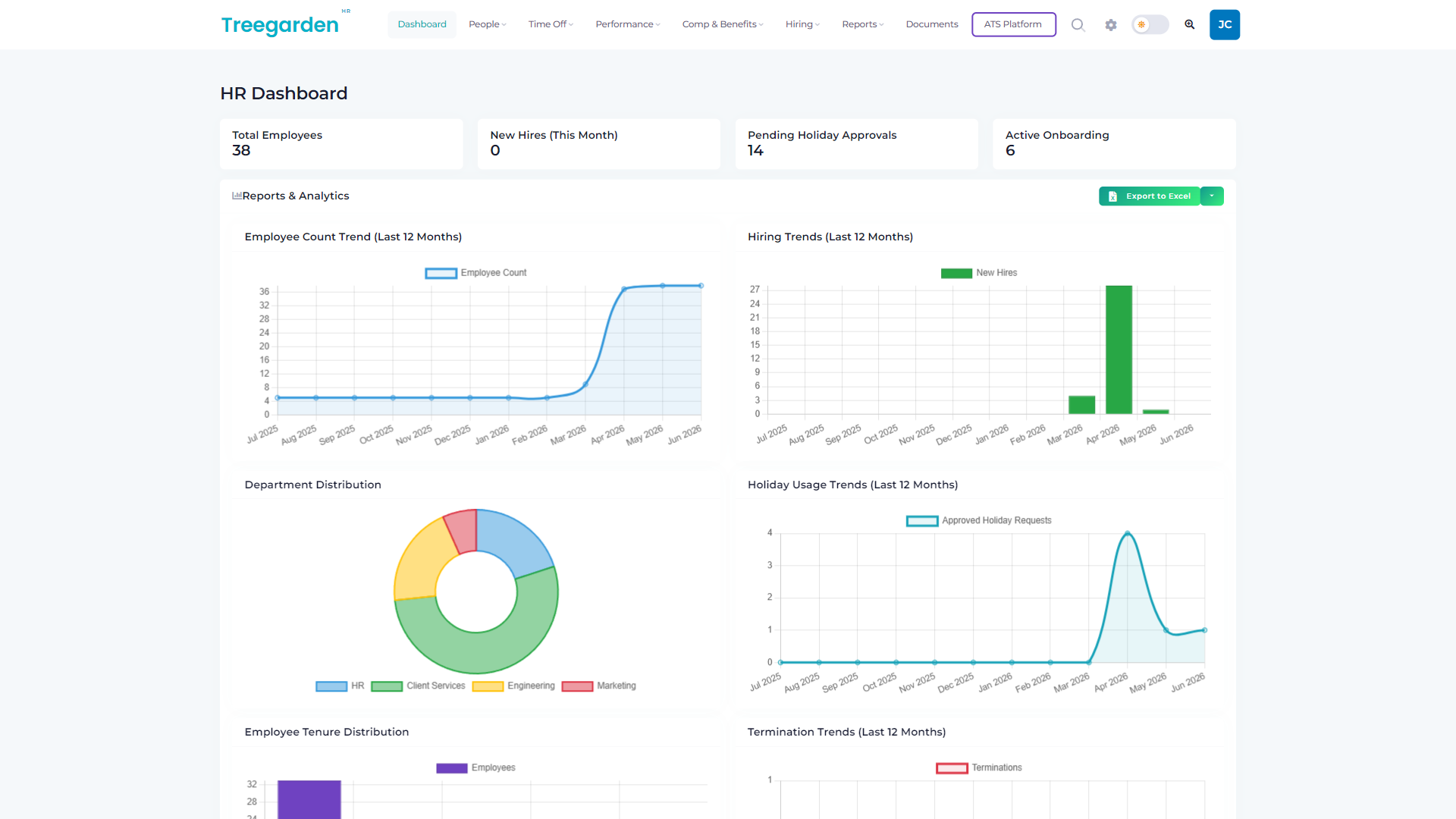
What Treegarden is and is not: Treegarden is an ATS-first platform with an HR module. It is not a full HRIS replacement. It does not include native payroll. It does not include the people analytics depth of HiBob. It does not include the compliance automation breadth of Personio for complex multi-country EU legal requirements. If those are your primary requirements, the platforms above serve them better. State this plainly at the start rather than letting it emerge as a discovery at the end of your evaluation.
Treegarden offers an ATS and a separately priced HR module for employers that want recruiting and employee management in one platform. Evaluate the handoff from hired candidate to employee record in a demo, including which fields transfer and what a user must approve. Do not assume that a completed hire automatically creates an employee record.
Published pricing (Treegarden pricing page, checked October 16, 2026). These are monthly equivalents on an annual commitment; monthly instalments are available. Above the published limits, request a quote:
- HR-only: $299/month equivalent for up to 25 employees; $499 for up to 50; $899 for up to 100
- ATS-only: $299/month equivalent for up to 10 active jobs; $499 for up to 25; $899 for up to 50
- ATS + HR: $598/month equivalent for 10 active jobs and 25 employees; $998 for 25 jobs and 50 employees; $1,798 for 50 jobs and 100 employees
- Above published limits: custom quote, not a continuation of the $899 HR or $1,798 bundle price
Where Treegarden does and does not compete:
Treegarden is ATS-first, with pipeline stages, candidate collaboration and recruiting reporting. Compare the exact recruiting workflow, integration and job-board requirements in a demo rather than assuming feature parity with other vendors.
Treegarden does not include native payroll. If payroll is your primary requirement, evaluate a payroll-first product and verify any needed integration before choosing Treegarden.
Treegarden does not compete on people analytics depth. HiBob's engagement surveys, DEI dashboards, compensation equity analysis, and retention modelling are more developed than what Treegarden's HR analytics layer provides. If those workflows are central to your HR strategy, evaluate HiBob seriously before Treegarden.
Treegarden's published HR price remains the same within an employee band. A company growing from 80 to 99 employees stays within the Scale HR band, but a 101st employee needs a custom quote. ATS pricing is based on concurrent active jobs, not employee count.
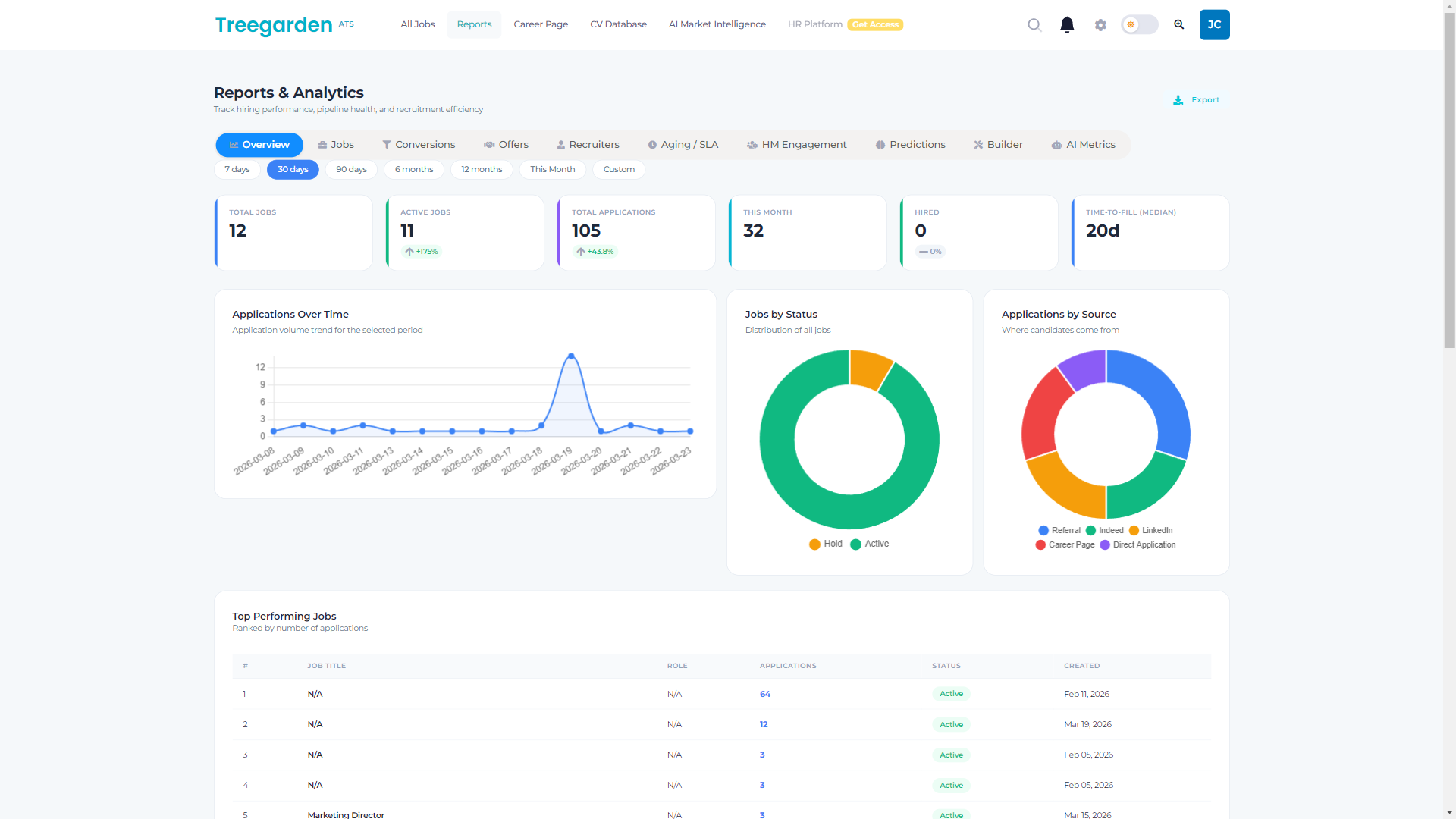
Best fit: employers that need ATS-led recruiting and optional HR workflows but do not require native payroll. US buyers can review the HR module and its standalone scope before comparing it with payroll-first HRIS products. For more than 100 employees, request a tailored HR or bundle quote.
Full Comparison: 150-Employee Cost and Capability Benchmark
The table below benchmarks estimated monthly cost and key capability flags for a 150-person company on a mid-tier plan. All cost figures link to the verification source. This is a planning benchmark, not a quote. Actual contract pricing will vary by negotiation, contract length, and module selection.
| Vendor | Approx. cost/mo (150 emp) | Full ATS | Native Payroll | People Analytics | EU Data Residency | Pricing Model | Source |
|---|---|---|---|---|---|---|---|
| BambooHR | Core ~$1,537.50; Pro ~$2,625 before discounts | Basic hiring module only | US only | Moderate | No | Per employee (published) | BambooHR |
| Personio | EUR 750-EUR 1,800+ | Basic hiring module only | EU markets | Moderate | Yes | Per employee (custom quote) | Vendr |
| HiBob | $1,200-$2,100 | Minimal | No | Strong | Yes | Per employee (custom quote) | CheckThat.ai |
| Rippling (HR + payroll) | $2,250-$3,300 | Minimal | Yes (global) | Moderate | Yes | Per employee per module (custom) | PMP |
| Gusto Plus | ~$1,880 | None | US only | Basic | No | Base + per employee (published) | Gusto |
| Deel HR Core | Free (under 200 emp) | Add-on, $14/emp/mo | Global EOR | Moderate | Yes | Free under 200; $5/emp/mo above | Deel |
| Treegarden Bundle | Custom quote at 150 employees | Full ATS (ATS-first) | No - integration only | Moderate | Yes | Flat rate per headcount tier | Treegarden |
| Workday Essentials | ~$15,000+ | Full ATS | Yes (global) | Strong | Yes | Per seat (enterprise, custom) | Redress Compliance |
Planning figures are not vendor quotes. Public rates and included modules can change; confirm terms before purchase. Treegarden's published $998/month equivalent bundle covers up to 50 employees and 25 active jobs, while the $1,798 tier covers up to 100 employees and 50 active jobs. At 150 employees, HR and bundle pricing require a custom quote.
The ATS Plus HRIS Integration Problem
The conventional mid-market buying pattern is to purchase the best HRIS and the best ATS separately and integrate them. In theory this gives you best-in-class for each function. In practice, the integration overhead is real and consistently underestimated at the point of purchase.
Consider a concrete case: Greenhouse (a strong standalone ATS) and BambooHR Pro (a strong standalone HRIS) for a 150-person company with an active recruiting team:
- Greenhouse for 150 employees: based on buyer-reported benchmarks from Leon Consulting and Vendr, a mid-tier Greenhouse contract for 100-200 employees typically runs $15,000-$40,000/year ($1,250-$3,333/month); the median contract is approximately $12,250/year
- BambooHR Pro for 150 employees: $2,625/month at the published starting rate, before volume discounts; request the actual quote
- Combined cost: $3,800-$5,883/month before integration work
- Integration overhead: typically 10-20 hours of technical time per quarter to manage field mapping, sync failures, and API version compatibility between the two systems, plus potential integration middleware
The integration between Greenhouse and BambooHR is not technically complex. When a candidate is marked as hired in Greenhouse, a webhook can create an employee record in BambooHR. But it requires maintenance. Every time either vendor updates their API, every time a custom field is added in one system that needs to appear in the other, every time a sync fails silently and a manager cannot locate an employee in the org chart, someone spends time on it. That time does not appear on any vendor invoice.
The integration problem is not unique to this specific pair. Any combination of a standalone ATS and standalone HRIS will have the same structural maintenance requirement. The question is whether the best-of-breed quality difference in each tool is worth the integration overhead cost.
This is not an argument that combined platforms are always correct. If you already have significant investment in Greenhouse's specific structured interview analytics, or if BambooHR's US payroll integration is a hard requirement, the integration cost may be worth maintaining. The point is that companies evaluating both tools simultaneously with no prior investment in either should run a genuine total-cost analysis, including integration overhead and the time cost of maintenance, before the default assumption of best-of-breed wins by inertia.
Pricing Model Deep Dive: Per-Employee vs Flat-Rate
The pricing model matters as much as the per-unit cost. Two platforms at the same monthly cost at 60 employees can differ by $3,000/month at 200 employees depending on whether they price per-employee or per-tier. Understanding the model before signing a multi-year contract is critical.
Per-employee per-month pricing
Most HRIS vendors use per-employee per-month (PEPM) pricing. This has intuitive appeal: costs scale with the size of the business being served. The problem for fast-growing companies is that every hire generates incremental subscription cost, and the compounding effect over a 24-month growth period is often larger than the initial budget anticipated.
A planning example using BambooHR Pro's published $17.50/employee/month starting rate: 60 employees would be $1,050/month, 100 would be $1,750, 150 would be $2,625, and 200 would be $3,500 before volume discounts. The actual contract may be lower; request written pricing at each projected headcount.
Flat-rate per-tier pricing
Some platforms price at flat rates within headcount bands. Treegarden's $998/month-equivalent ATS-plus-HR bundle covers up to 50 employees and 25 active jobs; the $1,798/month-equivalent tier covers up to 100 employees and 50 active jobs. HR headcount and active-job capacity are separate limits. Above either published limit, request a quote.
The trade-off: a headcount-band model has a step at tier boundaries instead of a per-employee increase. A company at 99 employees on Treegarden's Scale bundle remains within the published 100-employee HR limit after one hire; the next hire would require a custom quote. Confirm the applicable active-job capacity separately before committing.
Modular pricing
Rippling uses per-employee-per-module pricing, where you pay separately for HR core, payroll, benefits, IT management, and each additional module. This model is transparent about what each capability costs in isolation, but the total compounds quickly as module selection increases. A company that starts with HR core at $8/employee/month and adds payroll, benefits, and IT management reaches $30-$50/employee/month in buyer-reported real-world deployments.
The practical implication: always model your expected module selection at your projected headcount over the contract term, not just the entry-level module at current headcount, when evaluating modular pricing platforms.
Treegarden: ATS-First with Full HR Module
Treegarden is ATS-first with an optional HR module. There is no native payroll. Published HR pricing covers up to 100 employees; larger teams need a quote. Ask to see the recruiting-to-employee handoff during a demo.
Book a demoDecision Framework: Narrowing Your Shortlist
After working through the vendor assessments, the buying decision reliably comes down to four filters applied in sequence. Work through them before booking demos; each one eliminates platforms and narrows your evaluation to a manageable shortlist.
Filter 1: Primary geography
Start with the countries where you employ people and run payroll. If US payroll is a primary requirement, evaluate payroll-capable vendors first. If multi-country HR compliance or EOR is essential, verify the exact country coverage with each vendor. Treegarden has no native payroll; assess it for ATS and HR workflows, not as a substitute for country-specific payroll or legal advice.
Filter 2: Headcount trajectory over 24 months
Model the cost of each shortlisted platform at your current headcount, at 1.5x current, and at 2x current headcount. At BambooHR Pro's published starting rate, 60 employees would be $1,050/month and 180 would be $3,150/month before volume discounts. Request projected-headcount quotes instead of extrapolating from today's contract alone.
Filter 3: Recruiting volume
If your company hires fewer than 10 people per year, the built-in hiring modules in BambooHR or Personio are sufficient. Do not pay for a dedicated ATS for this volume. If you are actively filling 15-50 roles per year with a recruiting team, the quality difference between a hiring module and a purpose-built ATS is measurable. According to SHRM's 2025 Recruiting Benchmarking data, the average cost per hire stands at $4,425 for non-executive US roles. At that cost per hire across 30 annual hires, recruiting process efficiency has a direct budget consequence.
Filter 4: Budget ceiling at expected headcount
At 150 employees, compare the same set of modules and billing terms across vendors:
- Published starting rates: Gusto Plus is $1,880/month at 150 people before add-ons; BambooHR Pro starts at $2,625/month before volume discounts.
- Quote-based products: ask Personio, HiBob, Rippling and Workday for an itemized 150-person proposal rather than treating third-party estimates as contract prices.
- Treegarden: published HR tiers end at 100 employees. Request a custom HR-only or ATS + HR quote for 150 employees and state your peak concurrent active jobs.
The two-minute elimination test
After running through the four filters, apply this quick check: does any vendor on your remaining shortlist have a structural gap that eliminates them for your specific situation regardless of other factors? EU-only company with no US employees? BambooHR is eliminated by payroll geography. Company where payroll is the primary pain and HRIS is secondary? Treegarden is eliminated by the absence of native payroll. Company under 30 employees with low recruiting volume? HiBob, Rippling, and Personio are all priced for complexity you do not have yet.
What Implementation Actually Looks Like
Implementation timelines are consistently understated in vendor sales processes and consistently overestimated in vendor marketing materials. The real range for mid-market HRIS deployments as of 2026:
- BambooHR: Two weeks is a realistic target for core HRIS setup with employee data migration. Most teams deploying Core or Pro achieve this without significant friction. Performance management configuration and custom field setup add time but are optional for go-live.
- Personio: Four to eight weeks for a complete EU mid-market deployment covering HRIS, multi-country time-off policies, onboarding workflows, and the recruiting add-on. The compliance workflow configuration for countries with complex labour law (Germany, France, Netherlands) takes longer than single-country deployments.
- HiBob: Two to four months is the standard expectation for mid-market deployments. The implementation fee (10-20% of first-year contract) is a real cost that needs to be budgeted alongside subscription costs.
- Rippling: Four to eight weeks for a standard HR plus payroll deployment. IT management configuration and global payroll setup extend this to three or more months for complex configurations.
- Workday: Twelve to eighteen months for mid-market deployments. This is not a reason to avoid Workday if your scale justifies it, but it needs to be part of any honest implementation planning conversation.
Data migration quality is the most common cause of implementation delays across all platforms. The quality of your existing employee data - completeness, formatting consistency, accuracy of employment dates and compensation records - determines whether data migration takes days or weeks. Start a data audit in parallel with your vendor evaluation, not after contract signature.
Questions to Ask Every Vendor Before You Sign
The questions below are designed to surface answers that vendor demo scripts are designed to obscure. Ask them directly and note whether the answer is specific or evasive.
- "What is my exact cost at 75 employees, 100 employees, and 150 employees, in writing, with the specific modules we discussed today?" A vendor who cannot or will not answer this before contract signature should not be trusted to be transparent after it.
- "What has your average renewal increase been for the last three years?" Annual increases of 8-15% are standard in this market. Knowing the number before you commit avoids surprises at renewal.
- "Which specific countries does your payroll compliance cover, and what are the exact limitations in [your specific countries]?" General statements about "international payroll" are not useful. Names of countries and specific compliance features (social insurance, PAYE, works council notifications) are what matters.
- "What is the process for a GDPR data subject access request in your system, step by step?" The specific workflow test for EU compliance. A genuine GDPR-native platform can describe this immediately. A platform with bolted-on compliance will either fumble the answer or default to a generic privacy policy reference.
- "Can I speak to a customer in our industry and employee range who has been using your platform for 18-plus months?" Vendor-provided references are selected. Ask to speak to someone specific rather than waiting for the vendor to volunteer a reference.
- "What does the off-boarding and data export process look like if we need to migrate away from your platform in three years?" The data portability question is revealing about vendor confidence and platform quality. A vendor who makes this difficult in contract terms or cannot explain the data export process cleanly is a vendor who expects you will be unhappy later.
Related buyer guides
These articles extend the analysis above into specific vendor comparisons and adjacent workflow decisions.
Get an instant price — no sales call needed
HR-only plans start at $299/month equivalent for up to 25 employees with an annual commitment. ATS is separately priced; larger teams can request a tailored quote.
Frequently Asked Questions
What is the best HRIS software for small companies under 50 employees?
If US payroll is the priority, Gusto Simple starts at $49/month plus $6/person/month. If employee records and onboarding come first, BambooHR Core is $250/month for up to 25 employees; above that its FAQ lists a per-employee starting rate. Compare your actual modules, headcount and contract terms rather than assuming either is universally best.
What is the best HRIS for a company growing from 50 to 200 employees?
Model costs at 50, 100, 150 and 200 employees before choosing. BambooHR Pro's published starting rate calculates to $875/month at 50 employees and $3,500/month at 200 before volume discounts. Headcount-band products step up at stated thresholds, while per-employee products change with headcount; confirm both in a written quote. Evaluate recruiting depth and job-opening capacity separately from HR features.
What is the difference between HRIS, ATS, HCM and payroll software?
An HRIS manages employee records, org charts, time-off, onboarding documents, and basic HR workflows - the system of record for your workforce. An ATS manages the recruiting process from job posting to offer, a separate product category that most HRIS vendors conflate with their built-in hiring module. HCM is the umbrella term for platforms combining HRIS, ATS, payroll, and performance management. True HCM suites are Workday, SAP SuccessFactors, and Oracle HCM. Payroll handles gross-to-net calculation and tax compliance and is heavily geography-specific. Most mid-market companies need an HRIS and either a dedicated ATS or a combined platform.
How much does HRIS software cost for a 150-person company?
Using public starting rates checked October 16, 2026, BambooHR Pro starts at $17.50 per employee per month above 25 employees, or $2,625/month before volume discounts at 150. Gusto Plus is $80/month plus $12/person/month, or $1,880/month at 150 before add-ons. Personio and HiBob need quotes for this scenario. Treegarden's published HR tiers stop at 100 employees, so request a custom 150-person quote.
Does an HRIS include recruiting or applicant tracking?
Most HRIS platforms include a basic hiring module covering job posting, a candidate inbox, and offer letters. This is adequate for fewer than 10 hires per year. Recruiting teams running more than five simultaneous searches consistently find the built-in module inadequate for structured pipeline management, multi-recruiter collaboration, and recruiting analytics. SHRM's 2025 Recruiting Benchmarking data puts the average cost per hire for non-executive US roles at $4,425. At that cost per hire, the difference between a basic hiring module and a purpose-built ATS is measurable in dollars across a year of recruiting volume.
Should I buy a separate ATS and HRIS, or get a combined platform?
Compare the total price of the ATS, HRIS, integrations, migration and support at your actual headcount and hiring volume. A combined product can reduce the number of vendor relationships, but it does not guarantee automatic data transfer or feature parity with a specialist stack. Treegarden's published ATS + HR bundle starts at $598/month equivalent for 10 active jobs and 25 employees; a 150-employee buyer needs a custom quote.
What is the best HRIS for a European company in 2026?
For employers with European staff, verify each vendor's country-specific payroll, leave, privacy, data-residency and consultation requirements. Personio offers an EU-focused HR platform but prices by custom quote. Treegarden offers ATS and HR workflows; confirm hosting, legal requirements and needed integrations for each country during procurement rather than assuming a platform covers them automatically.
Cited Sources and Verification
- BambooHR pricing and FAQ - Core from $10.25/employee/month and Pro from $17.50/employee/month above 25 employees, with volume discounts; Core $250/month and Pro $425/month for 25 or fewer (checked October 16, 2026)
- People Managing People - BambooHR Pricing Tiers and Costs 2026; payroll and benefits add-on structure verified
- Personio Pricing Page - custom quotes, no published list price (verified June 2026)
- Vendr - Personio market pricing benchmarks EUR 5-20/employee/month by tier
- SaaSrat - Personio pricing review 2026; starts from EUR 7.60/employee/month
- HiBob Pricing Page - custom quotes, no published list price (verified June 2026)
- CheckThat.ai - HiBob buyer pricing benchmarks $8-$14/employee/month for 100-500 employee companies
- eLearning Industry - HiBob pricing guide 2026; implementation fee 10-20% of first-year contract
- Rippling Pricing Page - Unity platform from $8/employee/month; all full contracts custom-quoted (verified June 2026)
- People Managing People - Rippling pricing benchmarks by module combination 2026
- Gusto Pricing Page - Simple $49+$6 PEPM, Plus $80+$12 PEPM, Premium $180+$22 PEPM; Simple base increased from $40 to $49 March 1 2026 (verified June 2026)
- Deel Pricing Page - HR Core free under 200 employees, $5/employee/month above 200; EOR $599/employee/month (verified June 2026)
- People Managing People - Deel pricing breakdown by product category 2026
- Redress Compliance - Workday cost per employee benchmarks; mid-market HCM $25-$42/employee/month; sub-500 annual cost $150,000-$300,000
- Vendr - Workday HCM pricing benchmarks; year-one TCO including implementation 100-150% of annual subscription
- SHRM 2025 Recruiting Benchmarking Report - average cost per hire $4,425 for non-executive US roles; executive average $35,879
- G2 - BambooHR 4.4/5 from 5,100-plus reviews; ease of use cited as standout strength (verified June 2026)
- G2 - HiBob 4.5/5 from 800-plus reviews (verified June 2026)
- HRStacks - HR Tech Market reached USD 47.51 billion in 2026; CAGR 10.35% through 2031
- Fortune Business Insights - Human Resource Technology Market analysis; cloud HR adoption above 74% in mid-market segment
- Leon Consulting - Greenhouse ATS pricing 2026; median contract $12,250/year; mid-market $15,000-$40,000/year