
Quick answer
How much does an ATS cost in 2026?
An ATS price is comparable only after you know what changes the bill. Some vendors price around active-job capacity, employee bands or user seats; others require a quote. Workable currently publishes employee-band plan cards, while Greenhouse and Lever ask buyers to request a quote. Ask every vendor for the subscription, implementation, optional services, usage, renewal assumptions and first-year total in one written view.
- Active-job model: test the peak number of concurrent roles and how a temporary increase is handled
- Employee-band model: confirm when headcount is measured and what happens at renewal
- Quote-only contract: require subscription, implementation, optional services and renewal assumptions in one written first-year total
ATS price pages use different units, so a monthly line item is rarely a complete comparison. By the time a buyer has confirmed implementation, access needs, integrations, optional services and renewal treatment, the relevant number is the written first-year total for the requirements they will actually use.
I evaluate these platforms as part of building and positioning Treegarden, so treat this as interested commentary rather than an independent rating. The comparison explains pricing models and the questions that turn a price card or quote into a real purchasing decision. It does not crown a universal winner.
Greenhouse pricing, answered directly
Greenhouse does not publish a standard price. Its pricing page routes buyers to a quote. Ask for a written total that separates the subscription, implementation, migration, optional services and renewal terms, then compare it with the same scope from other vendors.
How ATS pricing scales as your team changes
There is no single ATS pricing model. A low monthly number can be useful, but it does not show what changes the bill when hiring volume, headcount, access needs, or optional services change. Compare the trigger first, then compare the plan price.
| Pricing basis | What changes the bill | Best question to ask |
|---|---|---|
| Active-job capacity | The number of roles open at the same time, including seasonal or expansion hiring. | How is an active job defined, and what happens during a short-lived hiring spike? |
| Employee bands | Total company headcount, whether or not every employee uses the ATS. | When is headcount measured, and what changes if the company crosses a band before renewal? |
| User seats | Recruiters, hiring managers, interviewers, and other people who need account access. | Which people need a paid seat, and are occasional reviewers included? |
| Add-ons and usage credits | Optional services such as messaging, assessments, video interviews, or AI actions. | Which required workflows are included, and which have separate usage or subscription charges? |
| Quote-based contracts | The negotiated scope, term, implementation work, and renewal terms in the order form. | Can the vendor show subscription, implementation, add-ons, and renewal assumptions in one written first-year total? |
Small-team cost checklist
Before asking for a quote, write down your peak concurrent roles, expected employee count at renewal, everyone who needs to participate in hiring, any required add-ons, and the contract term you can accept. That gives you a fair comparison between an active-job model, an employee-band model, and a seat-based model. See how Treegarden fits a small-team hiring workflow or review Treegarden's published ATS pricing.
ATS pricing compared: published terms and quote-only models
The table separates vendors that publish starting points from vendors that require a quote. Workable, Greenhouse and Lever were checked against their current first-party pricing pages on September 11, 2026. Other rows retain the source dates linked in the table. Treat a price card as a starting point and a quote-only platform as an invitation to request a written first-year total, not as a published price.
| Platform | Pricing model | Published entry price | Est. annual (small team) | Impl. fee | Price source |
|---|---|---|---|---|---|
| Treegarden | Active jobs (flat) | $299/mo (Startup, up to 10 jobs) | $3,588/yr | $0 | Published |
| JazzHR | Active jobs (flat) | $1,000/yr (Hero, 3 jobs) | $1,000-$5,508/yr | $0 | Published |
| Workable | Employee headcount bands | From $299/mo (Standard, 1-20 employees) | Varies by employee band and billing choice | Not published | Published, checked Sept. 2026 |
| Tellent Recruitee | Plan and employee count | Not published; Start includes 5 active jobs | Not published | Not published | Plan details, rechecked Aug. 2026 |
| Breezy HR | Flat-rate tiers | $157/mo (Startup, annual) | $0-$5,268/yr | $0 | Published |
| Zoho Recruit | Per user/month | $25/user/mo (Standard, annual) | $1,500-$4,500/yr (5 users) | $0 | Published |
| BambooHR | Per employee/month | ~$250/mo flat (≤25 employees) | ~$3,000-$15,000/yr | $0 | Quote req. |
| Ashby | Per employee (scales to custom) | $400/mo (Foundations, ≤100 employees) | $4,800/yr (Foundations); $14,000-$60,000+ (Plus/Scale) | Varies | Partial |
| Greenhouse | Custom quote | Not published | Not published | Not published | Quote only |
| Lever | Custom quote | Not published | Not published | Not published | Quote only |
| SmartRecruiters | Custom quote (headcount-based) | Not published | ~$15,000-$120,000+/yr est. | $5,000-$15,000 | Quote only |
| Teamtailor | Custom quote (job slots) | Not published | ~$2,750-$72,000+/yr est. (avg ~$16,500) | $0-$5,000+ | Quote only |
| Pinpoint | Custom quote (flat by size) | Not published | ~$4,140-$14,400+/yr est. | Varies | Quote only |
| iCIMS | Custom quote (modular) | Not published | ~$30,000-$150,000+/yr est. | $15,000-$60,000 | Quote only |
Workable, Greenhouse and Lever were checked September 11, 2026. Other rows retain their linked source dates. “Not published” means the vendor’s public pricing page did not provide a reliable figure for this comparison. Impl. = one-time implementation fee. Confirm every material term in a written proposal.
Platform-by-platform breakdown
I have ordered these by how often buyers ask me about them, starting with the quote-only enterprise names, then the published-price mid-market group. For each one I have tried to lead with its genuine strength before getting into where the bill grows, because every platform here is a serious product that someone is happily paying for.
Greenhouse
Greenhouse's pricing page asks buyers to request a quote. The public page is useful for establishing that pricing is not self-serve; it is not a source for a standard subscription, implementation or renewal amount.
Ask Greenhouse to provide one written view of the subscription, implementation, migration, optional services, support and renewal treatment for the scope you plan to buy. Use the same request with every vendor on the shortlist.
Lever
Lever's pricing page says pricing is tailored to a team’s hiring needs. Its product pages describe LeverTRM as an ATS and CRM platform; its current pricing page also lists Candidate Insights, AI Screening and Onboarding as add-ons. Do not infer a standard per-employee, implementation or renewal price from the public page.
Request a proposal that distinguishes the core platform, every add-on, implementation and migration work, data-export support, term and renewal treatment. Test the candidate relationship workflow and reporting you require in the same demonstration.
iCIMS
iCIMS is built for enterprise talent acquisition at scale, typically 1,000+ employees, and at that size its depth and configurability are hard to match. Pricing is fully custom via icims.com on a per-employee-per-month basis around $6-$9 PEPM for the core ATS. Buyer data from Vendr shows a very wide spread ($14,500 to $635,000/year, roughly $20,781 median for mid-market accounts), because the modules do the damage: adding the CRM, Text Recruiting, and Video Interviewing can multiply the base before you sign. Implementation runs $15,000-$25,000 for mid-market and can reach $35,000-$60,000+ for complex enterprise integrations. The single most important thing to know: iCIMS has raised some renewals by up to 40% in a single cycle (2024-2025), so a contractual renewal cap is not optional, it is the whole negotiation.
SmartRecruiters
SmartRecruiters positions itself as an enterprise hiring operating system and backs it with strong high-volume and global-hiring capabilities. It no longer offers self-serve sign-up or a public rate card. Buyer-reported entry on the Essential tier starts around $15,000/year; Professional, High Volume, and Complete tiers are quoted and typically range $30,000 to $120,000+ annually by headcount. Implementation through SmartRecruiters professional services or a certified partner usually runs $5,000-$15,000, and AI matching is priced as a separate add-on in 2026. A realistic three-year total for a mid-sized company reaches $75,000-$200,000 once implementation, add-ons, and renewal escalation are stacked in.
Teamtailor
Teamtailor's strength is employer branding: it produces genuinely attractive, easy-to-manage career sites and candidate experiences, which is why it is popular with marketing-minded talent teams in Europe and increasingly the US. Like the enterprise names, it is quote-only via teamtailor.com/pricing, but it prices on job slots rather than per seat, and most contracts include unlimited users. Buyer-reported figures put entry around $2,750/year for small teams, rising past $72,000 for large organizations, with Vendr data showing an average contract near $16,500/year and modest 3-8% renewal escalators. Self-service onboarding is free; managed migration and career-site setup can run into the low thousands. It is a credible pick if branding and candidate experience rank above deep analytics for you.
Pinpoint
Pinpoint is a strong, well-designed mid-market ATS that, like Teamtailor, charges a flat rate by company size with unlimited seats, so a ten-recruiter team pays the same as a three-recruiter team. Pricing is quote-only via Pinpoint's request-pricing page. Buyer-reported estimates put the Growth plan in the region of $4,140-$9,600/year and Enterprise around $10,800-$14,400+/year, on annual contracts only with no month-to-month option. Treat those as directional; Pinpoint does not publish them. For a company that values an unlimited-user model and a polished product but does not need enterprise-grade complexity, it is worth a place on the shortlist.
Workable
Workable prices by employee band. On September 11, 2026, its public pricing page showed Standard from $299 per month, Premier from $599 per month and Enterprise from $719 per month for the 1-20 employee band. It also presents paid-plan active-job use subject to fair-use limits.
Workable lists Texting+, Video Interviews+ and Assessments+ as optional services on Standard. Its pricing page says paid accounts start with 3,000 Workable Agent credits and shows usage-based credit actions. Confirm the current band, billing choice, required services, credit use and renewal treatment in writing.
JazzHR
JazzHR is one of the few mid-market platforms that publishes prices and keeps users unlimited, which I appreciate. Here is where honesty matters: the round monthly figures most comparison sites repeat ($75/$269/$420) are slightly below the annual totals JazzHR actually lists. The JazzHR pricing page shows Hero at $1,000/year (3 active jobs, extra jobs $9 each per month), Plus at $3,480/year (up to about 200 jobs), and Pro at $5,508/year (unlimited jobs). That works out to roughly $83, $290, and $459 per month. The 3-job cap on Hero is tight for any team hiring consistently, so most buyers land on Plus or Pro.
Add-ons such as candidate texting, eSignature, and advanced reporting are priced separately on the lower tiers (Pro folds eSignature and advanced reporting in), so confirm exactly what is included before you treat a plan price as final.
Ashby
Ashby's distinctive strength is analytics built natively into the product rather than bolted on as a reporting module, which makes it a favorite of data-driven talent teams. The Ashby pricing page publishes the Foundations plan at $400/month (about $360/month on annual billing) for companies up to 100 employees. Above 100 employees it shifts to a seat-based model around $795/user/year on annual contracts, and the Plus and Enterprise tiers are custom-quoted. Average SMB spend, per Vendr contract data, runs roughly $14,656/year, and 300-500 employee companies on the upper tiers land in the $60,000-$120,000+ range. If you need that analytics depth, Ashby is a genuinely strong buy. If your real need is straightforward pipeline management, the price-to-feature ratio is harder to justify.
BambooHR
BambooHR is an HRIS first (payroll, time tracking, performance, and benefits are all part of the suite), with the ATS as one included module rather than a standalone product. The BambooHR pricing page requires a quote, but per-employee rates widely cited by analysts are about $10/employee/month (Core), $17 (Pro), and $25 (Elite), with a flat minimum near $250/month for companies of 25 or fewer. If you want one system for HR and light recruiting, the value is real. If you only need applicant tracking, you are paying for a lot of HRIS you will not use, and for high-volume hiring most teams end up adding a dedicated ATS alongside it.
Breezy HR
Breezy HR is the easiest platform on this list to evaluate, and that simplicity is its strength. The Breezy pricing page lists four published tiers: Bootstrap ($0, one active position), Startup ($157/month annual), Growth ($273/month annual), and Business ($439/month annual), with unlimited users on every paid plan. Bootstrap is too thin for consistent hiring (limited retention, no integrations). Startup covers a team posting several roles, Growth adds multiple custom pipelines and automation, and Business adds advanced controls and priority support. Annual billing includes two months free.
Zoho Recruit
Zoho Recruit is the value play at the low end, with a published per-user rate card. The Zoho Recruit pricing page lists the Corporate edition at $25/user/month (Standard, 10 active jobs, annual billing) and $50/user/month (Enterprise, 20 active jobs); a separate Staffing Agency edition runs $25/$50/$75 per recruiter per month. Add-ons such as client portals and video interviews can push the effective cost 30-50% above base, and month-to-month billing costs roughly 20% more. For a five-user team on Standard that is $1,500/year before add-ons, genuinely cheap, though you are buying a recruiting bolt-on to a broader software suite rather than a purpose-built ATS.
Hidden costs: what ATS pricing pages don't tell you
The subscription price is rarely the full story, and the gap between it and your real invoice is where most buyers get caught. These are the cost categories that consistently surface once the sales process is underway, and in a few cases only after the contract is signed. If a vendor is reluctant to put any of them in writing, that reluctance is itself the answer.
Implementation fees: the cost that never appears on pricing pages
SmartRecruiters implementations run $5,000-$15,000 for typical mid-market deployments. Greenhouse charges $1,000-$15,000. Lever charges $5,000-$25,000. iCIMS can reach $35,000-$60,000+ for enterprise deployments with complex integrations. These costs are not negotiating tactics, they reflect genuine professional services work. But they are rarely mentioned until late in the sales process, which means they can disrupt a budget that was sized around the subscription price. When benchmarking platforms, always ask: "What is my total cost in year one, including implementation, onboarding, and any required professional services?"
Per-seat expansion costs. On platforms with per-user pricing, every person who needs access, a department head reviewing a shortlist, an interviewer providing structured feedback, a finance manager approving a role, requires a paid seat. At $50-$75/user/month, adding 10 occasional users costs $500-$750 more per month. Flat-rate and active-job models eliminate this problem by including unlimited users in the plan price.
Add-on modules. Many platforms unbundle capabilities that others include as standard. Workable sells Texting+ ($89/month), Video interviews+ ($109/month), and Assessments+ ($59/month) separately on its Standard plan. Lever charges separately for CRM and analytics add-ons. Greenhouse breaks out the Onboarding module ($2,500-$5,000/year). iCIMS and SmartRecruiters price AI and text recruiting as add-ons. Before signing, ask the exact question: "Which features I showed interest in are not included in the quoted price?" and get the answer in writing.
Data migration. Moving your candidate history, interview notes, and offer data from one ATS to another is non-trivial. Lever charges $3,000-$8,000 for data migration as a line item. Other platforms include basic import but charge for complex or high-volume migrations. Factor this in if you are switching from an established system.
Annual renewal escalation. Enterprise vendors routinely increase renewal prices by 8-15% annually. iCIMS raised prices by up to 40% in one renewal cycle (2024-2025). If you sign a multi-year contract, negotiate a cap on annual renewal increases before you sign, not at renewal time when your leverage is minimal.
Year-One Total Cost of Ownership formula
TCO = Annual Subscription + Implementation Fee + Training + Add-ons + Seat Expansion + Data Migration.
Example, Greenhouse for a 50-person company (5 recruiters, 10 hiring managers): ~$12,000 subscription + $5,000 implementation + $2,000 training + $5,000 Greenhouse Onboarding module = approximately $24,000 in year one. In year two, add an 8-15% renewal increase.
Example, Treegarden Growth plan (25 active jobs): $499/month × 12 = $5,988/year. Implementation: $0. Training: $0 (self-service onboarding). Add-ons: $0 (all features included). Year-one total: $5,988.
The number that should decide it: your true three-year cost
Year one flatters quote-only vendors. A discounted first year, a one-time implementation fee that feels like a sunk cost, and add-ons you have not switched on yet all make the sticker look manageable. The honest comparison is three years, because that is roughly how long you will live with the decision, and it is the window where renewal escalation does its quiet damage. Here is the model I actually use, in four steps.
Step 1: Find your real year-one number. Take the published or quoted annual subscription and add implementation, data migration, training, and every add-on you genuinely need (not the ones you might). For published-price platforms with no implementation fee and all features included, year one is just the subscription. For quote-only platforms, assume the first quote is the opening bid and that implementation and at least one add-on will appear.
Step 2: Apply renewal escalation to years two and three. Use 0% for a published-price vendor whose rate card you can re-check yourself, 8-15% for a typical enterprise contract, and budget for a worst-case spike (iCIMS has pushed some renewals up 40%) unless you have a written cap. The compounding matters: 12% a year turns a $30,000 contract into about $37,600 by year three on subscription alone.
Step 3: Add your growth delta. This is the step buyers skip, and it is where the pricing model you chose finally shows its hand. Project where your headcount, recruiter count, and simultaneous open roles will be in 24-36 months, then re-price each year at that level. On a per-seat model, every new hiring manager and interviewer is a new line item. On a per-employee model, you cross band cliffs as you grow. On a flat or active-job model with unlimited users, this delta is often zero until you change tier. Growth should not be punished by your tooling, but on some models it is.
Step 4: Sum it and divide by expected hires. Add the three years, then divide by the hires you expect to make across that period. That cost-per-hire number, not the monthly price, is what you take to a budget conversation.
Three-year cost, worked two ways
Quote-only enterprise platform, 120-person company growing to 200: Year 1 = $18,000 subscription + $6,000 implementation + $3,000 onboarding add-on = $27,000. Year 2 at +12% on subscription plus a higher headcount band ≈ $23,000. Year 3 ≈ $26,000. Three-year total ≈ $76,000 before any seat or module creep.
Published active-job platform, same company (Treegarden Growth, 25 active jobs, annual): $399/month effective × 12 = $4,788/year. No implementation, no add-ons, unlimited users, so growth from 120 to 200 employees changes nothing until you exceed the job tier. Three-year total ≈ $14,364. The gap is not the monthly price, it is implementation, escalation, and growth treatment compounding over three years.
Treegarden pricing: how it works
Disclosure: I'm the founder of Treegarden, so I have an obvious interest in how this platform is presented. I've tried to describe all platforms in this article as accurately as possible; I'll do the same here.
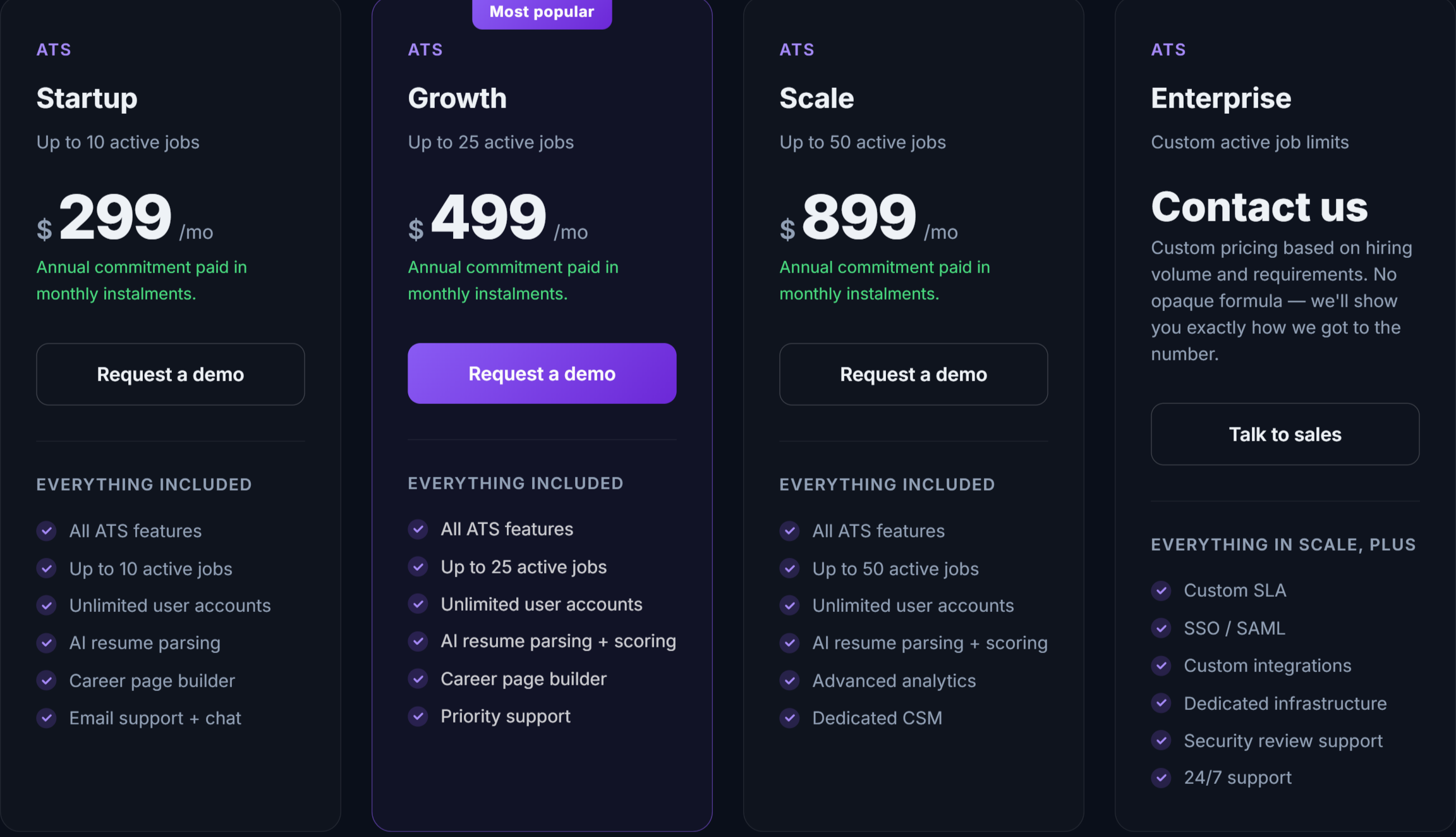
Treegarden prices by active-job count rather than employee headcount or recruiter seats:
- Startup, $299/month: Up to 10 active jobs. Unlimited users. All ATS features included.
- Growth, $499/month: Up to 25 active jobs. Unlimited users. All ATS features included.
- Scale, $899/month: Up to 50 active jobs. Unlimited users. All ATS features included.
- Enterprise, Custom pricing: Above 50 active jobs. Contact us for a quote.
"All ATS features included" means exactly that: AI Match Score, AI Job Description Generator, AI Bias Detection, multi-board publishing, Kanban pipeline, structured interview kits, team collaboration, GDPR compliance, and a customizable career page are all part of every plan. There are no feature gates by tier, no implementation fee, and no per-user charge as your team grows.
Annual billing takes 20% off, bringing the effective monthly rate to $239, $399, and $719 on Startup, Growth, and Scale respectively. UK pricing is published in pounds (£235/£395/£710 per month). Self-service onboarding typically takes under 30 minutes to a first job posting, and evaluation is a guided demo plus a sandbox on request rather than a self-serve guided demo.
Where Treegarden is not the right fit: if you are a high-volume enterprise hiring 200+ people per year across complex multi-region workflows, you will likely need the deeper HRIS integrations and dedicated customer success infrastructure that Greenhouse, Lever, or iCIMS provide. At that scale, the higher price of those platforms can be justified by time savings on complex workflow automation.
Best fit by company size and budget
There is no single right answer here. It depends on hiring volume, team structure, and how much of your workflow you want the system to automate. Below is an honest read on which platforms make sense at each stage, including where my own product is and is not the right call.
Startups and early-stage companies (1-30 employees, under $10,000/year budget)
At this stage, time-to-value matters as much as features, and any platform that needs paid professional services just to switch on is the wrong shape. Worth evaluating: Treegarden Startup ($299/month, $3,588/year, immediate self-serve setup), JazzHR Hero or Plus ($1,000-$3,480/year), and Breezy HR Startup ($157/month). Avoid Greenhouse, Lever, SmartRecruiters, and iCIMS at this size: the minimum contract values and implementation fees make them both financially prohibitive and operationally oversized for early-stage hiring.
Growing SMBs (30-200 employees, $5,000-$20,000/year budget)
At this stage, you need scalable pipeline management, multi-board publishing, team collaboration without per-seat friction, and integrations with your HRIS or payroll provider. Workable Standard ($299-$599/month depending on employee band) is a credible option if you stay within the base plan and avoid add-on accumulation. Treegarden Growth ($499/month) covers this range without per-seat expansion risk. Ashby Foundations ($400/month) is worth considering if reporting depth is a priority. Greenhouse Core is technically available but requires custom pricing that often starts at $12,000-$20,000/year for this segment, hard to justify unless you expect rapid growth into enterprise territory within 12 months.
Mid-market companies (200-1,000 employees)
At this stage, ATS requirements typically include HRIS integration, structured interviewing at scale, compliance reporting, and potentially CRM-style candidate sourcing. Greenhouse, Lever, and Ashby's upper tiers are all appropriate at this level. The critical discipline is evaluating three-year TCO, not just year-one subscription, and negotiating renewal caps before signing. Treegarden Scale ($899/month) covers up to 50 simultaneous open roles, which handles a significant portion of mid-market hiring volume without the enterprise-tier complexity cost.
Enterprise (1,000+ employees)
At this scale, iCIMS, SmartRecruiters, and Greenhouse Pro are the platforms most commonly deployed. Budget realistically for $60,000-$150,000+ a year in subscription alone, plus $15,000-$60,000 in implementation. Negotiation leverage is real at this budget level, so treat list prices as opening positions, not final ones, and secure a written renewal cap in the initial contract before anything else.
The metric that actually matters: cost per hire
Absolute platform cost means nothing without context. The number that matters when you weigh ATS value is cost per hire: what the platform costs you, divided by the number of successful hires it supports per year. A $30,000 platform that helps you make 300 hires is cheaper, per hire, than a $5,000 one that supports 20.
The formula: Annual ATS cost ÷ Number of hires per year = ATS cost per hire.
Worked examples using real 2026 pricing:
Scenario 1: 10-person startup making 8 hires per year. Treegarden Startup ($3,588/year) ÷ 8 hires = $448 per hire. JazzHR Plus ($3,480/year) ÷ 8 hires = $435 per hire. Greenhouse (buyer-reported ~$6,500/year minimum + ~$3,000 implementation in year one) ÷ 8 hires = roughly $1,190 per hire in year one. At this volume, Greenhouse costs well over twice as much per hire as either published-price alternative, which is exactly why it is the wrong tool for a team this size.
Scenario 2: 100-person company making 40 hires per year. Treegarden Growth ($5,988/year) ÷ 40 hires = $150 per hire. Workable Standard ($3,588/year on the base band, before add-ons) ÷ 40 hires = about $90 per hire if you stay on the base plan, more once texting or video is added. Greenhouse (buyer-reported $15,000-$20,000/year for this segment) ÷ 40 hires = $375-$500 per hire. The cost-per-hire gap between published-price and quote-only platforms widens sharply below enterprise scale.
Scenario 3: 500-person company making 150 hires per year. At this scale, enterprise platforms start to justify their cost through automation, compliance, and integration depth. Greenhouse (buyer-reported $30,000-$40,000/year) ÷ 150 hires = $200-$267 per hire. Lever ($25,000-$35,000/year at typical negotiated rates) ÷ 150 hires = $167-$233 per hire. Treegarden Scale ($10,788/year) ÷ 150 hires = $72 per hire, lower in absolute terms, though at this volume the workflow and integration requirements may genuinely warrant one of the deeper platforms. Cheaper per hire is not automatically the right answer once complexity is real.
Don't forget indirect savings in the ROI calculation
The cost-per-hire calculation only captures direct platform cost. A well-deployed ATS also reduces time-to-fill (every unfilled day costs in lost productivity), reduces reliance on external agencies (typical placement fee: 15-25% of first-year salary), and improves offer acceptance rates through a better candidate experience. A team that reduces agency reliance by two placements per year at $60,000 average salary saves $18,000-$30,000 in fees, often more than the annual cost of any platform on this list. Build that into your ROI model before concluding that an ATS is expensive.
Seven questions to ask before signing any ATS contract
These apply to every vendor, but they are most important for quote-only platforms where the list price is a starting position, not a final one.
1. "What is the total cost in year one, in writing, including implementation, migration, onboarding, and all features I've seen demonstrated?" Do not accept a subscription price without a written scope that covers everything. "Implementation not included" should be a red flag that triggers this question immediately.
2. "Which features require additional payment beyond what you quoted?" Ask specifically about AI scoring, advanced analytics, video interviews, onboarding modules, SSO, API access, and compliance reporting. Many platforms quote core ATS and add these later.
3. "How does pricing change if we add 10, 20, or 50 users over the next 18 months?" On per-seat models, this question reveals the scaling risk. On flat-rate or active-job models, the answer should be straightforward.
4. "What is the renewal price cap, and can we put it in the contract?" An 8-15% annual escalation on a $30,000 contract adds $2,400-$4,500 in year two. Negotiate a cap before you sign, not at renewal when your leverage is low.
5. "What are the exit terms if we want to leave after year one?" Understand the notice period, any penalties for early cancellation, and, critically, your right to export your own data on departure. Some contracts include data portability only as a paid professional service.
6. "Is data migration from our current platform included, and what does it cover?" If you have existing candidate records, interview history, or offer data, ask explicitly what will be migrated, what format it arrives in, and who performs the work.
7. "Do you have a startup, SMB, or regional discount program?" Many enterprise platforms have unpublished discount programs for early-stage companies, non-profits, or specific geographies. These are rarely offered proactively.
Conclusion: how to evaluate ATS pricing in 2026
The 2026 ATS market has something for every company size and budget. The catch is that the gap between published-price vendors and quote-only platforms is large, and the hidden categories (implementation, seat expansion, add-ons, and renewal escalation) can quietly double or triple what the pricing page implied.
The clearest dividing line is between platforms that publish their prices and those that hide them. Published-price platforms (Treegarden, Workable, Breezy HR, JazzHR, Zoho Recruit, Ashby Foundations) let you plan a budget before you ever talk to sales. Quote-only platforms (Greenhouse, Lever, SmartRecruiters, iCIMS, Teamtailor, Pinpoint) make you enter a sales process just to get a number, and that process is built to move you toward signing before you can see the full year-one and three-year picture.
If you are buying for a company under 500 employees, start with the published-price options, build the year-one and three-year totals using the models above, and only then bring quote-only vendors into the comparison. For most growing companies in that range, the total-cost difference between a well-structured published-price platform and an enterprise quote-only contract runs into tens of thousands of dollars a year, without a matching difference in the features that actually move recruiter productivity.
If you are buying at 1,000+ employees, the enterprise platforms earn their cost through automation depth, HRIS integration maturity, and compliance infrastructure. At that scale the negotiation discipline above is what protects you: treat list prices as opening positions, get a renewal cap in writing, and price the three-year total, not the first invoice.
The right question to start with
Before choosing an ATS based on price or brand, define what you actually need it to do: number of jobs running simultaneously, number of people who need access, integrations with existing tools (HRIS, payroll, calendar, Slack), and whether you need the ATS to be live next week or can absorb a 6-week implementation. The answers to those four questions will eliminate most of your candidate list before the first demo.
Before comparing prices, check if you actually need an ATS
Our 6-question fit assessment tells you whether an ATS is the right investment for your team right now, and which tier of platform fits your situation. No email required to see the result.
Frequently asked questions about ATS pricing
What are the main pricing models used by ATS platforms?
ATS platforms use five main models in 2026: per-user/seat pricing (e.g., Zoho Recruit), per-active-job pricing (e.g., JazzHR, Treegarden), per-employee headcount pricing (e.g., Workable, BambooHR), flat-rate subscription pricing (e.g., Breezy HR), and custom enterprise pricing (e.g., Greenhouse, Lever, SmartRecruiters, iCIMS). The pricing model matters because it determines how your costs scale as your team and hiring volume grow, and whether adding 10 more users or 5 more open roles triggers a price increase.
What hidden costs should companies expect beyond the advertised ATS price?
The cost categories to clarify are implementation, migration, integrations, optional services, usage credits, extra users or capacity, support and renewal terms. Ask the vendor to provide a written first-year total that itemizes each category and states what can change at renewal.
Which ATS platforms publish their pricing publicly in 2026?
Treegarden and Workable currently show public starting points, although the plan basis differs. On September 11, 2026, Workable showed Standard from $299 per month, Premier from $599 per month and Enterprise from $719 per month for the 1-20 employee band. Greenhouse and Lever direct buyers to request a quote. Check each vendor's current price page and written proposal because packages change.
How do you calculate the true first-year cost of an ATS?
Use this formula: subscription plus implementation plus training plus migration plus required integrations and services plus expected capacity or user changes. For a multi-year view, model the renewal terms written into the proposal rather than applying a generic percentage.
Is a cheaper ATS always a worse product?
No. A lower price can reflect a different capacity model, service level, feature scope or implementation approach. Compare the workflow, security and integration requirements you actually have, then compare the written total for that same scope.
Pricing owner pages by search intent
Use one owner URL for each pricing query so internal links, title signals, and buyer intent point in the same direction.
Related buyer guides and Treegarden workflows
Use these next steps to compare pricing, validate fit, and connect the article to the Treegarden product workflow.