
Quick answer
How much does Lever ATS cost in 2026?
Lever does not publish a price. Its official pricing page is quote-only (this is the one fact that is official, not buyer-reported). The most reliable public benchmark is Vendr's marketplace dataset of 318 verified buyer contracts (updated February 2026): a median annual contract of $15,400, a range from $6,714 to $51,864, and average buyer savings of about 16 percent off list. Buyer guides and reviews consistently report that the quote is driven mainly by total company headcount (plus hiring volume, seats, and term), so larger companies pay more for the same feature set. Treat the numbers below as informed budget anchors, then get a written quote.
- Pricing model (official): quote-only; no published list price on lever.co
- Median deal, buyer-reported: $15,400/year across 318 contracts (Vendr, Feb 2026)
- Range, buyer-reported: $6,714 to $51,864/year; average savings ~16% off list (Vendr)
- Year-1 extras to budget for: implementation, data migration, and add-ons (Advanced Analytics, Nurture, Data Warehouse Sync) on top of the subscription; renewal increases of 8 to 12% are commonly reported
- Transparent alternative: Treegarden publishes flat monthly pricing ($299/$499/$899), all features and unlimited users at every tier, no per-employee scaling
How to read the numbers in this guide
Two kinds of facts appear below, and the difference matters. Official facts come from lever.co and Employ Inc.: that pricing is quote-only, what LeverTRM includes, and which products are sold as separately named add-ons. Buyer-reported facts come from Vendr's marketplace dataset of 318 verified contracts (updated February 2026) and from verified G2 and Capterra reviews: contract values, discount rates, renewal increases, and which features buyers found gated. Where a figure is neither, it is labeled an estimate.
Buyer-reported ranges reflect US contracts roughly in the 50 to 1,000 employee band and are most reliable between 100 and 500 employees. Enterprise deals above 1,000 employees vary too widely for a median to be meaningful. None of this replaces a written quote; the value of these benchmarks is that they tell you whether the quote you get is normal, generous, or a markup.
Official sources: Lever pricing page, LeverTRM product page. Buyer-reported sources: Vendr Lever marketplace (318 contracts, February 2026), G2 Lever reviews, Capterra Lever pricing.
Buyer decision framework
Because Lever is quote-only, your leverage comes from asking the right cost questions before the sales cycle starts, not after. Get each line below in writing: subscription basis, implementation, data migration, add-ons, and a renewal cap. Then compare the all-in year-one number against transparent alternatives, not the headline subscription figure.
| Decision point | What to ask for | Why it matters |
|---|---|---|
| Pricing basis | Is the quote driven by total headcount, recruiter seats, hiring volume, or a blend? Get it in writing. | Buyer guides report headcount is the main driver, but the contract is what binds you. Knowing the basis tells you how the number moves as you grow. |
| First-year total cost | Subscription, implementation, data migration, each named add-on, support tier | Buyers report the base quote understates year-one spend once implementation and add-ons are included. Compare on the all-in number. |
| Renewal cap | Is there a written renewal price-increase cap in the contract? | Without a cap, reviewers report renewal increases around 8 to 12% per year. A cap is far cheaper to win before signing than at renewal. |
| Alternative model | Compare against a flat-fee platform with published pricing | Treegarden keeps all ATS features at every tier with unlimited users, no per-seat or per-employee escalation, and a price you can see before any call. |
Sources: Vendr (318 contracts, February 2026) | G2 Lever reviews | Capterra Lever pricing
Why Lever is quote-only, and why that matters to you
Lever's pricing page tells you to request a quote and nothing else. That is a deliberate commercial choice, and it changes the buyer's job. Quote-only pricing creates an information gap that runs one way: the seller knows what every comparable company paid, and you know only the number on your own page. Two companies of identical size can sign at materially different prices for the same product, and neither will ever find out. The number you are quoted is partly a function of how much homework you did before the call.
That is the practical reason this guide exists. You cannot negotiate against a list price that does not exist, so your only leverage is an external benchmark and a credible alternative. Saying "comparable 200-person buyers land near $12,000 a year per Vendr, and I have a published $499-a-month quote" moves the conversation from the vendor's frame to yours. Walk in without it and you are negotiating against the rep's memory of what your peers accepted.
None of this is a knock on the product. LeverTRM is genuinely one of the stronger mid-market platforms and scores well on G2 for hiring-manager adoption. The opacity is a sales strategy, not a quality signal; the right response is to price it like an informed buyer rather than a captive one.
What Lever costs in 2026: the buyer-reported numbers
Vendr aggregates real software contracts across thousands of B2B buyers and publishes the resulting Lever benchmarks from 318 verified deals (updated February 2026). These are buyer-reported, not official Lever figures, but they are the most trustworthy public anchor available because they come from signed contracts rather than vendor marketing.
Vendr benchmark numbers (318 verified contracts)
- Median annual contract: $15,400
- Low end of dataset: $6,714/year (smallest buyers)
- High end of dataset: $51,864/year (larger mid-market, below enterprise-scale deals)
- Average buyer savings off list: about 16% (16.26%)
Source: Vendr Lever marketplace, 318 contracts, February 2026 (buyer-reported).
Indicative cost by company size
Vendr itself reports directional bands rather than a price for every headcount: small companies (under 100) in the lower-to-mid five figures a year, mid-market (100 to 500) in the mid-to-upper five figures, and 500-plus often reaching six figures. The more specific per-size figures below circulate across independent buyer guides (Pin, Leon Consulting, AVA HR) as typical negotiated annual costs. Treat them as buyer-reported estimates that point you to the right order of magnitude, not as quotes.
| Company size (employees) | Typical negotiated cost/year (buyer-reported) | What it usually reflects |
|---|---|---|
| Under 100 | ~$6,700 to $8,000 | Core ATS, smaller seat counts; near the bottom of Vendr's range |
| ~200 | ~$12,000 to $13,000 | Full LeverTRM (ATS + CRM); the most common mid-market band |
| ~500 | ~$36,000 to $37,000 | Larger seat counts, often one or more add-ons |
| ~1,000 | ~$60,000 and up | Enterprise territory; variance is high and a median means little |
Buyer-reported, compiled from Vendr, Pin, and Leon Consulting. These are negotiated-cost estimates, not Lever list prices. Lever publishes no list price, so any exact official figure should be treated as fabricated.
The per-employee dynamic in practice
A rough benchmark that recurs across buyer guides is roughly $6 to $8 per employee per month for the core product. At 200 employees that implies about $14,400 to $19,200 a year before negotiation, which lines up with where negotiated mid-market deals land after the typical discount. Lever does not confirm this formula, so use it to sanity-check a quote, not to predict one to the dollar.
The point that matters is directional and well supported: when headcount is the main driver, your ATS bill rises as the company grows even if your recruiting team and hiring volume do not. A company going from 200 to 400 people over two years should expect a materially higher renewal quote on that basis alone. That is the single dynamic most worth modeling before you sign, and the one a flat-fee competitor removes entirely.
What LeverTRM includes, and what is sold as an add-on
Lever's core product is LeverTRM, which the company describes as one platform combining an ATS with a CRM. That much is official. What varies is which capabilities are bundled into your contract versus sold on top, and Lever names several add-ons publicly. The split below pairs Lever's product pages (what exists and how it is packaged) with buyer reviews (what people actually paid extra for).
Part of the LeverTRM core (per Lever's product pages)
- ATS pipeline with configurable stages, custom fields, and automation for scheduling and candidate movement
- CRM layer for nurturing passive candidates: sourcing lists, talent pools, candidate tagging, and email sequences
- Interview scheduling with calendar sync and candidate self-scheduling links
- Job distribution to major boards (Lever advertises 200-plus) and branded career sites
- Offer management with multi-level approval workflows
- Reporting dashboards covering pipeline metrics such as conversion, time-to-fill, and source attribution
- AI-assisted features Lever now markets on its pricing page, including candidate ranking plus AI interview transcripts and summaries
Sold as separately named add-ons or higher-tier capability
- Lever Advanced Analytics (official add-on): Lever sells deeper, customizable talent reporting as a distinct product above the standard dashboards. Reviewers consistently note that the reporting depth they wanted (detailed funnel and DEI analysis) sat behind this rather than in the base product. Standalone analytics is buyer-reported around $5,000 to $16,000 per year depending on depth; treat that band as an estimate.
- Lever Advanced Nurture (official add-on): Lever lists an enhanced Nurture tier for scaling sourcing and cross-department collaboration above the CRM included in the core.
- Lever Data Warehouse Sync (official add-on): A connector that pipes your Lever data into a warehouse for BI. Lever's materials describe it as including two named logins, eighteen prebuilt dashboards, and Snowflake real-time reporting. This is the route to true BI-grade reporting and it is explicitly a separate product.
- Newer AI and onboarding add-ons (official): Lever's pricing page now also lists Candidate Insights, AI Screening by VONQ, and an Onboarding module as add-on options.
- Implementation and data migration (buyer-reported): Onboarding and moving history from a prior ATS are billed as professional services, not bundled into the subscription. See the worked ranges below.
Who owns Lever now, and why it affects your contract
Lever has been owned by Employ Inc. since August 2022. Employ also owns JazzHR and Jobvite, and it positions the three as a ladder: JazzHR for foundational hiring, Lever for scaling teams, Jobvite for the most complex enterprises. That structure is not trivia; it shapes two things a buyer should price in.
First, the roadmap. Reviewers covering 2024 and 2025 repeatedly note that feature velocity has slowed since the acquisition, with some capabilities that looked imminent in 2022 still unshipped (buyer-reported, via G2 and review aggregators). Inside a multi-brand portfolio, investment competes across brands, so do not buy on a "coming soon" feature. Buy on what LeverTRM does today, and ask the rep for dated, shipped releases rather than roadmap slides.
Second, pricing posture. A portfolio owner has a clear incentive to retain accounts and lift them at renewal, consistent with the steady increases buyers report. It also gives you a lever: in a hard renewal you can credibly reference the cheaper sibling product or an outside platform, and an owner that would rather move you within its own ladder than lose you has room to deal. The takeaway is to treat this as a multi-year commercial relationship from day one: lock a renewal cap and revisit fit annually instead of drifting on auto-renewal.
The costs that surface after you sign
The subscription is not the total cost of ownership. A handful of categories reliably appear after the contract is signed, and they are large enough that budgeting from the base quote alone produces year-one overruns and renewal sticker shock. The ranges below are buyer-reported estimates; use them to build a line-item budget you can hold the quote against.
Implementation and onboarding (buyer-reported)
Lever bills implementation (workflow configuration, integration setup, training) as a separate engagement rather than bundling it. Buyers commonly report negotiated mid-market implementation in the low five figures, with some larger deals getting it waived as a signing concession. The move is the same wherever your number lands: insist on an itemized implementation line before you countersign, and try to fold it into the subscription rather than accept it as a separate invoice.
Data migration (buyer-reported)
Moving candidate and application history from a legacy ATS is usually its own professional-services line, separate from implementation, and it scales with how many years and how much structured data you carry over. Buyers report a rough $3,000 to $8,000 band, with multi-year migrations from a prior enterprise ATS at the top. Budget it as a distinct line item so it does not surprise you in the year-one total.
Renewal increases: roughly 8 to 12% per year (buyer-reported)
Across G2 and Capterra, reviewers consistently report annual renewal increases in the 8 to 12% range, with some accounts higher. These are buyer-reported, not published figures. The compounding is what hurts: on a $15,000 starting contract, a 10% annual increase reaches about $16,500 in year two and roughly $18,150 in year three for the identical product. Without a written renewal cap in the original contract, there is no stated ceiling, which is exactly why the cap is the single most valuable term to win up front.
Sources: G2 Lever reviews, Capterra Lever pricing (buyer-reported).
Add-ons stack on top of the subscription
Advanced Analytics, Advanced Nurture, and Data Warehouse Sync are separate line items, not tiers you grow into for free (these add-ons are confirmed by name on Lever's own product pages; the dollar figures are buyer-reported). If board-level DEI and funnel reporting is a real requirement, price the analytics add-on now rather than discovering the gate after signing; buyers put standalone analytics roughly in the $5,000 to $16,000 per year range depending on depth.
Auto-renewal plus headcount growth compound together
Standard contracts carry auto-renewal and an annual minimum. When the quote is headcount-driven, growth during the term feeds the next renewal twice over: the percentage increase and the larger employee count both push the number up at once. Buyers who grew significantly report renewal quotes well above their original contract with no change in features. Put a reminder 90 to 120 days before renewal so you have time to gather competing quotes; that lead time is the difference between negotiating and rubber-stamping.
Three-year total cost of ownership: a worked example
This scenario shows how subscription, implementation, add-ons, and renewal increases compound over a standard contract life. Every input is a buyer-reported estimate from this article's sources, not a quote. Your number will differ; the point is the shape of the total, and which line you should be comparing against alternatives.
Scenario assumptions
- Company size: ~200 employees at start, growing to ~280 by end of year two
- Recruiting team: 3 full-time recruiters, 12 hiring managers using the system for interviews and approvals
- Prior system: spreadsheet-based tracking, so limited structured data to migrate
- Analytics requirement: EEO and DEI funnel reporting for the board (so the Advanced Analytics add-on)
- Contract term: annual, no multi-year discount taken
- Renewal assumption: 10% annually (midpoint of the buyer-reported 8 to 12% range)
- Base subscription: ~$12,500/year (buyer-reported anchor for a ~200-person company)
| Cost category | Year 1 | Year 2 | Year 3 |
|---|---|---|---|
| Base subscription | $12,500 | $13,750 (10% increase) | $15,125 (10% increase) |
| Headcount growth adjustment (est.) | -- | +$2,000 est. (~280 employees) | +$2,000 est. |
| Implementation (negotiated) | $6,500 | -- | -- |
| Data migration | $3,000 | -- | -- |
| Advanced Analytics add-on (EEO/DEI) | $5,000 | $5,500 (10% increase) | $6,050 (10% increase) |
| Annual total | $27,000 | $21,250 | $23,175 |
Three-year total: approximately $71,425. Every input is buyer-reported or an estimate: base anchored to Vendr ranges; implementation, migration, and analytics from G2 and Capterra reports; 10% renewal and the headcount adjustment are assumptions. This is an illustrative model, not a vendor quote.
The shape here is the lesson. Year-one total is roughly double the headline subscription, and three years lands above $71,000 for a 200-person company with ordinary requirements. The number you should carry into any comparison is the all-in year-one figure (about $27,000 here), not the base subscription. Compare a flat-fee platform against that, not against the quote the rep leads with.
How to get and benchmark a Lever quote
With no list price to anchor to, your entire position rests on what you bring to the table. The buyers who land the best Lever contracts arrive with a market benchmark, a credible alternative, and a clear read of the vendor's incentives at their deal size. Vendr puts average buyer savings at about 16% off list, and reports that multi-year terms can unlock roughly 15 to 30% lower effective pricing. Much of that spread exists simply because many buyers do not push. Here is a four-step method to estimate your number before the call and pressure-test the quote after it.
Step 1: Build your benchmark before you take the demo
Pin your expected band from the buyer-reported figures above (for a 200-person company, roughly $12,000 to $13,000 a year for the core product) and write down the all-in year-one number you can afford, add-ons included. Get a published competing quote in hand, for example a Treegarden plan at $499 a month, so you have a specific external figure, not a vague "we are looking at others."
Step 2: Make the rep itemize the quote
When the quote arrives, send it back for a line-item breakdown: subscription and its basis (headcount, seats, or volume), implementation, data migration, and each add-on by name (Advanced Analytics, Advanced Nurture, Data Warehouse Sync). A single bundled number is the vendor's friend, not yours. You cannot benchmark what you cannot see broken out.
Step 3: Pressure-test against the benchmark
Compare the itemized all-in year-one total against your band and your competing quote. If the subscription sits above the buyer-reported range for your size, name the gap and the source. If add-ons push the total well past a flat-fee alternative, say so plainly. A specific number the rep can mentally verify ("comparable buyers are near $12,000; I have a published $499-a-month option") moves price far more than general negotiating language.
Step 4: Win the terms that protect you later
- Cap the renewal in writing. Push for a maximum annual increase, for instance 5% or CPI, whichever is lower. This is the highest-value term in the contract and it is far cheaper to win before signing than at renewal, when your leverage is gone.
- Fold implementation into the deal. Asking for implementation as a no-cost or reduced line during the initial negotiation works better than fighting it as a separate invoice afterward, and is most achievable once the total relationship is sizeable.
- Model multi-year carefully. A multi-year term can unlock 15 to 30% lower effective pricing per Vendr, but it trades away exit optionality if the product underdelivers, your needs change, or headcount drops. Calculate the break-even before committing: how many years until the discount outweighs being locked in through a downturn?
- Use the portfolio. Lever sits alongside JazzHR and Jobvite under Employ. In a hard renewal you can credibly weigh the cheaper sibling or an outside platform, and an owner that would rather move you within its own ladder than lose you has room to negotiate.
Source: Vendr Lever marketplace (318 contracts, February 2026) (buyer-reported).
Treegarden as an alternative: a different pricing model, not just a lower price
The real contrast between Lever and Treegarden is structural. Lever's quote scales with company size, so your ATS bill rises as you grow whether or not your recruiting needs change, and the all-in cost depends on add-ons and renewal increases you only partly control. Treegarden charges a flat monthly fee with all features and unlimited users at every tier, published before any call. The comparison below uses the same 200-person scenario to make the difference concrete. The Lever figure is the all-in year-one total from the TCO model above, which is the honest number to compare against, not the bare subscription.
| Platform | Pricing model | Year-1 total cost (200 employees) | Published price? | Unlimited users? |
|---|---|---|---|---|
| Lever (LeverTRM) | Quote-only, headcount-driven | ~$27,000 (subscription + implementation + analytics, modeled) | No | No |
| Treegarden Growth | Flat monthly, all features | $5,988/year ($499/month) | Yes | Yes |
| Treegarden Scale | Flat monthly, all features | $10,788/year ($899/month) | Yes | Yes |
| Greenhouse | Quote-only, headcount-driven | $12,000 to $25,000 est. (subscription only) | No | No |
Treegarden pricing is published at treegarden.io/pricing. The Lever year-one figure is this article's modeled all-in total (subscription plus implementation plus analytics add-on), built from buyer-reported ranges, not an official quote. Greenhouse is a buyer-reported subscription estimate.
The table understates the gap over time, because Treegarden's number does not move. A Growth plan at $499 a month costs the same in month 36 as in month 1 whether the company grows from 200 to 400 people: no renewal increases, no headcount adjustment, no implementation surcharge. Over three years, the modeled Lever scenario above totals roughly $71,425; three years of Treegarden Growth totals $17,964. That is a difference in model, not a rounding error, and it is the difference between a budget you can forecast with one multiplication and one that depends on variables the vendor controls.
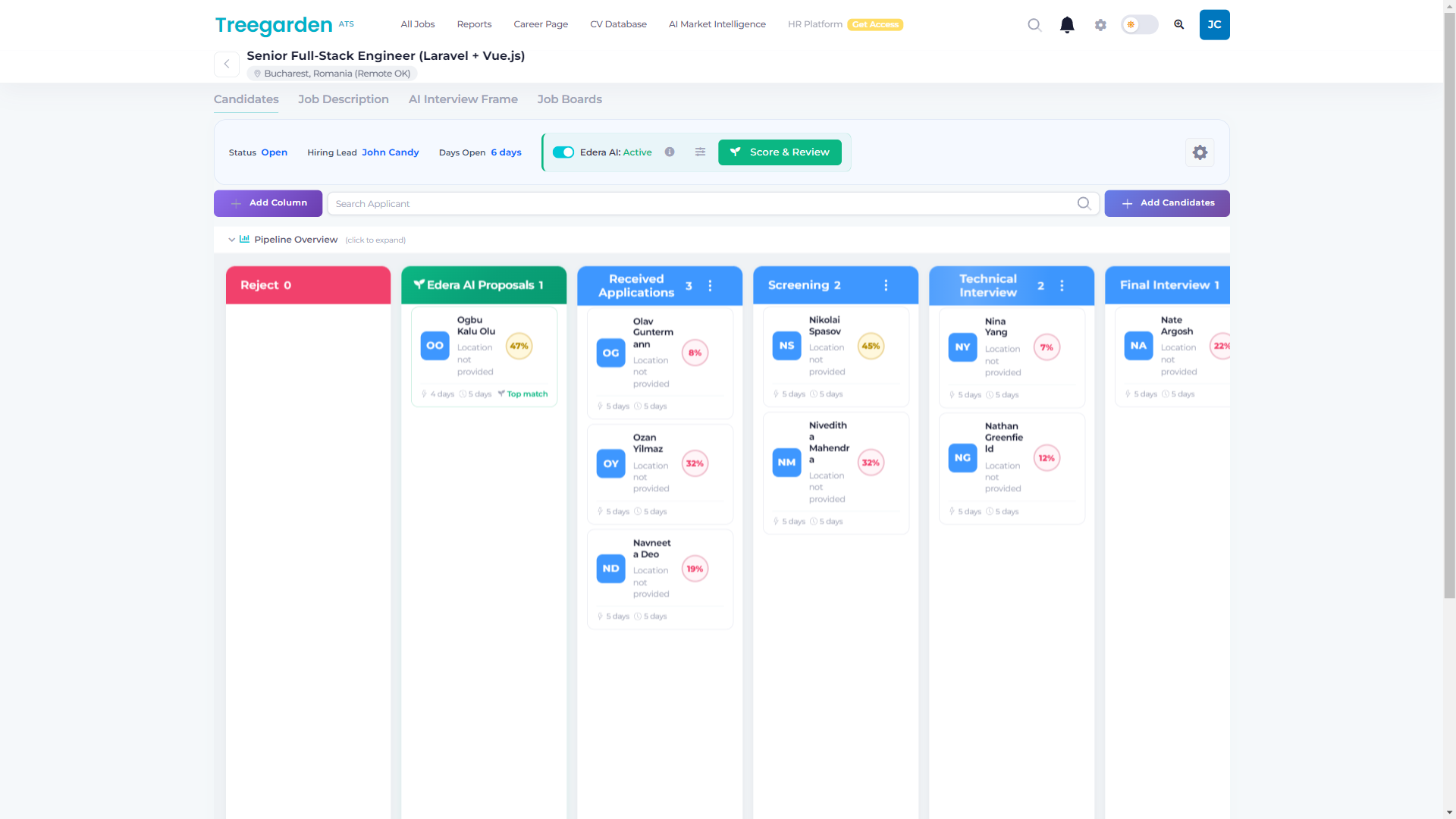
Capability matters too, not just price. Treegarden's Scale plan at $899 a month includes advanced analytics and priority support in the plan price, not as add-ons. Edera AI candidate matching is built into the pipeline at every paid tier, surfacing match scores on candidate cards across every stage, alongside a Kanban pipeline, bulk CV upload, custom career pages, structured interviews, and an HR module, with data under GDPR and EU residency. The honest trade-off: if you need Lever's depth of CRM-led sourcing, that is a real reason to pay its premium (covered next); if you mainly need a complete, predictable ATS plus HR for a 10 to 500 person team, a published flat price removes the negotiation problem entirely.
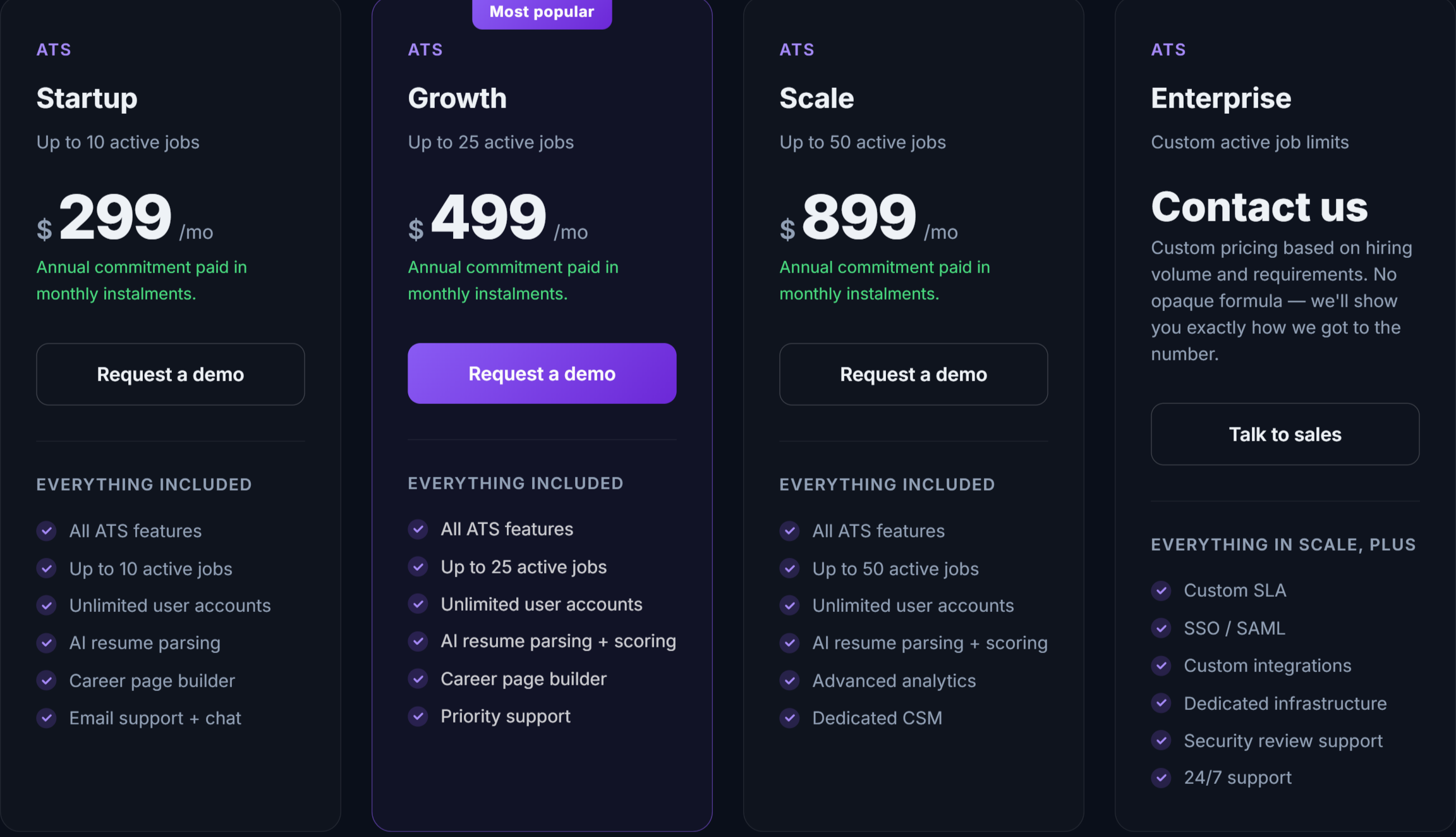
Because Treegarden pricing does not scale with headcount, buyers can model their three-year cost with a single multiplication. With Lever, the equivalent model requires projecting headcount growth, estimating renewal escalators, and forecasting add-on needs, all variables the vendor controls more than the buyer does. Predictable pricing is not a trivial benefit when you are operating a recruiting budget under scrutiny.
See exactly what Treegarden costs
Published prices. All features at every tier. Unlimited users. No per-employee scaling. No implementation fee. No demo required to see the number. Startup: $299/mo · Growth: $499/mo · Scale: $899/mo.
View transparent pricingWho Lever fits, and who should look elsewhere
This is a fit question, not a quality question, and the cost structure decides it as much as the feature set does.
Lever fits if
- Sourcing is your motion. LeverTRM is one of the few mid-market platforms where the CRM for nurturing passive candidates is genuinely one product with the ATS, not a bolt-on. Teams running active outbound, building talent communities, and maintaining long-term candidate relationships get a real efficiency gain over pairing a plain ATS with a separate sourcing tool.
- Hiring-manager adoption has been your problem. Lever earns consistent G2 praise for managers actually completing feedback in the tool, which is unusual for an ATS. If your past systems died on hiring-manager compliance, that interface advantage can justify a premium on its own.
- Your headcount is relatively stable. A flat or slowly growing company absorbs headcount-driven pricing far better than a fast-scaling one, because the renewal does not balloon underneath you.
Look elsewhere if
- You hire mostly reactively from inbound applicants and a small team without an outbound sourcing motion, so you would pay for the CRM depth that is Lever's main reason to exist and barely use it.
- You are scaling fast, because headcount-driven pricing means every growth spurt re-prices your ATS at renewal independent of any feature change.
- Predictable, published cost matters to your budget, or you do not want to run a quote-and-negotiate cycle and an annual renewal defense to know what you will pay.
For the second group, the question is not whether Lever is capable; it clearly is. It is whether a three-year total cost of ownership, honestly modeled with implementation, add-ons, and renewal increases included, is proportionate to how you actually recruit, compared with a flat-priced alternative. If you are a 10 to 500 person UK or US team that wants a complete ATS plus an HR module at a price you can see today, that is exactly the gap Treegarden is built for.
Related buyer guides and Treegarden workflows
Use these next steps to compare pricing, validate fit, and connect the article to the Treegarden product workflow.
Get an instant price — no sales call needed
Startup $299/mo · Growth $499/mo · Scale $899/mo. Flat rate, no per-seat fees. Quote emailed in under 60 seconds.
Frequently Asked Questions About Lever Pricing
How much does Lever ATS cost in 2026?
Lever does not publish a price; its pricing page is quote-only (this is official). The best public benchmark is buyer-reported: Vendr's dataset of 318 verified contracts (February 2026) shows a median annual contract of $15,400, a range from $6,714 to $51,864, and average savings of about 16 percent off list. Independent buyer guides put a typical ~200-person deal near $12,000 to $13,000 a year for the core product. Year-one total including implementation and add-ons commonly runs well above the base quote. Source: Vendr Lever marketplace, February 2026 (buyer-reported).
Does Lever charge per user or per employee?
Lever does not publish its formula. Vendr and multiple buyer guides report that the quote is driven mainly by total company headcount, along with hiring volume, seats, and contract term, rather than recruiter seats alone. The practical effect buyers describe is that company growth raises the renewal quote even when the recruiting team and hiring volume hold steady. Confirm the basis in writing in your own quote rather than assuming.
What is included in Lever, and what costs extra?
Lever's core product, LeverTRM, combines an ATS with a CRM, plus interview scheduling, automation, job distribution, branded career sites, offer management, and reporting dashboards (per Lever's product pages). Lever sells several capabilities as separately named add-ons: Lever Advanced Analytics, Lever Advanced Nurture, and Lever Data Warehouse Sync, plus newer Candidate Insights, AI Screening, and Onboarding options. Implementation and data migration are typically billed as separate services. Which items are bundled into your deal depends on the negotiated package, so itemize each one.
Does Lever require annual contracts, and what happens at renewal?
Buyer reviews on G2 and Capterra describe a minimum one-year commitment with auto-renewal as the norm, and annual renewal increases commonly in the 8 to 12 percent range (buyer-reported, not official). Without a written renewal cap negotiated into the original contract, there is no stated ceiling. On a $15,000 starting contract, a 10 percent annual increase reaches about $16,500 in year two and roughly $18,150 in year three for the identical product.
Can you negotiate Lever's pricing, and how much can you realistically save?
Yes. Vendr reports buyers save an average of about 16 percent off list across 318 contracts, and that multi-year commitments can unlock roughly 15 to 30 percent lower effective pricing. The most effective approaches buyers report: arrive with a specific competing quote from a platform with published pricing, request a written renewal cap as a contract term before signing, and bundle implementation into the initial deal. Get the quote itemized first; you cannot benchmark a single bundled number. Source: Vendr Lever marketplace, February 2026 (buyer-reported).
Sources cited in this article
Official (Lever / Employ):
- Lever pricing page - confirms the quote-only model and lists the AI, Candidate Insights, and Onboarding add-ons; no list prices published as of June 2026
- LeverTRM product page - confirms the ATS-plus-CRM core and the Advanced Nurture, Advanced Analytics, and Data Warehouse Sync products
- Lever (company), Wikipedia - confirms the August 2022 acquisition by Employ Inc.
Buyer-reported (transactions and reviews):
- Vendr: Lever pricing (318 verified contracts, February 2026) - primary source for the median, range, average savings, and multi-year discount figures
- G2: Lever Reviews 2026 - renewal increases, analytics add-on costs, hiring-manager adoption, and post-acquisition roadmap pace
- Capterra: Lever Pricing 2026 - renewal increase disclosures and contract structure observations from verified buyers
- Pin: Lever Pricing 2026 - corroborating per-employee benchmark and per-size cost estimates
- Leon Consulting: Lever ATS Pricing 2026 - corroborating implementation ranges, add-on descriptions, and negotiation guidance